Question
Explain the process of thermonuclear fusion with example.

Answer

When two light nuclei fuse to form a larger nucleus, energy is released, because binding energy increases during the process.
Some examples of such energy liberating nuclear fusion reactions are :
$\begin{array}{l}
{ }_1 H ^1+{ }_1 H ^1 \rightarrow{ }_1 H ^2+e^{+}+v+0.42 MeV \\
{ }_1 H ^2+{ }_1 H ^2 \rightarrow{ }_2 He ^3+n+3.27 MeV \\
{ }_1 H ^2+{ }_1 H ^2 \rightarrow{ }_1 H ^3+{ }_1 H ^1+4.03 MeV
\end{array}$
In the first reaction, two protons combine to form a deuteron and a positron with a release of 0.42 MeV energy.
In the second reaction, two deuterons combine to form the isotope of helium ${ }_2 He ^3$.
In third reaction two deuterons combine to form a tritium and a proton. 4.03 MeV energy is released during this process.
For a fusion to take place, the two nuclei must come close enough so that nuclear force is able to affect them.
This force must be strong enough to overcome the repulsive barrier between two positively charged nuclei.
The height of the barrier depends on the charges and radii of the two interacting nuclei.
→For example :
The barrier height for two protons is $\sim 400 keV$. The temperature required for a proton to overcome this barrier is T .
$\begin{aligned}
\therefore \quad \frac{3}{2} k T & =400 keV \\
T & =\frac{2 \times 400 \times 10^3 \times 1.6 \times 10^{-19}}{3 \times 1.38 \times 10^{-23}} \\
T & =3 \times 10^9 K
\end{aligned}$
When fusion is achieved by raising the temperature of the system so that particles have enough kinetic energy to overcome the Coulomb repulsive barrier, it is called thermo - nuclear fusion.

Need a full question paper?

Generate a complete, print-ready paper with questions like this in minutes — across 16+ boards, with answer keys.
Start Generating Free

Similar questions

A heater coil is cut in two parts and only one of them is used in the heater. What is the ratio of the heat produced by this half coil to that by the original coil if the voltage applied is the same?
A straight wire carrying an electric current is placed along the axis of a uniformly charged ring. Will there be a magnetic force on the wire if the ring starts rotating about the wire? If yes, in which direction?
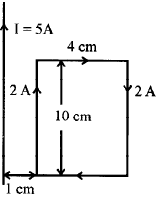
A rectangular loop of wire of size 4cm × 10cm carries a steady current of 2A. A straight long wire carrying 5A current is kept near the loop as shown. If the loop and  the wire are coplanar, find

  1. The torque acting on the loop and.
  2. The magnitude and direction of the force on the loop due to the current carrying wire.
A current loop of arbitrary shape lies in a uniform magnetic field B. Show that the net magnetic force acting on the loop is zero.
Plot a graph showing the variation of binding energy per nucleon as a function of mass number. Which property of nuclear force explains the approximate constancy of binding energy in the range 30 < A < 170? How does one explain the release of energy in both the processes of nuclear fission and fusion from the graph?
Derive the formula (/ equation) of capacitance for a paralled plate capacitor.
The Q value of a nuclear reaction A + b → C + d is defined by

Q = [ mA + mb – mC – md]c2

where the masses refer to the respective nuclei. Determine from the given data the Q-value of the following reactions and state whether the reactions are exothermic or endothermic.

  1. $^1_1\text{H}+^3_1\text{H}\rightarrow^2_1\text{H}+^2_1\text{H}$
  2. $^{12}_6\text{C}+^{12}_6\text{C}\rightarrow^{20}_{10}\text{Ne}+^4_2\text{He}$

Atomic masses are given to be

$\text{m}(^2_1\text{H})=2.014102\text{ u}$

$\text{m}(^3_1\text{H})=3.016049\text{ u}$

$\text{m}(^{12}_6\text{C})=12.000000\text{ u}$

$\text{m}(^{20}_{10}\text{Ne})=19.992439\text{ u}$
A lens forms a real image of an object. The distance from the object to the lens is u cm and the distance of the image from the lens is v cm. The given graphs shows variation of v with u.
  1. What is the nature of the lens?
  2. Using the graph, find the focal length of this lens.
A circular coil of radius 8 cm and 20 turns is rotated about its vertical diameter with an angular speed of $50 rad s ^{-1}$ in a uniform horizontal magnetic field of magnitude $3 \times 10^{-2} T$. Obtain the maximum and average emf induced in the coil. If the coil forms a closed loop of resistance $10 \Omega$, calculate the maximum value of current in the coil.