Rajasthan BoardEnglish MediumSTD 12 SciencePhysicsWAVE OPTICS2 Marks
Question
Explain the refraction of a plane wave from rarer medium to a denser medium, using Huygen's principle.
✓
Answer
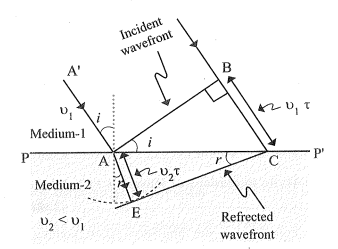
$\rightarrow$ As shown in fig. $PP\ ^{\prime}$ represents the surface separating medium $1$ and medium $2 .$
$\rightarrow$ Let $v_1$ and $v_2$ represent the speed of light in medium $1$ and medium $2,$ respectively.
Also, the refractive indices of medium $1$ and $2$ are $n_1$ and $n_2$ respectively.
$\rightarrow$ As shown in fig. a plane wave front $AB$ is incident on the interface at an angle $i$.
$\rightarrow$ Let $\tau$ be the time taken by the wavefront to travel the distance $BC$.
Thus, $BC =v_1 \tau$
$\rightarrow$ In order to determine the shape of the refracted wavefront, we draw a sphere of radius $v_2 \tau$ from the point $A$ in the second medium.
A tangent $($tangent plane$) CE$ is drawn from the point $C$ on the sphere.
$\rightarrow$ Let $CE$ represent the refracted wavefront at the end of time $\tau$.
$AE = v _2 \tau$ and $r$ is the angle formed at point $C$ which is angle of refraction.
$\rightarrow$ From Fig., From $\triangle ABC$
$\sin i=\frac{ BC }{ AC }=\frac{v_1 \tau}{ AC }.......(1)$
$\rightarrow$ From, $\triangle AEC$
$\sin r=\frac{ AE }{ AC }=\frac{v_2 \tau}{ AC }.......(2)$
$\rightarrow$ Taking the ratio of eq. $(1)$ and $(2),$
$\frac{\sin i}{\sin r}=\frac{v_1 \tau}{ AC } \times \frac{ AC }{v_2 \tau}$
$\frac{\sin i}{\sin r}=\frac{v_1}{v_2}.......(3)$
$\rightarrow$ Refractive index of medium $1, n_1=\frac{c}{v_1}$
$\rightarrow$ Refractive index of medium $2, n_2=\frac{c}{v_2}$
$\therefore \frac{n_2}{n_1}=\frac{v_1}{v_2}........(4)$
$\rightarrow$ From eq. $(3)$ and $(4),$
$\frac{\sin i}{\sin r}=\frac{n_2}{n_1}$
$\therefore n_1 \sin i= n_2 \sin r$
$\rightarrow$ which is Snell's law of refraction.
$\rightarrow$ Thus, the refraction of given plane wave front can be explained using Huygen's principle.
Need a full question paper?
Generate a complete, print-ready paper with questions like this in minutes — across 16+ boards, with answer keys.