Question
Write short note: Green revolution.

Answer

  • In agriculture, different methods used to harvest maximum yield from minimum land, these methods are collectively called green revolution.
  • Dr. M.S. Swaminathan is called father of Green Revolution in India while Dr. Norman Borlaug has done the similar efforts in the U.S.
  • Before the Green Revolution in India, there was always the dearth of the food grains. The overflowing Indian population was badly affected due to poor quality and quantity of food.
  • But due to the Green Revolution in India, attention was focussed on the agricultural research.
  • Improvised dwarf varieties of wheat and rice, proper use of fertilizers and pesticides and water management were the proper methods that increased production of food grains.
  • This created abundance of the grains for Indian population.

Need a full question paper?

Generate a complete, print-ready paper with questions like this in minutes — across 16+ boards, with answer keys.
Start Generating Free

Similar questions

Explain the application of heating effect of electric current in an electric bulb with a diagram.
Who will spend more electrical energy? $500 W TV$ Set in $30$ mins, or $600 W$ heater in $20$ mins?
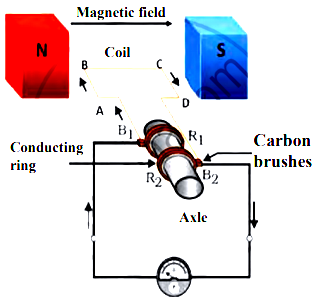
Observe the figure and write the answers to the questions asked.
  1. The construction shown in the figure is of which device?
  2. Explain the principle on which this device works.
  3. Write any three uses of this device.
Write a short note.
Moon missions
Pure-bred tall pea plants are first crossed with pure-bred dwarf pea plants. The pea plants obtained in $F_1$ generation are then cross-bred to produce $F_2$ generation of pea plants.
  1. What do the plants of $F_1$ generation look like?
  2. What is the ratio of tall plants to dwarf plants in $F_2$ generation?
  3. Which type of plants were missing in $F_1$ generation but reappeared in $F_2$ generation?
The descriptions of five kinds of images are given below:
  1. Diminished and virtual.
  2. Enlarged and real.
  3. Enlarged and erect.
  4. Real and inverted.
  5. Virtual and the same size.
Which one of these describes the image formed:
  1. On the retina of the eye?
  2. By a magnifying glass?
  3. By a convex driving mirror on a car?
  4. By a plane mirror?
  5. on the screen of a slide projector?
If a concave mirror has a focal length of 10cm, find the two positions where an object can be placed to give, in each case, an image twice the height of the object.
Explain with diagrams what is meant by the “series combination” and “parallel combination” of resistances. In which case the resultant resistance is:
  1. Less, and
  2. More, than either of the individual resistances?
Differentiate between nuclear fission and nuclear fusion.
Describe how washing soda is produced starting from sodium chloride (common salt). Write equations of all the reactions involved.