Question
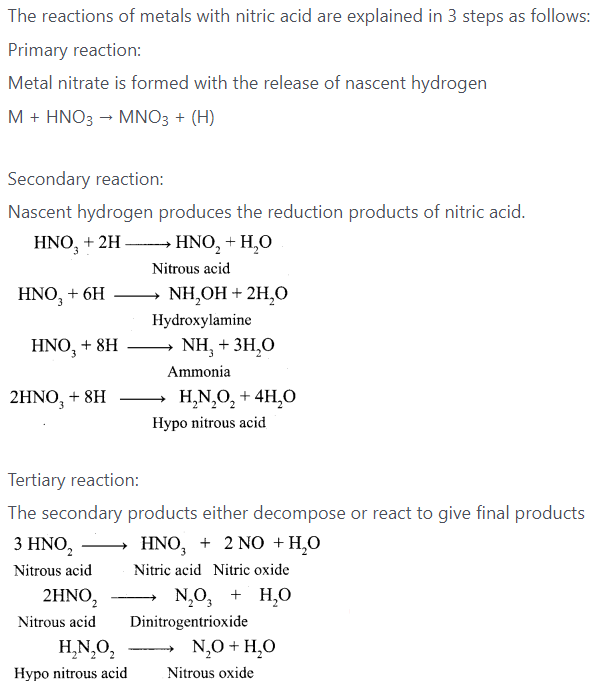
Explain the reaction of metals with nitric acid.

Answer

Image
For examples:
Copper reacts with nitric acid in the following manner
$3 Cu+6 HNO_3 \rightarrow 3 Cu\left(NO_3\right)_2+6(H)$
$6(H)+3 HNO_3 \rightarrow 3 HNO_2+3 H_2 O$
$3 HNO_2 \rightarrow HNO_3+2 NO^2+H_2 O$
Overall reaction
$3 Cu+8 HNO_3 \rightarrow 3 CU\left(NO_3\right)_2+2 NO+4 H_2 O$
The concentrated acid has a tendency to form nitrogen dioxide
$Cu+4 HNO_3 \rightarrow 3 CU\left(NO_3\right)_2+2 NO_2+2 H_2 O$

Need a full question paper?

Generate a complete, print-ready paper with questions like this in minutes — across 16+ boards, with answer keys.
Start Generating Free

Similar questions

Write the IUPAC names of the following :
1. $\left[ CO \left( NH _3\right)_6\right] Cl _3$
2. $\left[ CO \left( NH _3\right)_5 Cl \right] Cl _2$
3. $K _3\left[ Fe ( CN )_6\right]$
4. $K _3\left[ Fe \left( C _2 O _4\right)_3\right]$
5. $K _2\left[ PdCl _4\right]$
6. $\left[ Pt \left( NH _3\right)_2 Cl \left( NH _2 CH _3\right)\right] Cl$
Write the formulae for the following coordination compounds :
Answer:
  1. Tetraamminediaquacobalt (III) chloride.
  2. Potassium tetracyanonickelate (II).
  3. Tris ( ethane – 1, 2 – diamine ) chromium (III) chloride.
  4. Amminebromidochloridonitrito – N – platinate (II).
  5. Dichlorobis(ethane – 1, 2 – diamine ) platinum (IV) nitrate.
  6. Iron (III) hexacyanoferrate (II)
Write a note on thermodynamic principle of metallurgy.
Describe about the structure, nature and properties of starch.
A compound ' $A$ ' with molecular formula $C _4 H _{10} O$ is unreactive towards sodium metal. it does not add Bromine water and does not react with $NaHSO _3$ solution. On refluxing ' $A$ ' with excess of HI , it gives ' $B$ ' which reacts with aqueous NaOH to form 'C'. 'C' can be converted into 'B' by reacting with red $P$ and $I _3$. 'C, on treating with conc. $H _2 SO _4$ forms ' D '. ' D ' decolounses bromine water. Identify A to D and write the reactions involved.
(a) How can a colloidal solution and a true solution of the same colour be distinguished from each other?
(b) List four applications of adsorption.
Explain about the importance and application of coordination complexes.
Distinguish between Leclanche cell and Lead storage battery.
What are emulsion? Mention its type with example. What is emulsification? How the types of emulsions are identified?
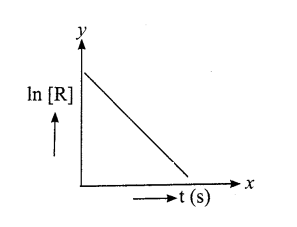
For a certain chemical reaction variation In concentration, In IRI Vs time (s) plot is given below.
For this reaction write/draw:
1. What is the order of the reaction?
2. What is the units of rate constant ( k $)$ ?
3. Give the relationship between k and $t _{1 / 2}$ (half-life period).
4. What does the slope of above line indicate?
5. Draw the plot of $\log \left[R_0\right] /[R]$ vs time (s)

Image