Question
Explain the reading and interpretation of bar graphs.

Answer

A bar graph is a diagram consisting of a sequence of vertical or horizontal bars or rectangles, each of which represents an equal interval of the values of a variable, and has the height proportional to the quantities of the phenomenon under consideration in that interval. A bar graph may also be used to illustrate discrete data, in which case each bar represents a distinct circumstance.
While drawing a bar graph, we keep in mind that:
  • The width of the bars should be uniform throughout.
  • The gap between any two bars should be uniform throughout.
  • Bars may be either horizontal or vertical.
Each bar must be of the same width and the gap between them must be uniform. Make sure that the width of the bars and the gap between them should not be necessarily same.

Need a full question paper?

Generate a complete, print-ready paper with questions like this in minutes — across 16+ boards, with answer keys.
Start Generating Free

Similar questions

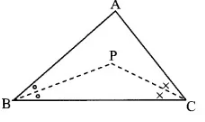
In the given figure, bisectors of $\angle B$ and $\angle C$ of $\triangle A B C$ intersect at point P. Prove that $\angle BPC =90^{\circ}+\frac{1}{2} \angle B A C$.
Complete the proof by filling in the blanks.Image
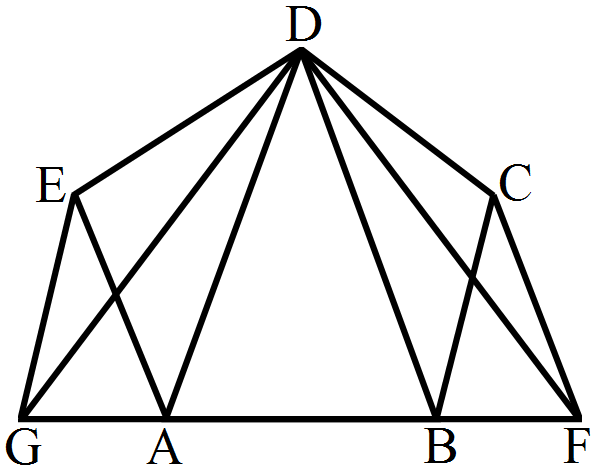
The given figure shows a pentagon ABCDE. EG, drawn parallel to DA, meets BA produced at G, and CF, drawn parallel to DB, meets AB produced at F. Show that:
$\text{ar}(\text{pentagon ABCDE})=\text{ar}(\triangle\text{DGF}).$
A rectangular sheet of paper $30cm \times 18cm$ can be transformed into the curved surface of a right circular cylinder in two ways i.e. either by rolling the paper along its length or by rolling it along its breadth.
Find the ratio of the volumes of the two cylinders thus formed.
The monthly wages of 30 workers in a factory are given below:
83.0, 835, 890, 810, 835, 836, 869, 845, 898, 890, 820, 860, 832, 833, 855, 845, 804, 808, 812, 840, 885, 835, 836, 878, 840, 868, 890, 806, 840, 890.
Represent the data in the form of a frequency distribution with class size 10.
Diagonals of a square IJKL intersects at point M. Find the measures of ∠IMJ, ∠JIK and ∠LJK.
A triangle and a parallelogram have the same base and the same area. If the sides of the triangle are $13 cm, 14 cm$ and 15 cm and the parallelogram stands on the base 14 cm , find the height of a parallelogram.
Evaluate:
$(-12)^3 + 7^3 + 5^3$
Following data gives the number of children in 40 families:
1, 2, 6, 5, 1, 5, 1, 3, 2, 6, 2, 3, 4, 2, 0, 0, 4, 4, 3, 2, 2, 0, 0, 1, 2, 2, 4, 3, 2, 1, 0, 5, 1, 2, 4, 3, 4, 1, 6, 2, 2.
Represent it in the form of a frequency distribution.
In a parallelogram ABCD, the bisector of $\angle\text{A}$ also bisects BC at X. Find AB : AD.
If diagonal of a square is $13\ cm$, then find its side.