Questions

4 Mark Question

Take a timed test

22 questions · self-marked practice — reveal the answer and mark yourself.

Question 14 Marks
Read the following bar graph and answer the following questions:
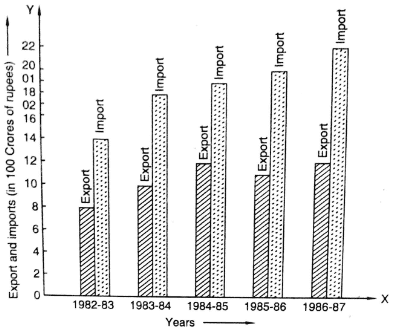
  1. What information is given by the bar graph?
  2. In which year the export is minimum?
  3. In which year the import is maximum?
  4. In which year the difference of the values of export and import is maximum?
​​​​​​​
Answer
  1. The bar graph represents the import and export (in 100 Crores of rupees) from 1982–83 to 1986–87.
  2. The export is minimum in the year 1982-83 at the height of the bar corresponding to export is minimum in the year 1982–83.
  3. The import is maximum in the year 1986-87 as the height of the bar corresponding to import is maximum in the year 1986–87.
  4. The bars of export and import are side by side. Clearly, it is seen from the bar graph that the difference between the values of export and import is maximum in the year 1986–87.
It is seen from the bar graph that the height of the 3s bar from the left is least, which is corresponding to DCE. Hence, the requirement is least in DCE.
View full question & answer
Question 24 Marks
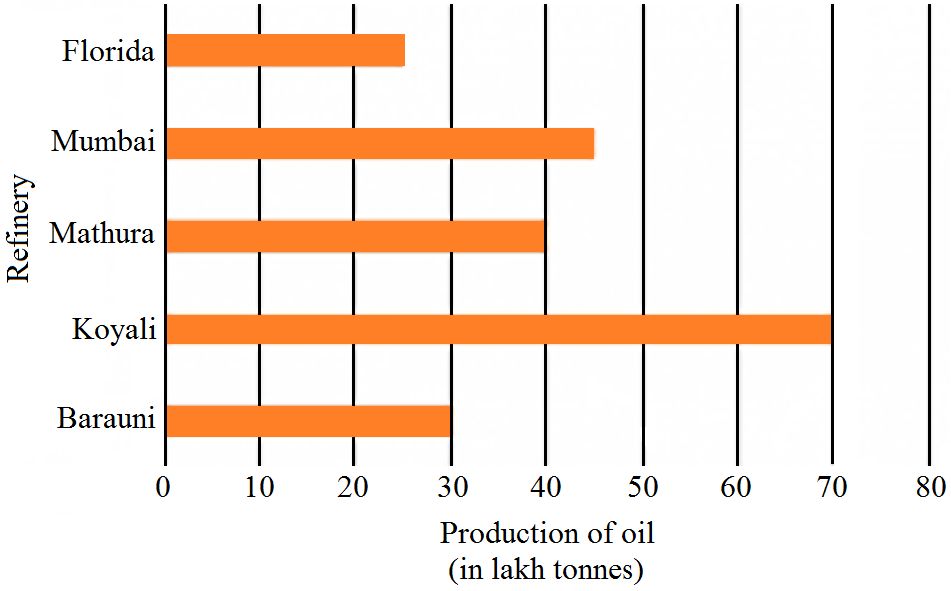
The production of oil (in lakh tonnes) in some of the refineries in India during 1982 was given below:
Refinery
Barauni
Koyali
Mathura
Mumbai
Florida
Production of oil (in lakh tonnes)
30
70
40
45
25
Construct a bar graph to represent the above data so that the bars are drawn horizontally.
Answer
To represent the given data by a vertical bar graph, we first draw horizontal and vertical axes. Let u consider that the vertical and horizontal axes represent the refineries and the production of oil in la] tonnes respectively. We have to draw 5 bars of different lengths given in the table. At first, we mark 5 points in the vertical axis at equal distances and erect rectangles of the same wk at these points. The lengths of the rectangles are proportional to the productions of oil.The horizontal bar graph of the given data is following:
View full question & answer
Question 34 Marks
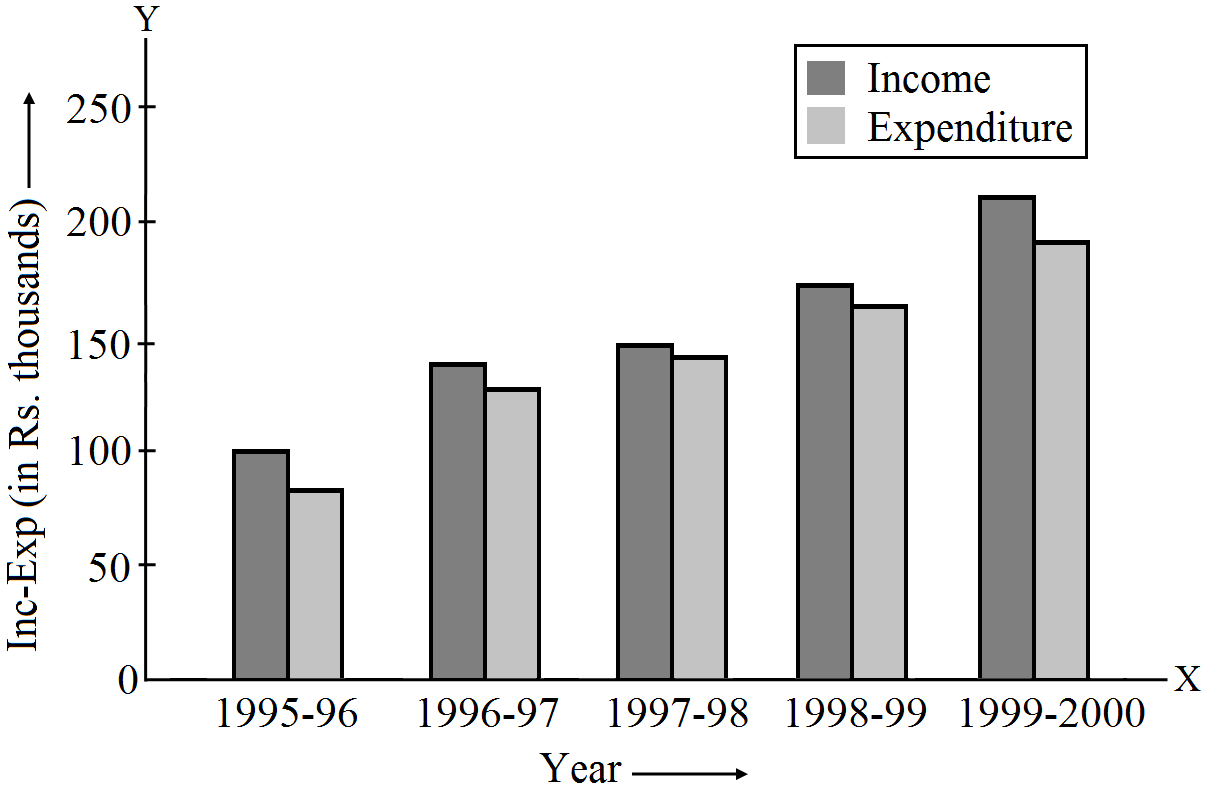
The income and expenditure for 5 years of a family is given in the following data:
Years
1995–96
1996–97
1997–98
1998–99
1999–2000
Income (Rs. In thousands)
100
140
150
170
210
Expenditure (Rs. in thousands)
80
130
145
160
190
Represent the above data by a bar graph.
Answer
To represent the given data by a vertical bar graph, we first draw horizontal and vertical axes. Let us consider that the horizontal and vertical axes represent the years and the income or expenditure in thousand rupees respectively. We have to draw 5 bars for each income and expenditure side by side of different lengths given in the table.
At first, we mark 5 points for each income and expenditure in the horizontal axis at equal distances and erect rectangles of the same width at these points. The heights of the rectangles are proportional to the corresponding income or expenditures.
View full question & answer
Question 44 Marks
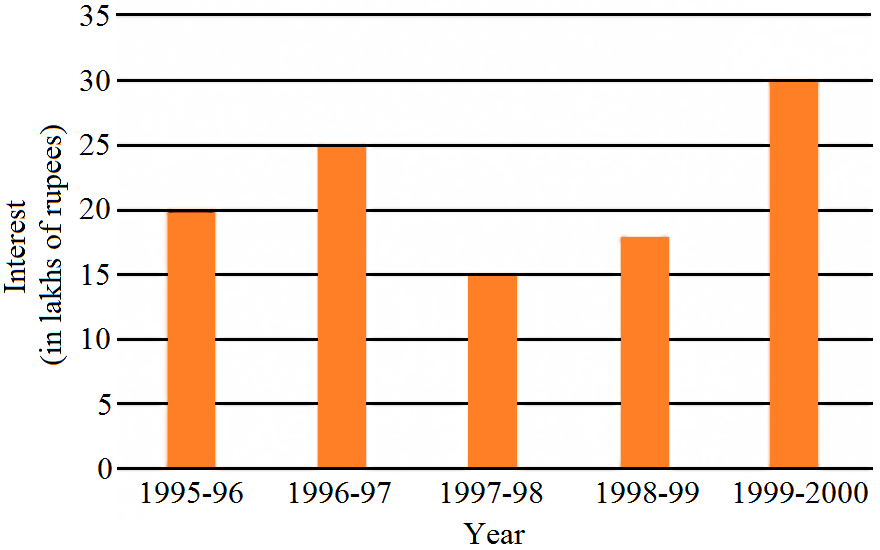
The following table shows the interest paid by a company (in lakhs):
Year
1995–96
1996–97
1997–98
1998–99
1999–2000
Interest (in lakhs of rupees)
20
25
15
18
30
Draw the bar graph to represent the above information.
Answer
To represent the given data by a vertical bar graph, we first draw horizontal and vertical axes. Let us consider that the horizontal and vertical axes represent the years and the interests in lakhs of rupees respectively. We have to draw 5 bars of different lengths given in the table. At first, we mark 5 points in the horizontal axis at equal distances and erect rectangles of the same width at these points. The heights of the rectangles are proportional to the interests paid by the company.The vertical bar graph of the given data is following:
View full question & answer
Question 54 Marks
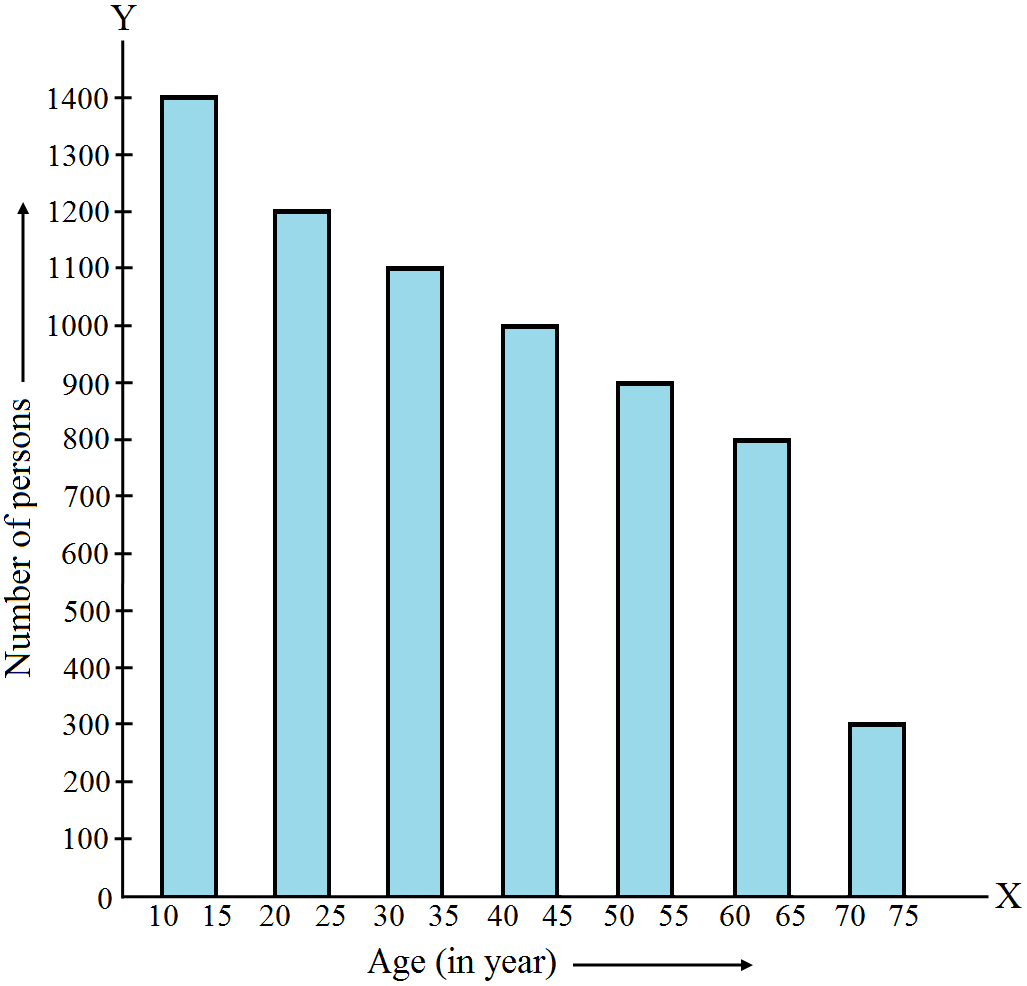
Study the bar graph representing the number of persons in various age groups in a town shown in figure Observe the bar graph and answer the following questions:
  1. What is the percentage of the youngest age-group persons over those in the oldest age group?
  2. What is the total population of the town?
  3. What is the number of persons in the age-group 60–65?
  4. How many persons are more in the age-group 10–15 than in the age group 30–35?
  5. What is the age-group of exactly 1200 persons living in the town?
  6. What is the total number of persons living in the town in the age-group 50–55?
  7. What is the total number of persons living in the town in the age-groups 10 – 15 and 60 – 65?
  1. Whether the population in general increases, decreases or remains constant with the increase in the age-group.
Answer
  1. The youngest age-group is 10-15 years. The number of persons belonging to this group is 1400. The oldest age-group is 70-75 years. The number of persons belonging to this group is 300. The percentage of youngest age-group persons over those in the oldest group is
$\frac{1400}{300}\times100$

$=\frac{1400}{3}$

$=466\frac{2}3{}$
  1. The population of the town is 300 + 800 + 900 + 1000 + 1100 + 1200 + 1400 = 6700
  2. The number of persons in the age group 60–65 is 800.
  3. The number of persons in the age group 10–15 is 1400 and the number of persons in the age group 30–35 is 1100. Hence the number of more persons in the age group 10– 5 than the group 30–35 is 1400 - 1100 = 300
  4. The age group of 1200 persons living in the town is 20–25
  5. The total number of persons living in the town in the age-group 50–55 is 900
  6. The total number of persons living in the town in the age-groups 10-15 and 60–65 is 1400 + 800 = 2200
  7. It is shown from the bar graph that the height of the bars decreases as the age-group increases. Hence, the population decreases with the increases in the age-group.
View full question & answer
Question 64 Marks
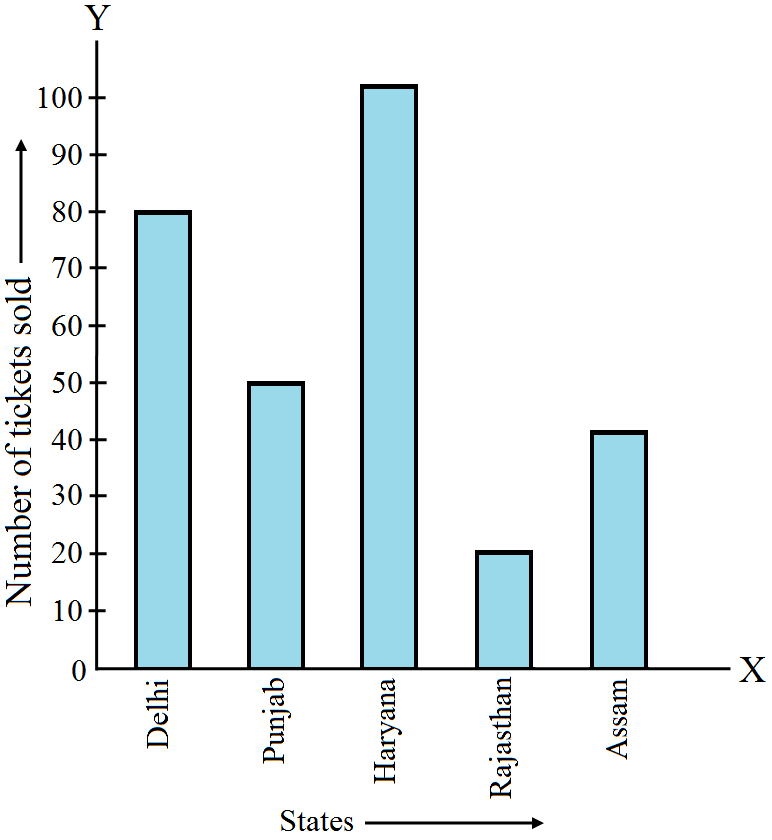
Read the bar graph shown in the figure and answer the following questions:
  1. What is the information given by the bar graph?
  2. How many tickets of Assam State Lottery were sold by the agent?
  3. Of which state, were the maximum number of tickets sold?
  4. State whether true or false.
The maximum number of tickets sold is three times the minimum number of tickets sold
  1. Of which state were the minimum numbers of tickets sold?
Answer
  1. The bar graph represents the number of tickets of different state lotteries sold by an agent on a day.
  2. The number of tickets of Assam State Lottery were sold by the agent is 40.
  3. The maximum numbers of tickets were sold is 100, in the state Haryana
  4. The maximum number of tickets were sold is 100, in the state Haryana the minimum number of tickets were sold is 20, in the state Rajasthan. It is clear that 100 are equal to the 5 times of 20. Hence, the statement is false.
  5. The minimum numbers of tickets were sold is 20, in the state Rajasthan.
View full question & answer
Question 74 Marks
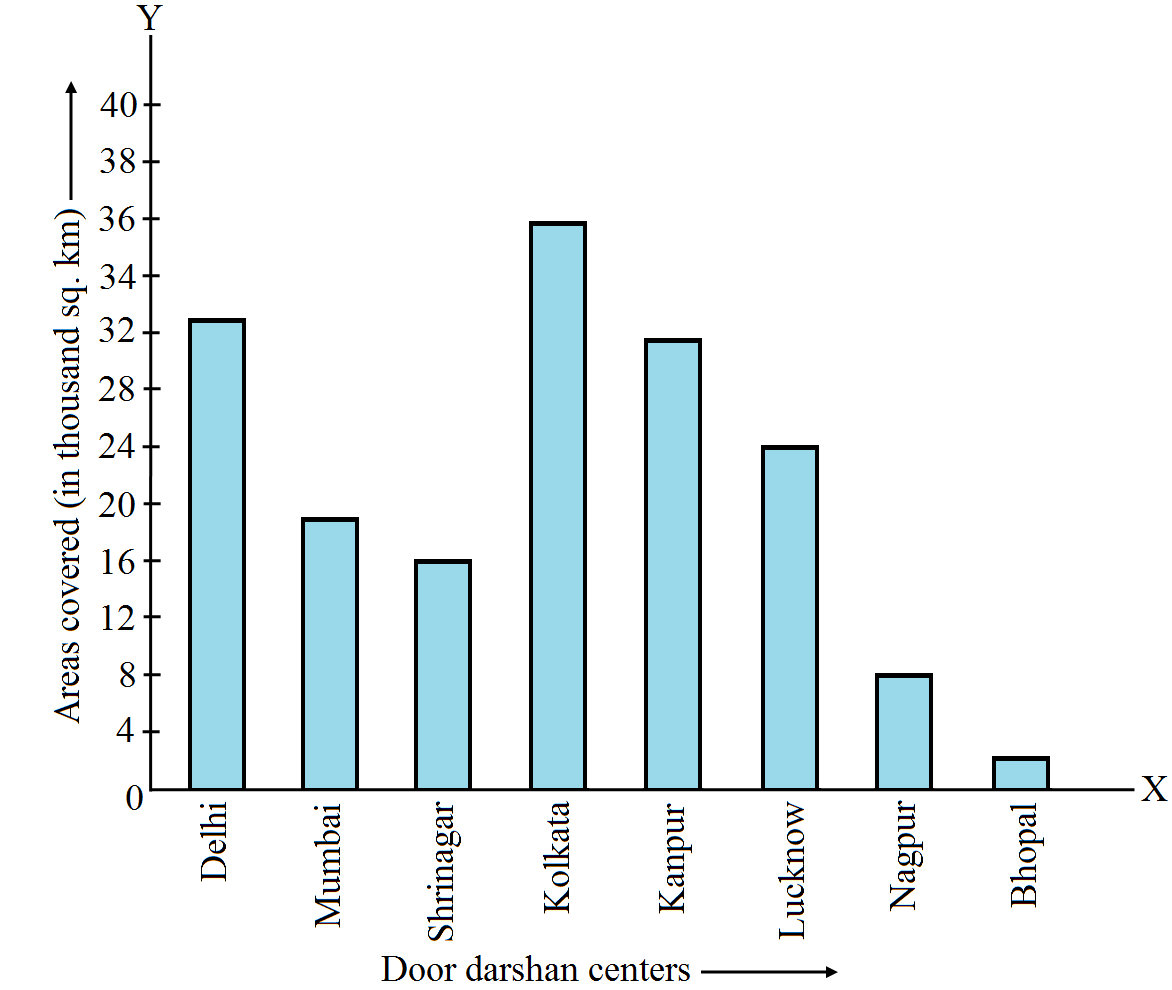
Read the bar graph given in Fig. and answer the following questions:

  1. What information is given by the bar graph?
  2. Which Door darshan center covers maximum area? Also, tell the covered area.
  3. What is the difference between the areas covered by the centers at Delhi and Bombay?
  4. Which Door darshan centers are in U.P. State? What are the areas covered by them?
Answer
i. The bar graph represents the area of coverage (in 1000 square km ) of some Doordarshan Centers of India.
ii. It is seen from the bar graph that the height of the $4^{\text {th }}$ bar from the left is maximum, which is corresponding to Kolkata. Hence, the Kolkata Doordarshan covers a maximum area. The area covered by Kolkata Doordarshan is $36 \times 1000=36000$ sq.km
iii. The area covered by Delhi Doordarshan is $34 \times 1000=34000$ sq.km The area covered by Mumbai Doordarshan is $20 \times 1000=20000$ sq.km Their difference is $34000-20000=14000$ sq.km.
iv. The Doordarshan centers in Kanpur and Lucknow are in the U.P. state. The area covered by Kanpur Doordarshan is $32 \times 1000=32000$ sq.km The area covered by Lucknow Doordarshan is $25 \times 1000=25000$ sq.km.
View full question & answer
Question 84 Marks
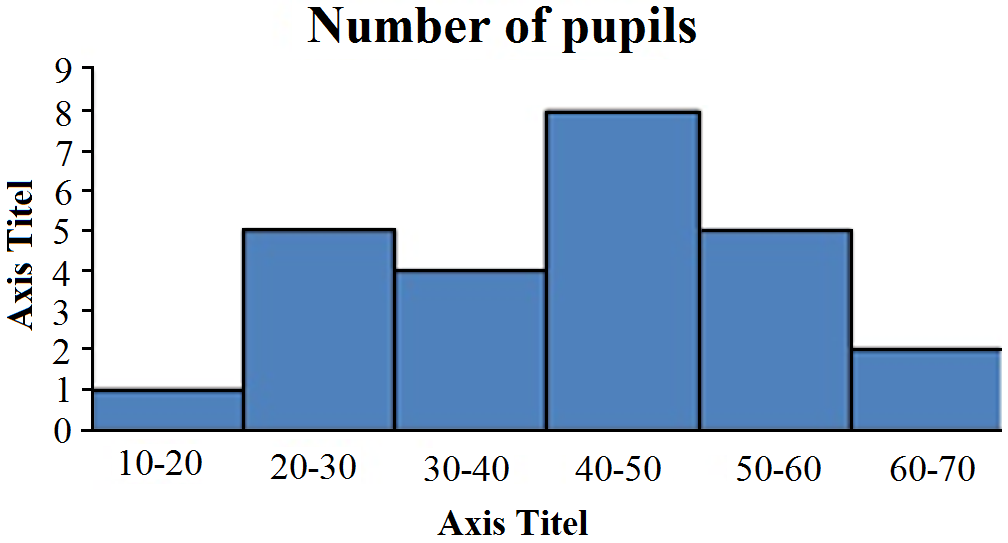
The time taken, in seconds, to solve a problem by each of 25 pupils is as follows:
16, 20, 26, 27, 28, 30, 33, 37, 38, 40, 42, 43, 46, 46, 46, 48, 49, 50, 53, 58, 59, 60, 64, 52, 20
  1. Construct a frequency distribution for these data, using a class interval of 10 seconds.
  2. Draw a histogram to represent the frequency distribution.
Answer
  1.  
Time taken to solve a problem
Number of pupils
10-20
1
20-30
5
30-40
4
40-50
8
50-60
5
60-70
2
  1.  
 
View full question & answer
Question 94 Marks
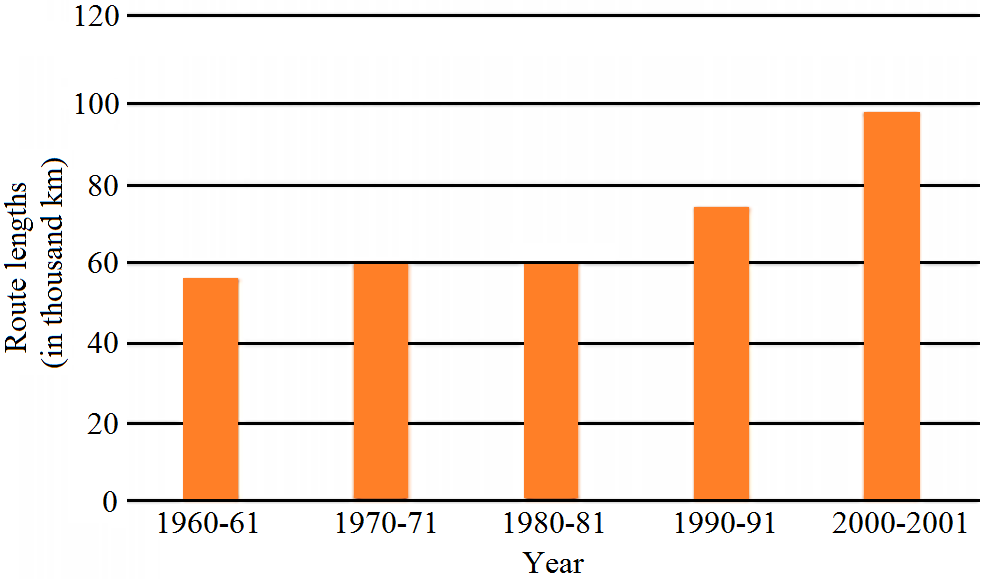
The following table gives the route length (in thousand kilometres) of the Indian Railways in some of the years:
Year 1960-61 1970-71 1980-81 1990-91 2000-2001
Route lenght (in thousand Km) 56 60 61 74 98
Represent the above data with the help of a bar graph.
Answer
To represent the given data by a vertical bar graph, we first draw horizontal and vertical axes. Let us consider that the horizontal and vertical axes represent the years and the route lengths in thousand km respectively. We have to draw 5 bars of different lengths given in the table. At first we mark 5 points in the horizontal axis at equal distances and erect rectangles of the same width at these points. The heights of the rectangles are proportional to the route lengths.The vertical bar graph of the given data is following:
View full question & answer
Question 104 Marks
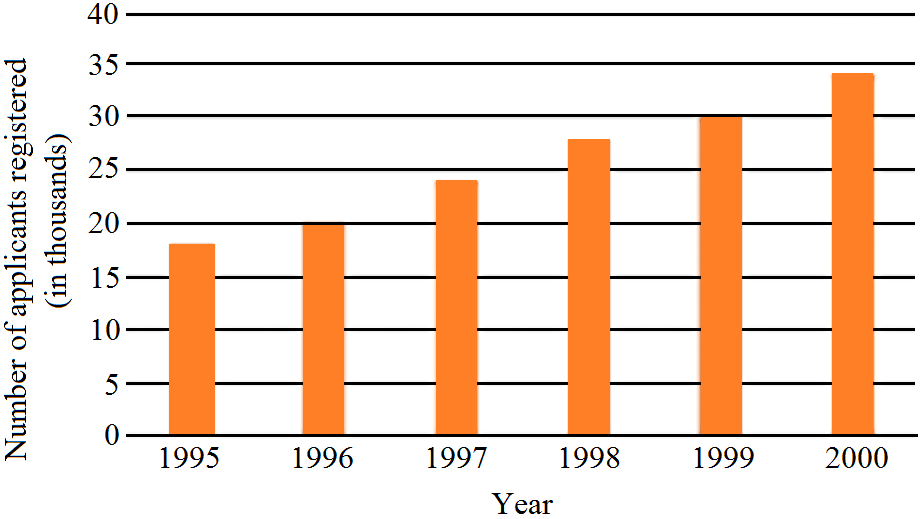
The following data gives the number (in thousands) of applicants registered with an Employment Exchange during 1995–2000:
Year
1995
1996
1997
1998
1999
2000
Number of Applicants Registered (in thousands)
18
20
24
28
30
34
Construct a bar graph to represent the above data.
Answer
To represent the given data by a vertical bar graph, we first draw horizontal and vertical axes. Let us consider that the horizontal and vertical axes represent the years and the number of applicants registered in thousands respectively. We have to draw 6 bars of different lengths given in the table. At first we mark 6 points in the horizontal axis at equal distances and erect rectangles of the same width at these points. The heights of the rectangles are proportional to the number of applicants registered.The vertical bar graph of the given data is following:
View full question & answer
Question 114 Marks
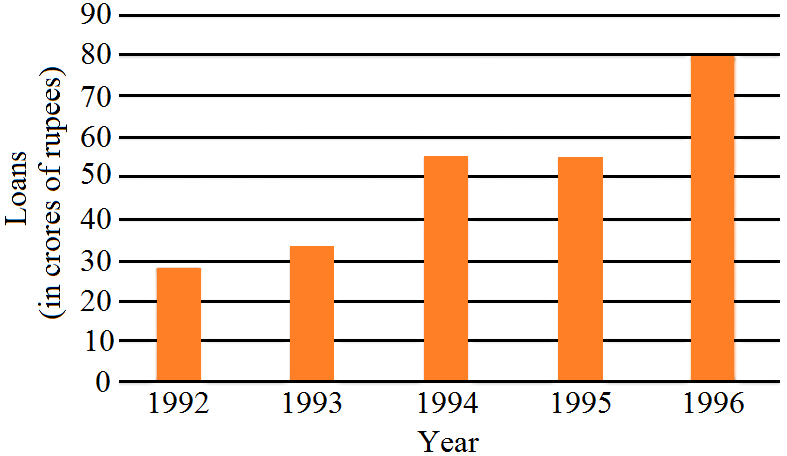
The following data gives the amount of loans (in crores of rupees) disbursed by a bank during some years:
Year
1992
1993
1994
1995
1996
Loan (in corers of rupees)
28
33
55
55
80
  1. Represent the above data with the help of a bar graph.
  2. With the help of the bar graph, indicate the year in which amount of loan is not increased over that of the preceding year.
Answer
To represent the given data by a vertical bar graph, we first draw horizontal and vertical axes. Let us consider that the horizontal and vertical axes represent the years and the amount of loan in Crores of rupees respectively. We have to draw 5 bars of different lengths given in the table. At first, we mark 5 points in the horizontal axis at equal distances and erect rectangles of the same width at these points. The heights of the rectangles are proportional to the amount of loan disbursed by the bank.
  1. The vertical bar graph of the given data is following:
  1. It is seen from the bar graph that the heights of the bars in the years 1994 and 1995 are same. Hence, the amount of loan is not increased in the year 1995 over the preceding year 1994.
View full question & answer
Question 124 Marks
The following table shows the daily production of T.V. sets in an industry for 7 days of a week:
Day
Mon
Tue
Wed
Thurs
Fri
Sat
Sun
Number of T.V. Sets
300
400
150
250
100
350
200
Represent the above information by a pictograph.
View full question & answer
Question 134 Marks
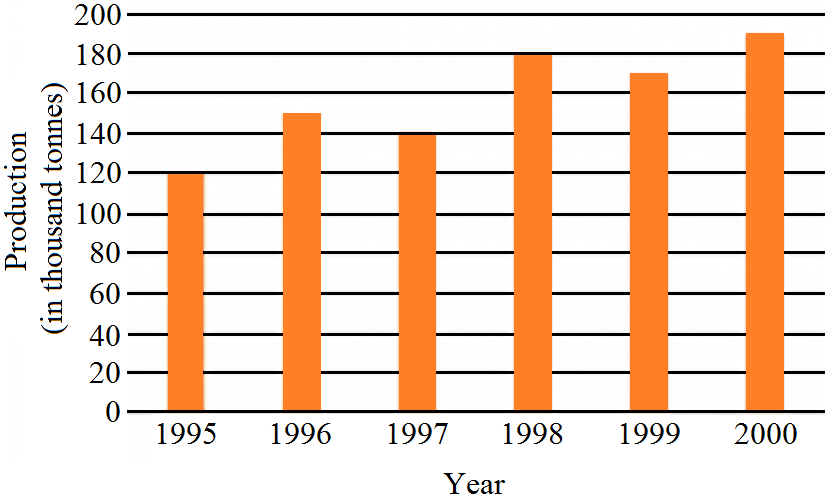
The following data gives the production of food grains (In thousand tonnes) for some years:
Year
1995
1996
1997
1998
19999
2000
Production (in thousand tonnes)
120
150
140
180
170
190
Represent the above data with the help of a bar graph.
Answer
To represent the given data by a vertical bar graph, we first draw horizontal and vertical axes. Let us consider that the horizontal and vertical axes represent the years and the production of food grains in thousand tonnes respectively. We have to draw 6 bars of different lengths given in the table. At first, we mark 6 points in the horizontal axis at equal distances and erect rectangles of the same width at these points. The heights of the rectangles are proportional to the production of food grains. The vertical bar graph of the given data is following:
View full question & answer
Question 144 Marks
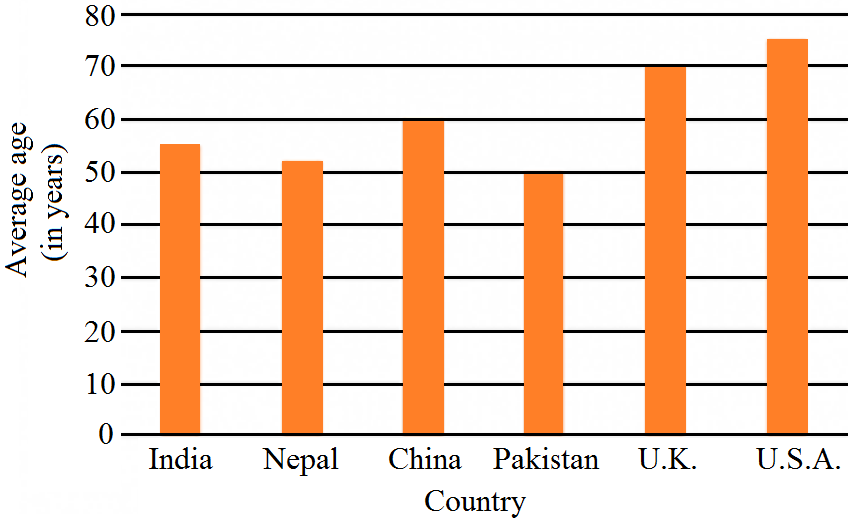
The following data shows the average age of men in various countries in a certain year.
Country
India
Nepal
China
Pakistan
U.K
U.S.A
Average age (in years)
55
52
60
50
70
75
Represent the above information by a bar graph.
Answer
To represent the given data by a vertical bar graph, we first draw horizontal and vertical axes. Let us consider that the horizontal and vertical axes represent the countries and the average age of men’s respectively. We have to draw 6 bars of different lengths given in the table. At first, we mark 6 points in the horizontal axis at equal distances and erect rectangles of the same width at these points. The heights of the rectangles are proportional to the average age of men’s in different countries.The vertical bar graph of the given data is following:
View full question & answer
Question 154 Marks
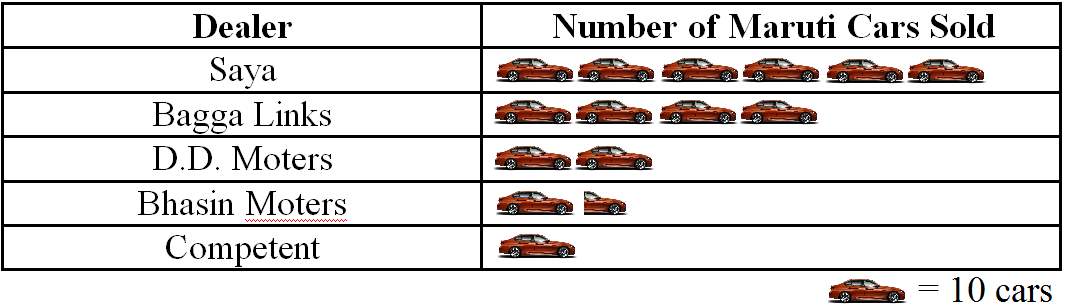
The following table shows the number of Maruti cars sold by five dealers in a particular month:
Dealer
saya
Bagga links
D.D Motors
Bhasin Motors
Competent
Cars sold
60
40
20
15
10
Represent the above information by a pictograph.
Answer
The given information can be represented using a pictograph in the following manner:
View full question & answer
Question 164 Marks
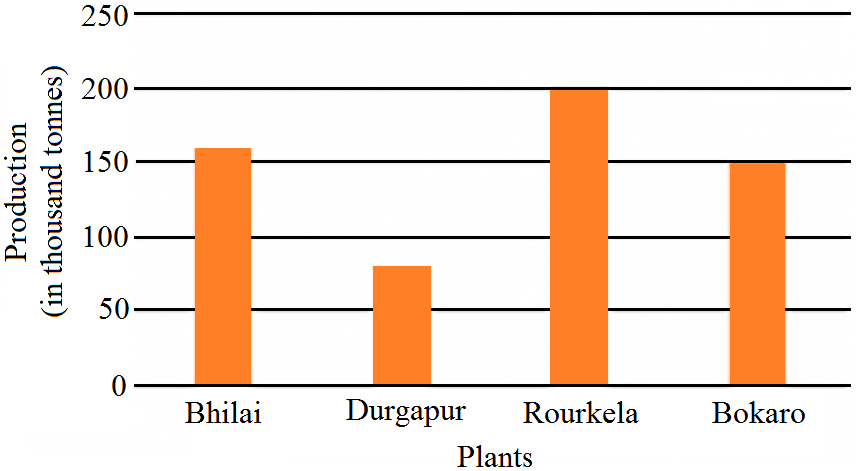
The production of saleable steel in some of the steel plants of our country during 1999 is given below:
Plant
Bhilai
Durgapur
Rourkela
Bokaro
Production (in thousands)
160
80
200
150
Construct a bar graph to represent the above data on a graph paper by using the scale 1 big divisions = 20 thousand tones.
Answer
To represent the given data by a vertical bar graph, we first draw horizontal and vertical axes. Let us consider that the horizontal and vertical axes represent the plants and the production in thousand tonnes respectively. We have to draw 4 bars of different lengths given in the table. The scale 1 big divisions must be 20 thousand tonnes. So, fast find the heights of the bars corresponding to different plants. After that, we follow the well known procedure. The heights of the different bars are: The height of the bar corresponding to Bhilai $\frac{160}{20}=8$ big division. The height of the bar corresponding to Durgapur is $\frac{80}{20}=4$ big divisions. The height of the bar corresponding to Rourkela = 10 big divisions. The height of the bar corresponding to Bokaro is = 7.5 big divisions. At first we mark 4 points in the horizontal axis at equal distances and erect rectangles of the same width at these points. The heights of the rectangles are proportional to the productions. The vertical bar graph of the given data is following:
Note that one big division in the vertical axis is equivalent to 20 thousand tones.
View full question & answer
Question 174 Marks
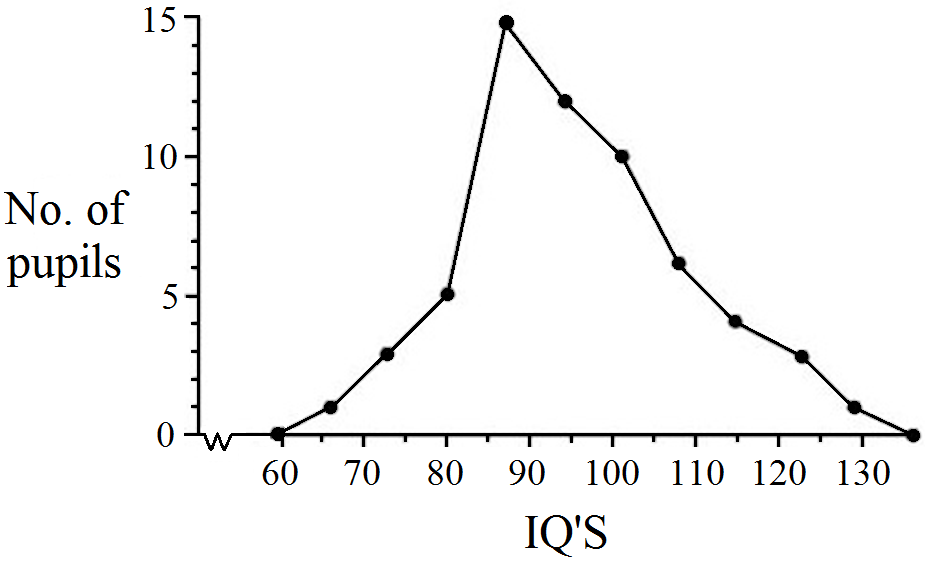
The following table gives the distribution of IQ's (intelligence quotients) of 60 pupils of class V in a school:
IQ's:
125.5 to 13.25
118 to 125.5
111.5 to 118.5
104.5 to 111.5
97.5 to 104.5
90.5 to 97.5
83.5 to 90.5
76.5 to 83.5
69.5 to 76
62.5 to 69.5
No. of pupils:
1
3
4
6
10
12
15
5
3
1
Draw a frequence polygon for the above data.
Answer
We first draw horizontal and vertical axes. Let us consider that the horizontal and vertical axes represent the class-limits and the frequencies of the class-intervals respectively.
The given data is a continuous grouped frequency distribution with equal class-intervals. To draw the frequency polygon of the given data without using histogram, obtain the class-limits of the class intervals. Obtain the class-limits of two class-intervals of 0 frequencies, i.e. on the horizontal axis, one adjacent to the first, on its left and one adjacent to the last, on its right. These class-intervals are known as imagined class-intervals. Then plot the frequencies against class-limits.
The following table is useful to draw the frequency polygon of the given data.
Class-Intervals Class-Marks Frequency
55.5-62.5 59 0
62.5-69.5 66 1
69.5-76.5 73 3
76.5-83.5 80 5
83.5-90.5 87 15
90.5-97.5 94 12
97.5-104.5 101 10
104.5-111.5 108 6
111.5-118.5 115 4
118.5-125.5 122 3
125.5-132.5 129 1
132.5-139.5 136 0
We represent class marks on X-axis on a suitable scale and the frequencies on Y-axis on a suitable scale.
To obtain the frequency polygon we plot the points (66, 1), (73, 3), (80, 5), (87, 15), (94, 12), (101, 10), (108, 6), (115, 4), (122, 3), (129, 1).
Now we join the plotted points by line segments. The end points (66, 1) and (129, 1) are joined to the mid points (59, 0) and (136, 0) respectively of imagined class intervals to obtain the frequency polygon.
View full question & answer
Question 184 Marks
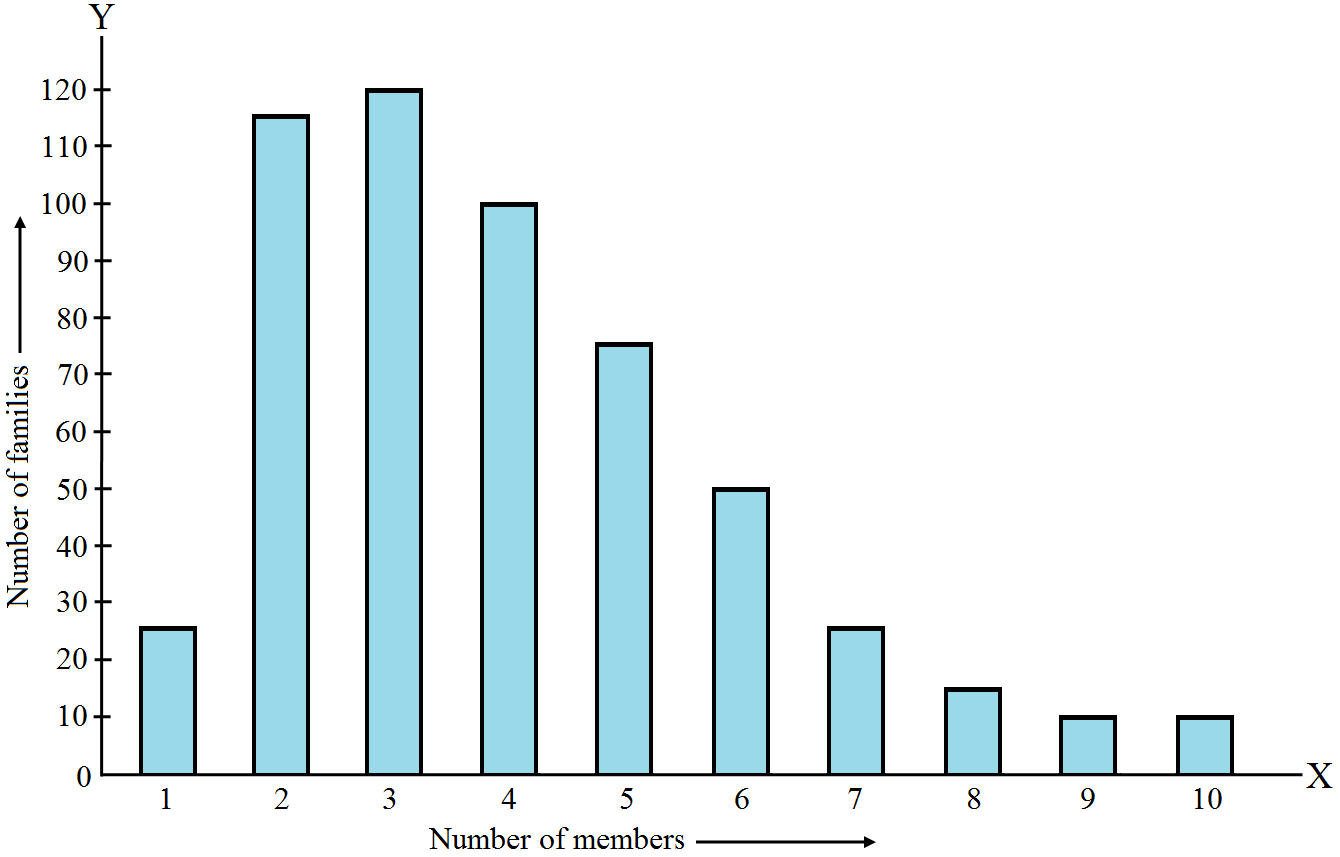
Read the bar graph given in figure and answer the following questions:
  1. What is the information given by the bar graph?
  2. What is the number of families having 6 members?
  3. How many members per family are there in the maximum number of families? Also tell the number of such families.
  4. What are the number of members per family for which the number of families are equal? Also, tell the number of such families?
Answer
i. The bar graph represents the number of families with the different number of members in a locality.
ii. The number of families having 6 members is 50 , the height of the $6^{\text {th }}$ bar from the left.
iii. The maximum number of families is 120 . There are 3 members per family in the maximum number of families.
iv. It is seen from the bar graph that the height of the $9^{\text {th }}$ and $10^{\text {th }}$ bars from the left are same (equals to 5 ). Hence, the numbers of members per family for which the number of families are equal are 9 and 10 . The number of such families is 5 .
View full question & answer
Question 194 Marks
Draw, in the same diagram, a histogram and a frequency polygon to represent the following data which shows the monthly cost of living index of a city in a period of 2 years:
Cost of living inex: 440-460 460-480 480-500 500-520 520-540 540-560 560-580 580-600
No.of months: 2 4 3 5 3 2 1 4
View full question & answer
Question 204 Marks
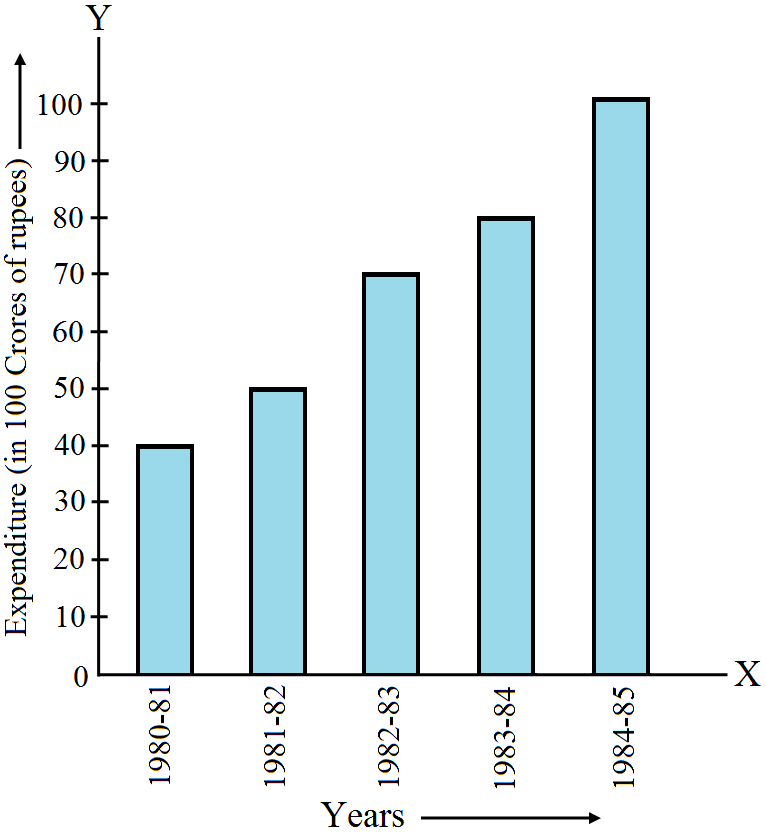
Read the bar graph given in figure and answer the following questions:
  1. What information is given by the bar graph?
  2. What was the expenditure on health and family planning in the year $1982-83$?
  3. In which year is the increase in expenditure maximum over the expenditure in the previous year? What is the maximum increase?
Answer
i. The bar graph represents the expenditure (in 100 Crores of rupees) on health and family planning during the Sixth Five Year Plan in India.
ii. he height of the $2^{\text {nd }}$ bar from the left is 7 units, which is corresponding to the year 1982-83. Hence, the expenditure on health and family planning in the year 1982-83 was 700 Crores rupees.
iii. Take the year 1980-81 as the initial year of expenditure. Then:
a. The increase in expenditure in the year 1981-82 is $5-4=1$ unit.
b. The increase in expenditure in the year 1982-83 is $7-5=2$ units.
c. The increase in expenditure in the year 1983-84 is $8-7=1$ unit.
d. The increase in expenditure in the year 1984-85 is $10.2-8=2.2$ units.
Hence, in the year 1984-85 the increase in expenditure is the maximum and the maximum increase is $2.2 \times 100=$ 220 Cores rupees.
View full question & answer
Question 214 Marks
Explain the reading and interpretation of bar graphs.
Answer
A bar graph is a diagram consisting of a sequence of vertical or horizontal bars or rectangles, each of which represents an equal interval of the values of a variable, and has the height proportional to the quantities of the phenomenon under consideration in that interval. A bar graph may also be used to illustrate discrete data, in which case each bar represents a distinct circumstance.
While drawing a bar graph, we keep in mind that:
  • The width of the bars should be uniform throughout.
  • The gap between any two bars should be uniform throughout.
  • Bars may be either horizontal or vertical.
Each bar must be of the same width and the gap between them must be uniform. Make sure that the width of the bars and the gap between them should not be necessarily same.
View full question & answer
Question 224 Marks
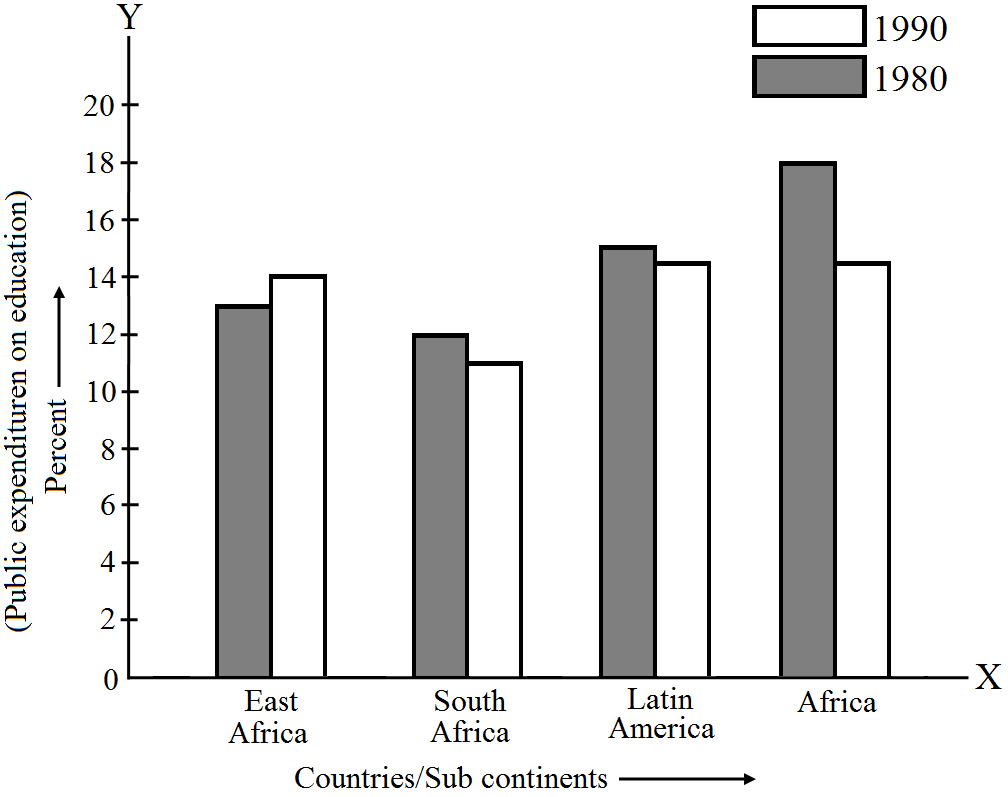
Read the bar graph given in figure and answer the following questions:
  1. What information does it give?
  2. In which part the expenditure on education is maximum in 1980?
  3. In which part the expenditure has gone up from 1980 to 1990?
  4. In which part the gap between 1980 and 1990 is maximum?
Answer
  1. The bar graph represents the public expenditure on education in different countries and sub continents in the years 1980 and 1990.
  2. The expenditure on education in Africa in 1980 is the maximum.
  3. It is clear from the bar graph that in East Africa the expenditure has gone up from 1980 to 1990.
  4. It is observed from the bar graph that the gap between expenditures in 1980 and 1990 is maximum in Africa, which is 18 - 14 = 4%
View full question & answer
4 Mark Question - Maths STD 9 Questions - Vidyadip