Question
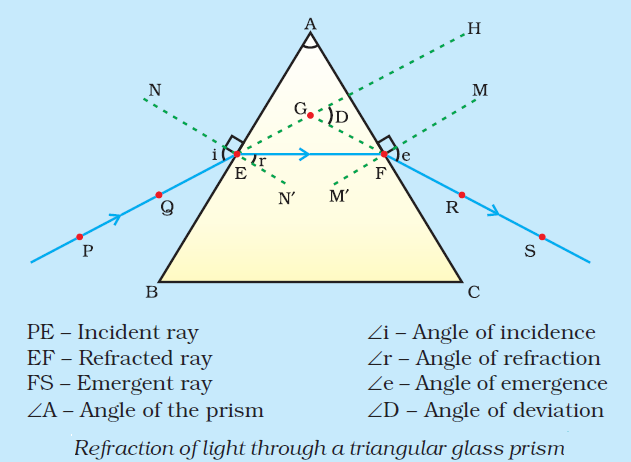
Explain the refraction of light through a triangular glass prism using a labelled ray diagram. Hence define the angle of deviation.
Answer


The light ray PE enters from air to glass (rarer to denser medium) at surface AB and therefore, bends towards the normal. The refracted ray EF now exits from glass and enters air (from denser to rarer medium) and therefore, bends away from the normal. Extrapolation of incident and emergent ray gives the angle of deviation.

Need a full question paper?

Generate a complete, print-ready paper with questions like this in minutes — across 16+ boards, with answer keys.

Start Generating Free

Similar questions

Draw a circuit diagram of an electric circuit containing a cell, a key, an ammeter, a resistor of 2Ω in series with a combination of two resistors (4Ω each) in parallel and a voltmeter across the parallel combination. Will the potential difference across the 2Ω resistor be the same as that across the parallel combination of 4Ω resistors? Give reason.
What are the differences between aerobic and anaerobic respiration? Name some organisms that use anaerobic mode of respiration.
How are fossils formed? Describe, in brief, two methods of determining the age of fossils.
Determine how far an object must be placed in front of a converging lens of focal length 10cm in order to produce an erect (upright) image of linear magnification 4.
When a piece of limestone reacts with dilute HCl, a gas X is produced. When gas X is passed through lime water then a white precipitate Y is formed. On passing excess of gas X, the white precipitate dissolves forming a soluble compound Z.
  1. What are X, Y and Z?
  2. Write equations for the reactions which take place:
  1. When limestone reacts with dilute HCl.
  2. When gas X reacts with lime water to form white precipitate Y.
  3. When excess of gas X dissolves white precipitate Y to form a soluble compound Z.
List three ways in which the magnetic field strength of a current-carrying solenoid can be increased?
Among sulphurous acid and sulphuric acid, which is stronger and why?
Give reasons:
Baking powder is added to make the cakes spongy and soft.
What is photosynthesis? Explain its mechanism.
A green stemmed tomato plant denoted by (GG) is crossed with a tomato plant with purple stem denoted by (gg).
a. What colour of the stem would you expect in their $F_{1}$ progeny?
b. In what ratio would you find the green and purple coloured stem in plants of $\mathrm{F}_{2}$ progeny?
c. What conclusion can be drawn for the above observations?