MCQ
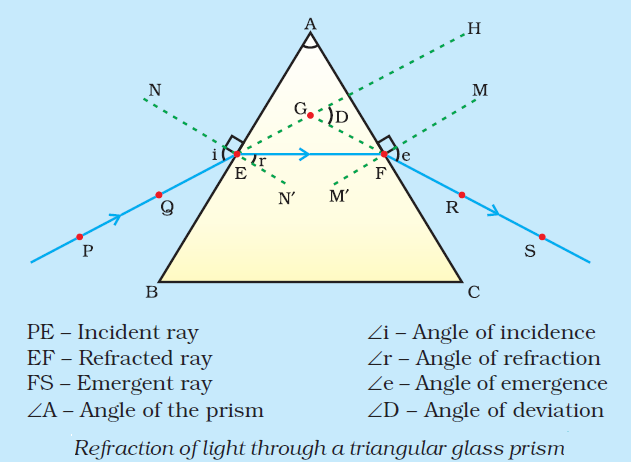
Explain the refraction of light through a triangular glass prism using a labelled ray diagram. Hence define the angle of deviation.

  • The light ray PE enters from air to glass (rarer to denser medium) at surface AB and therefore, bends towards the normal. The refracted ray EF now exits from glass and enters air (from denser to rarer medium) and therefore, bends away from the normal. Extrapolation of incident and emergent ray gives the angle of deviation.
Answer

Correct option: A.

The light ray PE enters from air to glass (rarer to denser medium) at surface AB and therefore, bends towards the normal. The refracted ray EF now exits from glass and enters air (from denser to rarer medium) and therefore, bends away from the normal. Extrapolation of incident and emergent ray gives the angle of deviation.

The light ray PE enters from air to glass (rarer to denser medium) at surface AB and therefore, bends towards the normal. The refracted ray EF now exits from glass and enters air (from denser to rarer medium) and therefore, bends away from the normal. Extrapolation of incident and emergent ray gives the angle of deviation.

Need a full question paper?

Generate a complete, print-ready paper with questions like this in minutes — across 16+ boards, with answer keys.

Start Generating Free

Similar questions

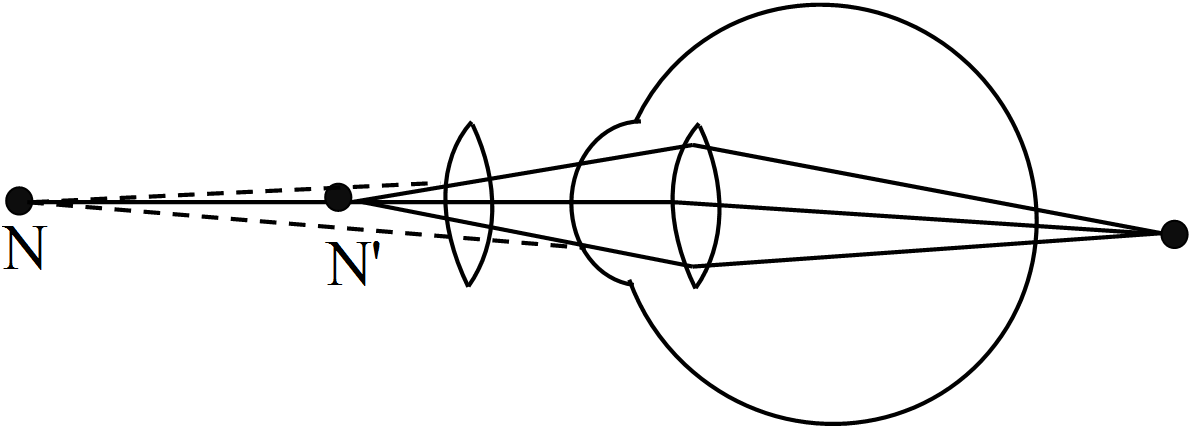
Study the diagram given below, and answer the questions that follow it.
  1. Identify the defect of vision. Give reason for your answer.
  2. State two possible causes of this defect.
  3. How can we rectify this defect? Explain with a diagram.
Explain, what happens to the egg once it gets fertilized in a human female?
An element ' $X$ ' belong to $3^{\text {rd }}$ period and group 13 of the Modern Periodic Table.
  1. Determine the valence electrons and the valency of ‘X’.
  2. Molecular formula of the compound formed when ‘X’ reacts with an element ‘Y’ (atomic number=8).
  3. Write the name and formula of the compound formed when ‘X’ combines with chlorine.
A concave lens has focal length 15cm. At what distance should the object from the lens be placed so that it forms an image at 10cm from the lens? Also find the magnification produced by the lens.
Two exactly similar electric lamps are arranged (i) in parallel, and (ii) in series. If the parallel and series combination of lamps are connected to 220V supply line one by one, what will be the ratio of electric power consumed by them?
How toothpaste prevents tooth decay?
A child questioned his teacher that why do organisms resemble their parents more as compared to grandparents. In which way will the teacher explain to the child?
A reddish-brown metal ' $X$ ', when heated in air, gives a black compound ' $Y$ ', which when heated in presence of $H _2$ gas gives ' $X$ ' back. ' $X$ ' is refined by the process of electrolysis; this refined form of ' $X$ ' is used in electrical wiring.
Identify ' $X$ ' and ' $Y$ '. Draw a well-labeled diagram to represent the process of refining ' $X$ '.
When is a person said to have developed cataract in his eye ? How is the vision of a person having cataract restored?
  1. Differentiate, between alkanes and alkenes. Name and draw the structure of one member of each.
  2. Alkanes generally give clean flame. Why?