Question
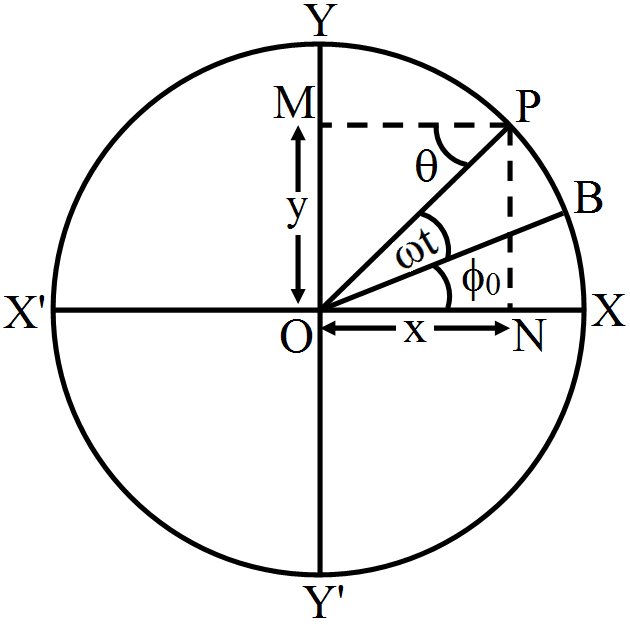
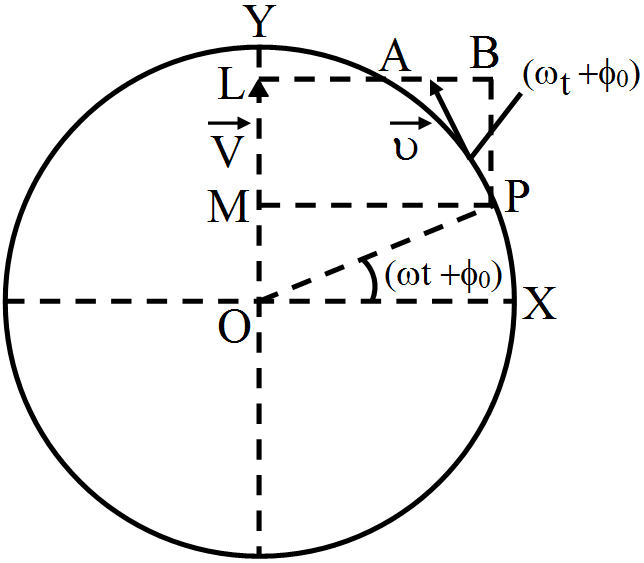
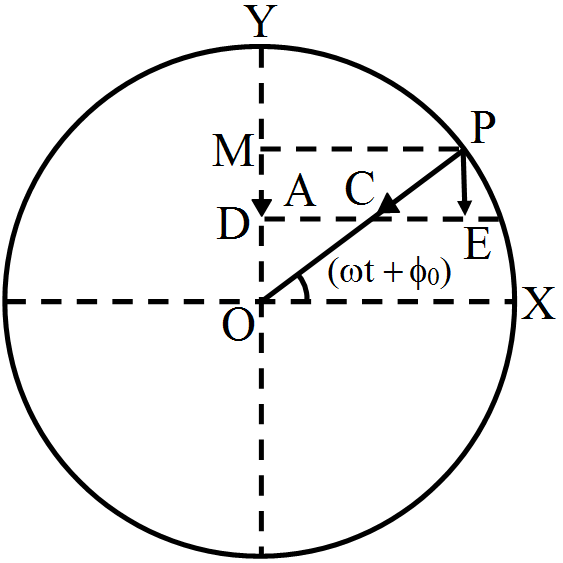
Explain the relation in phase between displacement, velocity and acceleration in S.H.M., graphically as well as theoretically.
Answer

If displacement:$\text{y = A}\sin(\omega\text{t}+\phi_0)$
velocity $\text{v}=\omega\text{A}\cos(\omega\text{t}+\phi_0)$ acceleration $\text{a}=-\omega^2\text{A}\sin(\omega\text{t}+\phi_0)$ x and v differ in phase by $\frac{\pi}{2}.$ v and a differ in phase by $\frac{\pi}{2}.$
Need a full question paper?

Generate a complete, print-ready paper with questions like this in minutes — across 16+ boards, with answer keys.
Start Generating Free

Similar questions

An object is thrown vertically upward with some speed. It crosses two points $p$ and $q$ which are separated by $h$ metre. If $t_p$ is the time between $p$ and the highest point and coming back and $t_q$ is the time between $q$ and the highest point and coming back, relate acceleration due to gravity, $\mathrm{t}_{\mathrm{p}}, \mathrm{t}_{\mathrm{q}}$, and h .
A uniform rod of mass $300g$ and length $50\ cm$ rotates at a uniform angular speed of $2\text{rad/s}$ about an axis perpendicular to the rod through an end. Calculate:
  1. The angular momentum of the rod about the axis of rotation.
  2. The speed of the centre of the rod.
  3. Its kinetic energy.
A wheel rotating with uniform angular acceleration covers 50 revolutions in the first five seconds after the start. Find the angular acceleration and the angular velocity at the end of five seconds.
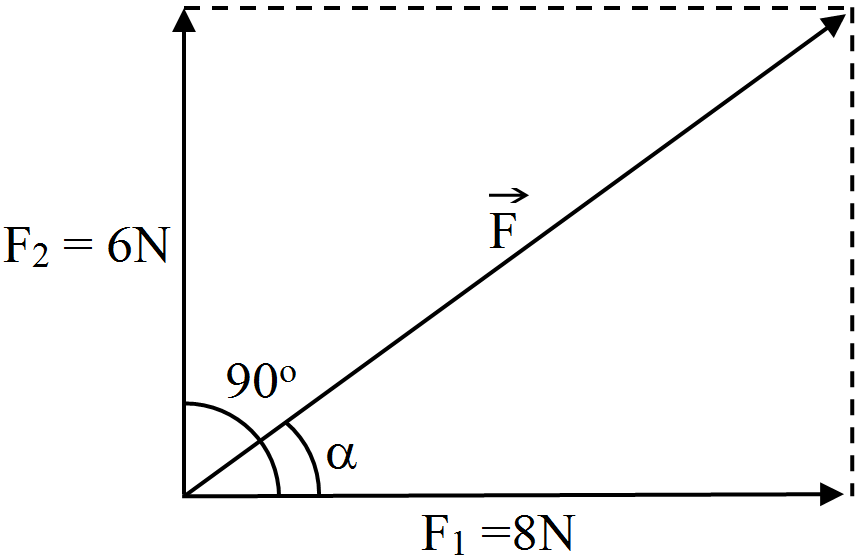
Two mutually perpendicular forces of $8N$ and $6N$ acts on the same body of mass $10\ kg$. Calculate
  1. Net force acting on the body,
  2. Magnitude of the acceleration of the body,
  3. Direction of acceleration of the body.
A U-shaped wire is dipped in a soap solution, and removed. The thin soap film formed between the wire and the light slider supports a weight of $1.5 × 10⁻²N$ (which includes the small weight of the slider). The length of the slider is $30cm$. What is the surface tension of the film?
Two strips of metal are riveted together at their ends by four rivets, each of diameter 6.0 mm . What is the maximum tension that can be exerted by the riveted strip if the shearing stress on the rivet is not to exceed $6.9 \times 10^7 \mathrm{~Pa}$ ?
Assume that each rivet is to carry one quarter of the load.
A simple pendulum is suspended from the ceiling of a car taking a turn of radius $10m$ at a speed of $36km/ h$. Find the angle made by the string of the pendulum with the vertical if this angle does not change during the turn. Take $g= 10m/s^2$.
Artificial diamond crystals have been manufactured by subjecting carbon in the form of graphite to a pressure of $1.55 \times 10^{10} \mathrm{Nm}^{-2}$ at a high temperature. Assuming that natural dimonds were formed at similar high pressures within the earth, what must have been the original volume o the Kohinoor diamond, whose mass before cutting was about 175 g ? The density of the diamond $=3.5 \mathrm{~g} / \mathrm{cm}^{-3}$ and its bulk modulus $=62 \times 10^{10} \mathrm{Nm}^{-2}$.
A particle executes the motion described by $\text{x}(\text{t})=\text{x}_0(1-\text{e}^{-\gamma\text{t}});\text{t}\ge0,\text{x}_0>0.$ Find maximum and minimum values of x(t), v(t), a(t). Show that x(t) and a(t) increase with time and v(t) decreases with time.
A body oscillates with SHM according to the equation (in SI unit)$\text{x}=5\cos\Big[2\pi\text{t}+\frac{\pi}{4}\Big]$
At t = 1.5 second, calculate (i) displecement, (ii) speed.