Question
A U-shaped wire is dipped in a soap solution, and removed. The thin soap film formed between the wire and the light slider supports a weight of $1.5 × 10⁻²N$ (which includes the small weight of the slider). The length of the slider is $30cm$. What is the surface tension of the film?
Answer

The weight that the soap film supports, $\mathrm{W}=1.5 \times 10^{-2} \mathrm{~N}$ Length of the slider, $\mathrm{I}=30 \mathrm{~cm}=0.3 \mathrm{~mA}$ soap film has two free surfaces.
$\therefore$ Total length $=2 \mathrm{l}=2 \times 0.3=0.6 \mathrm{~m}$
Surface tension, $S=\frac{\text { Force of Weight }}{21}=1.5 \times \frac{10^{-2}}{0.6}=2.5 \times 10-2 \mathrm{~N} / \mathrm{m}$
Therefore, the surface tension of the film is $2.5 \times 10-2 \mathrm{~N} \mathrm{~m}^{-1}$.

Need a full question paper?

Generate a complete, print-ready paper with questions like this in minutes — across 16+ boards, with answer keys.

Start Generating Free

Similar questions

A boy travelling in an open car moving on a levelled road with constant speed tosses a ball vertically up in the air and catches it back. Sketch the motion of the ball as observed by a boy standing on the footpath. Give explanation to support your diagram.
A set of $25$ tuning forks is arranged in order of decreasing frequency. Each fork gives $3$ beats with succeeding one. The first fork is octave of the last. Calculate the frequency of the first and $16^{\text {th }}$ fork.
Two rods A and B are of equal length. Each rod has its ends at temperatures $T_1$ and $T_2$. What are the conditions that will ensure equal rates of flow of heat through the rods A and B?
The weight of a body at the poles is greater than the weight at the equator. Is it the actual weight or the apparent weight we are talking about? Does your answer depend on whether only the earth's rotation is taken into account or the flattening of the earth at the poles is also taken into account?​​​​​
A batsman deflects a ball by an angle of $45^{\circ}$ without changing its initial speed which is equal to $54 km / h$. What is the impulse imparted to the ball? (Mass of the ball is 0.15 kg .)
If the acceleration due to gravity on moon is one sixth that on the earth what will be the length and time period of a second's pendulum there? (g = 9.8 ms?)
What is the need for banking of road? Write the expression for the maximum speed with which a vehicle can safely negotiate a curved road banked at an angle $\theta.$ The coefficient of friction between the wheels and the road is $\mu.$
Consider the situation of the previous problem. A particle having charge q and mass m is projected from the point Q in a direction going into the plane of the diagram. It is found to describe a circle of radius r between the two plates. Find the speed of the charged particle.
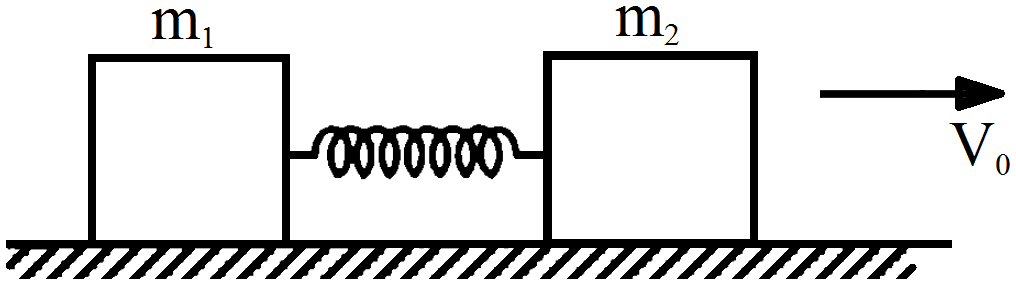
Two blocks of masses $m_1$ and $m_2$ are connected by a spring of spring constant k. The block of mass $m_2$ is given a sharp impulse so that it acquires a velocity $v_0$ towards right. Find
  1. The velocity of the centre of mass.
  2. The maximum elongation that the spring will suffer.
​​​​​​​
Find the radius and energy of a $He^+$ ion in the states $(a) n = 1, (b) n = 4$ and $(c) n = 10.$