Question
Explain the relation in phase between displacement, velocity and acceleration in S.H.M., graphically as well as theoretically.

Answer

If displacement:

$\text{y = A}\sin(\omega\text{t}+\phi_0)$
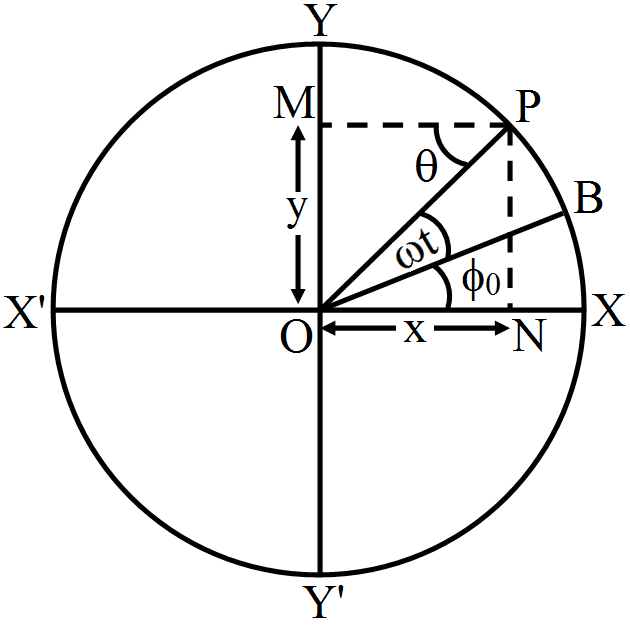
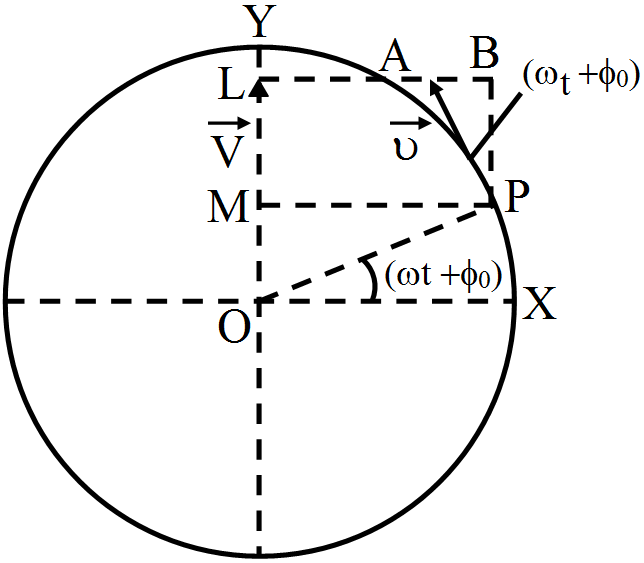
velocity $\text{v}=\omega\text{A}\cos(\omega\text{t}+\phi_0)$
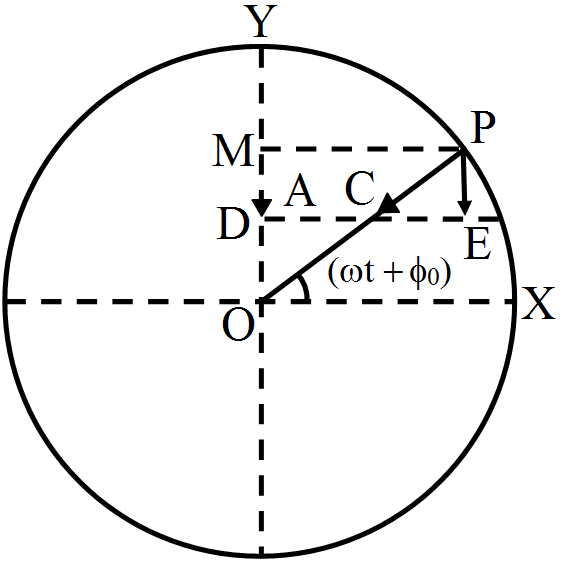
acceleration $\text{a}=-\omega^2\text{A}\sin(\omega\text{t}+\phi_0)$
x and v differ in phase by $\frac{\pi}{2}.$

v and a differ in phase by $\frac{\pi}{2}.$

Need a full question paper?

Generate a complete, print-ready paper with questions like this in minutes — across 16+ boards, with answer keys.

Start Generating Free

Similar questions

A cylinder of fixed capacity contains 44.8L of helium gas at STP. Calculate the amount of heat required to raise the temperature of container by 15°C? [given R = 8.31J-mol-1K-1]
Define the term 'coefficient of limiting friction' between two surfaces. A body of mass 10kg is placed on an inclined surface of angle 30°. If the coefficient of limiting friction is $\frac{1}{\sqrt{3}}$ find the force required to just push the body up the inclined surface. The force is being applied parallel to the inclined surface.
Find the ratio of the linear momenta of two particles of masses 1.0kg and 4.0kg if their kinetic energies are equal.
A glass marble slides from rest from the topmost point of a vertical circle of radius r along a smooth chord. Does the time of descent depend upon the chord chosen?
A uniform U-tube has a liquid of density $\rho$ and a length L. The cross-sectional area is A. If it is made to oscillate, show that it will be S.H.M. and find its frequency.
The weight of a body at the poles is greater than the weight at the equator. Is it the actual weight or the apparent weight we are talking about? Does your answer depend on whether only the earth's rotation is taken into account or the flattening of the earth at the poles is also taken into account?​​​​​
A block of mass 2kg is pulled up on a smooth incline of angle 30° with horizontal. If the block moves with an acceleration of 1m/ s2, find the power delivered by the pulling force at a time 4 seconds after motion starts. What is the/ frac delivered during these four seconds after the motion starts?
Find the radius of gyration of a circular ring of radius r about a line perpendicular to the plane of the ring and passing through one of its particles.
A rod of length L is placed along the X-axis between x = 0 and x = L. The linear density (mass/ length) $\rho$ of the rod varies with the distance x from the origin as $\rho=\text{a + bx.}$
  1. Find the SI units of a and b.
  2. Find the mass of the rod in terms of a, b and L.
An electron travelling with a speed of 5 × 10³ms-1 passes through an electric field with an acceleration of 1012ms-2. How long will it take for the electron to double its speed?