ALTERNATING CURRENT — Physics STD 12 Science — Question
Gujarat BoardEnglish MediumSTD 12 SciencePhysicsALTERNATING CURRENT2 Marks
Question
Explain the representation of AC current and voltage by rotating vectors. (phasors).
✓
Answer
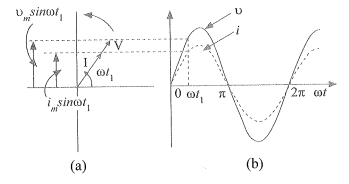
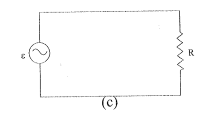
→In an AC circuit in order to show the phase relationship between voltage and current the notion of phasor is used. →A phasor is a vector, which is used to represent periodically changing quantities in the form of vectors. →For example to draw a phasor representing voltage $V =v_m \sin \omega t$, draw a vector of magnitude equal to $v_m$ and in the direction making an angle $\omega t$ with the horizontal axis. →As time increases, value of $\omega t$ goes on increasing and the phasor (vector) rotates in anticlockwise direction accordingly. And its instantaneous value also keeps changing. →The voltage and current phasor shown in the fig. rotates about the origin with angular speed $\omega$. The vertical components of $\vec{V}$ and $\vec{I}$ represent the sinusoidally varying quantities $v$ and $i$.The magnitudes of phasors $\vec{V}$ and $\vec{I}$ represent the amplitudes (/peak values $v_m$ and $i_m$ ) of these oscillating quantities. →Fig. (a) shows the voltage and current phasors and their relationship at time $t_1$ for the case of an AC source connected to a resistor. (fig. c) →The projection of voltage and current phasors on vertical axis, i.e. $v_m \sin \omega t_1$, and $i_m \sin \omega t_1$ respectively represent the value of voltage and current at that instant. →As shown in fig. (a), phasors $\vec{V}$ and $\vec{I}$ for the case of a resistor are in the same direction. This means that phase angle(/phase difference) between the voltage and current is zero.
Need a full question paper?
Generate a complete, print-ready paper with questions like this in minutes — across 16+ boards, with answer keys.