Question
From what it can be said that the electric charge on any object is always an integral multiple of 'e' ?

Answer

►If the protons and electrons are the only basic charges in the universe, all the observable charges have to be integral multiples of $e$.
►Thus, if a body contains $n_1$ electrons and $n_2$ protons, the total amount of charge on the body is $n_2 \times e+n_1 \times(-e)=\left(n_2-n_1\right) e$. Since $n_1$ and $n_2$ are integers, their difference is also an integer.
►Thus the charge on any body is always an integral multiple of $e$ and can be increased or decreased in steps of e.

Need a full question paper?

Generate a complete, print-ready paper with questions like this in minutes — across 16+ boards, with answer keys.
Start Generating Free

Similar questions

A transparent paper (refractive index = 1.45) of thickness 0.02mm is pasted on one of the slits of a Young's double slit experiment which uses monochromatic light of wavelength 620nm. How many fringes will cross through the centre if the paper is removed?
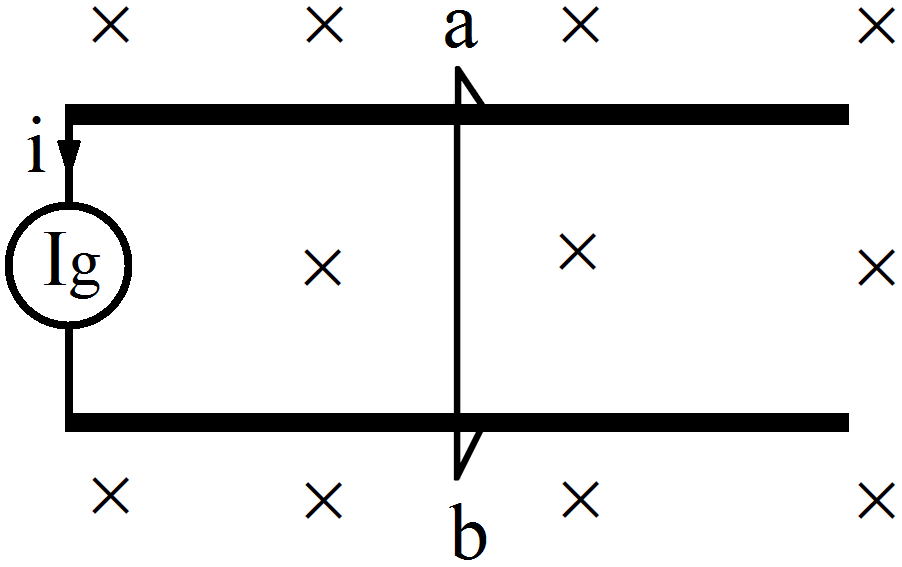
The current generator $I_g$ shown in figure, sends a constant current i through the circuit. The wire ab has a length l and mass m and can slide on the smooth, horizontal rails connected to $I_g.$  The entire system lies in a vertical magnetic field B. Find the velocity of the wire as a function of time.
Define activity of a sample of a radioactive substance. The value of the disintegration constant of a radioactive substance is $0.0693h^{-1}$. Find the time after which the activity of a sample of this substance reduces to one-half that of its present value.
Explain : "Electric charges are additive in nature."
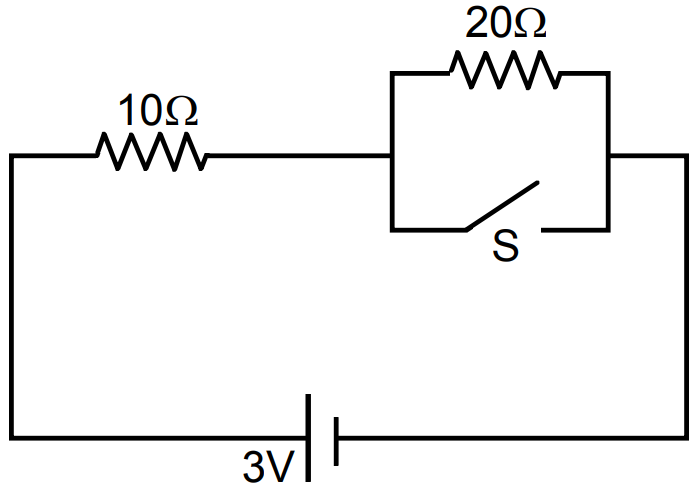
Consider the circuit shown in figure. Find the current through the $10\Omega$ resistor when the switch S is (a) Open (b) Closed.
The energy gaps in the energy band diagrams of a conductor, semiconductor and insulator are $\mathrm{E}_1, \mathrm{E}_2$ and $\mathrm{E}_3$. Arrange them in increasing order.
A bob suspended from the ceiling of a car which is accelerating on a horizontal road. The bob stays at rest with respect to the car with the string making an angle $\theta$ with the vertical. The linear momentum of the bob as seen from the road is increasing with time. Is it a violation of conservation of linear momentum? If not, where is the external force which changes the linear momentum?
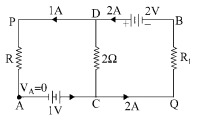
In the given figure, point A is at zero potential. Use Kirchhoff's rules to find out the potential at B.
Image
White light is used in a Young's double slit experiment. Find the minimum order of the violet fringe $(\lambda=400\text{nm}),$ which overlaps with a red fringe $(\lambda=700\text{nm}).$
If two quantities have same dimensions, do they represent same physical content?