Question
Explain the reverse blas characteristics of $p-n$ junction diode with proper graph.

Answer

Image


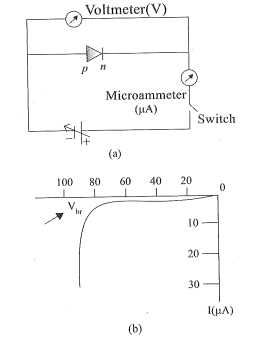
The circuit arrangement for studying the V-I characteristics of a diode in Reverse bias is shown in the figure.
As shown the battery is connected to the diode through a potentiometer (or rheostat) so that the applied voltage to the diode can be changed.
For different values of voltages, the value of the current is noted, and as shown in fig (b), a `graph of $V \rightarrow I$ is obtained. The current obtained in the reverse bias is of the order of micro ampere, $(\mu A )$. This current is known as reverse saturation current.
For the diode in reverse bias, the current is very small and almost remains constant (increases very slowly) with change in bias.
Beyond a particular value of characteristic voltage, diode current changes/increases suddenly with small change in voltage. The reverse voltage, at which this phenomenon is seen is called Breakdown voltage.
In reverse bias, after the breakdown occurs, voltage almost remains constant. Regulator circuits are prepared using this characteristic of a diode.
In reverse bias mode, the dynamic resistance of $p-n$ junction is of the order of $10^6 \Omega( M \Omega)$.

Need a full question paper?

Generate a complete, print-ready paper with questions like this in minutes — across 16+ boards, with answer keys.
Start Generating Free

Similar questions

In a chamber, a uniform magnetic field of 6.5 G (1 G = 10-4T ) is maintained. An electron is shot into the field with a speed of 4.8 X 10⁶ m s-1normal to the field. Explain why the path of the electron is a circle. Determine the radius of the circular orbit.
$\left( e =1.6 \times 10^{-19} C , m_e=9.1 \times 10^{-31} kg\right)$
A short magnet oscillates in an oscillation magnetometern with a time period of 0.10s where the earth's horizontal magnetic field is $24\mu\text{T}.$ A downward current of 18 A is established in a vertical wire placed 20cm east of the magnet. Find the new time period.
TV signals broadcast by Delhi studio cannot be directly received at Patna which is about 1000km away. But the same signal goes some 36000km away to a satellite, gets reflected and is then received at Patna. Explain.
Drive the formula for the magnifying power of a compound microscope if the final images formed at Infinity. Draw the necessary diagram.
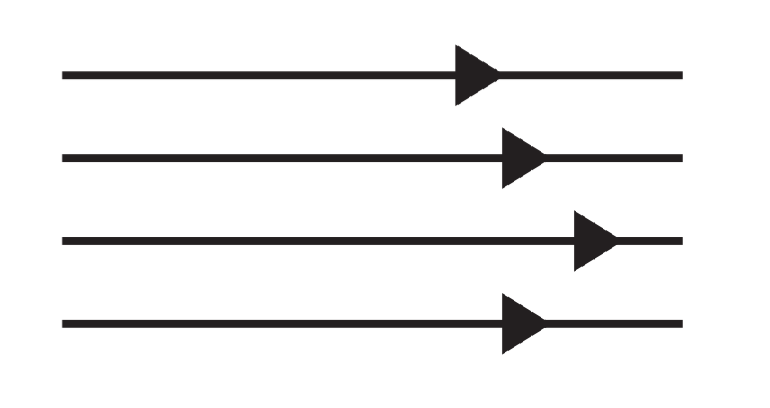
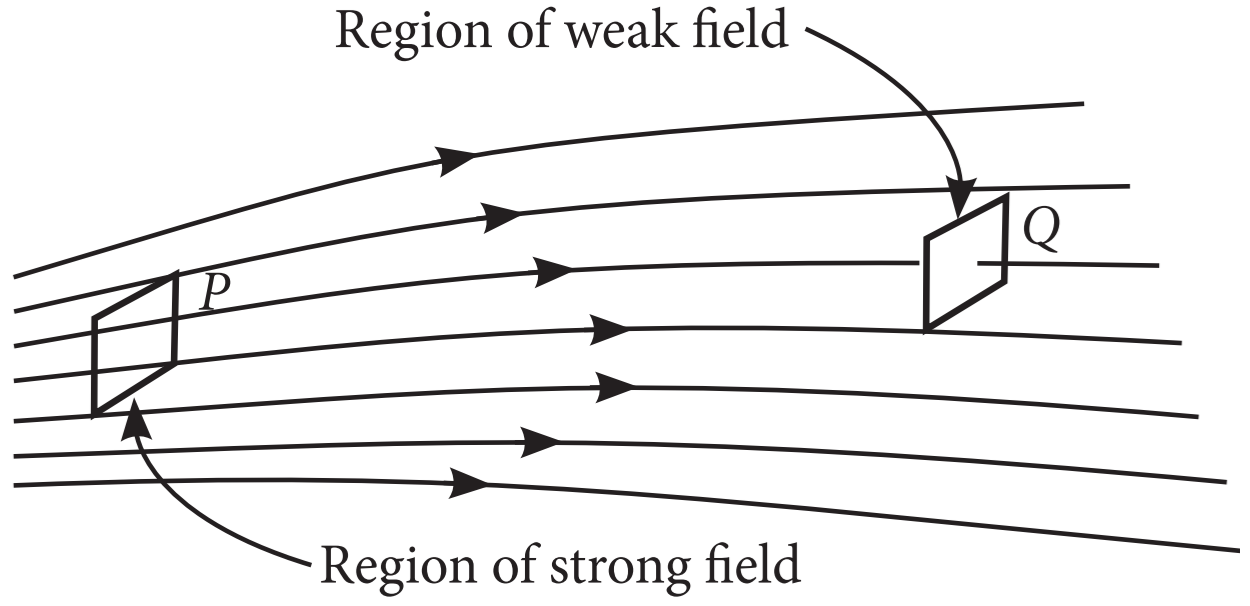
Electric field strength is proportional to the density of lines of force i.e., electric field strength at a point is proportional to the number of lines of force cutting a unit area element placed normal to the field at that point. As illustrated in the given figure, the electric field at P is stronger that at Q.

  1. Electric lines of force about a positive point charge are:
  1. Radially outwards.
  2. Circular clockwise.
  3. Radially inwards.
  4. Parallel straight lines.
  1. Which of the following is false for electric lines of force?
  1. They always start from positive charges and terminate on negative charges.
  2. They are always perpendicular to the surface of a charged conductor.
  3. They always form closed loops.
  4. They are parallel and equally spaced in a region of uniform electric field.
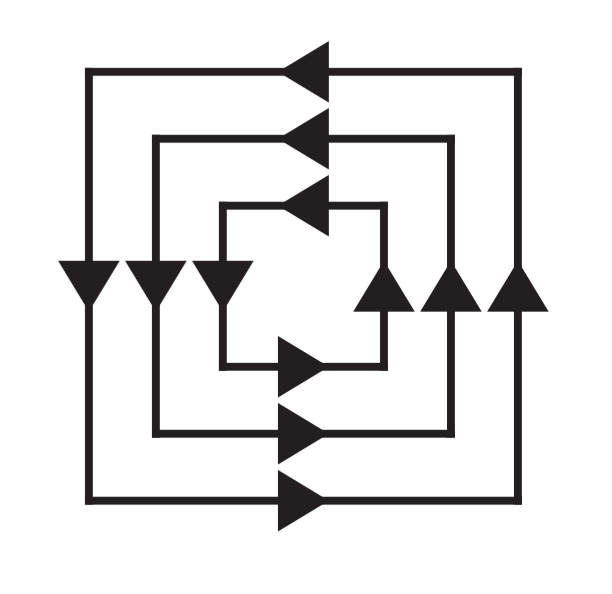
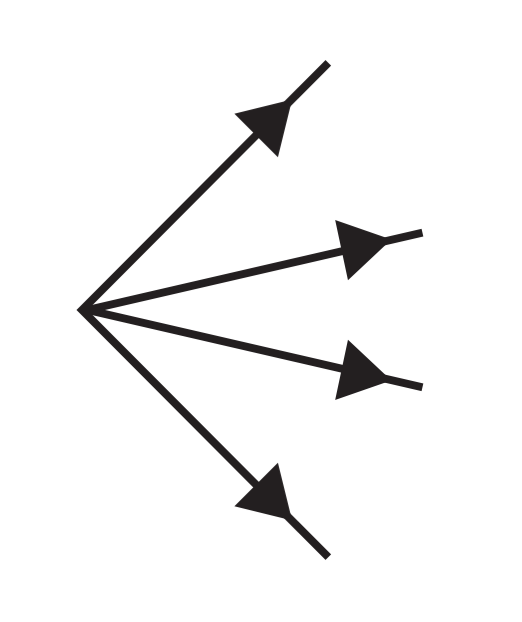
  1. Which one of the following pattern of electric line of force in not possible in filed due to stationary charges?
  1.  

  1.  

  1.  

  1.  

  1. Electric lines of force are curved:
  1. In the field of a single positive or negative charge.
  2. In the field of two equal and opposite charges.
  3. In the field of two like charges.
  4. Both (b) and (c).
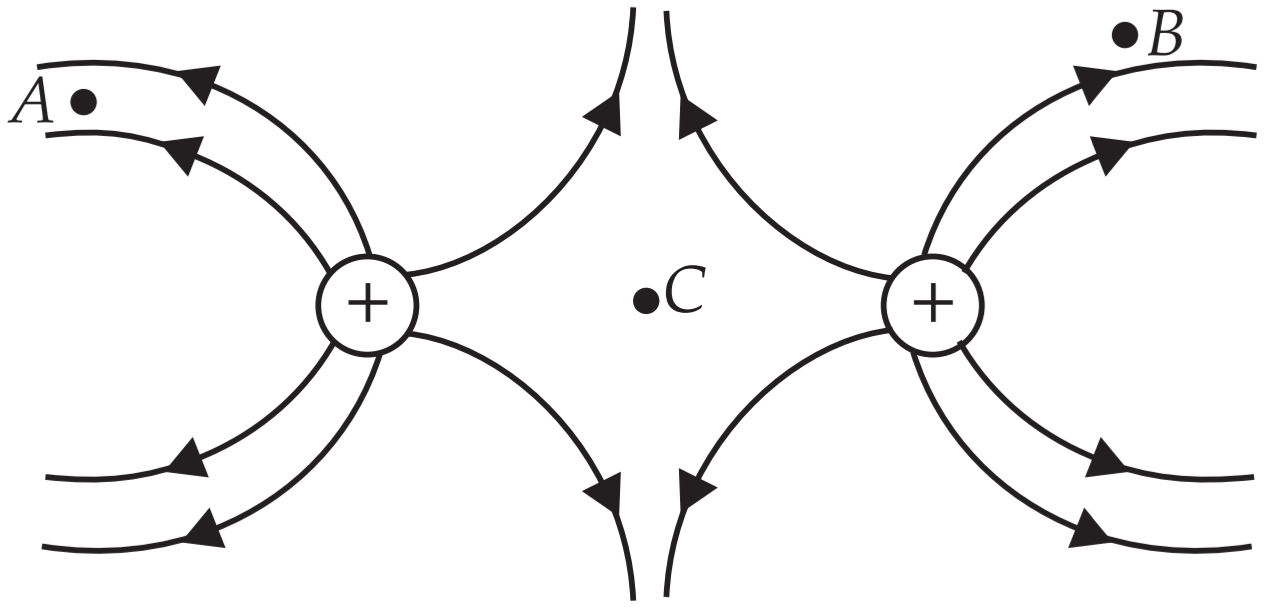
  1. The figure below shows the electric field lines due to two positive charges. The magnitudes EA, EB and EC of the electric fields at points A, Band C respectively are related as:

  1. EA > EB > EC
  2. EB > EA > EC
  3. EA = EB > EC
  4. EA > EB = EC
Three capacitors each of capacitance 9 pF are connected in series.
(a) What is the total capacitance of the combination?
(b) What is the potential difference across each capacitor if the combination is connected to a 120 V supply? S
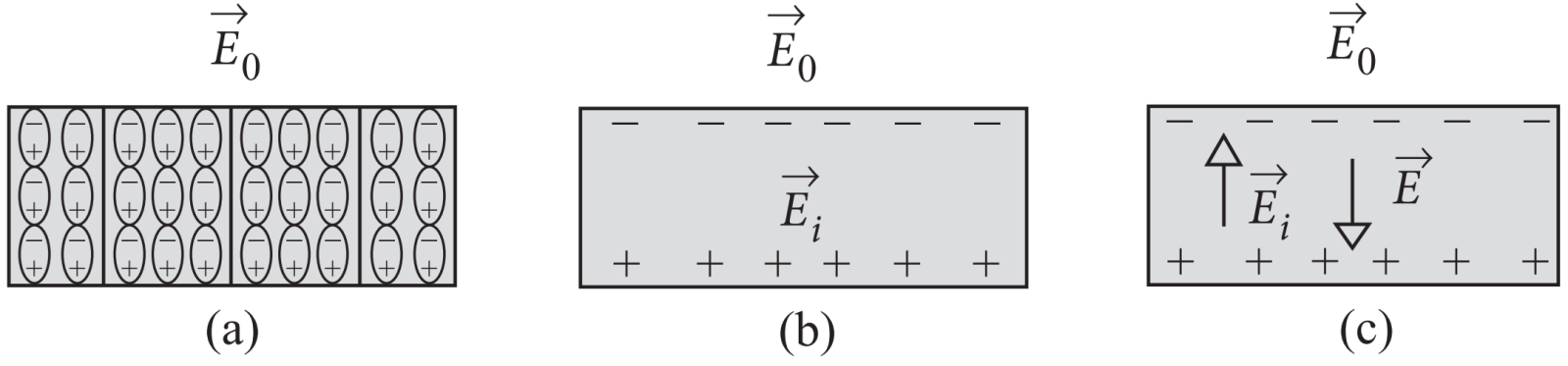
When an insulator is placed in an external field, the dipoles become aligned. Induced surface charges on the insulator establish a polarization field $\vec{\text{E}}_\text{i}$ in its interior. The net field $\vec{\text{E}}$ in the insulator is the vector sum of $\vec{\text{E}}_0$ and $\vec{\text{E}}_\text{i}$ as shown in the figure.

On the application of external electric field, the effect of aligning the electric dipoles in the insulator is called polarisation, and the field $\vec{\text{E}}_\text{i}$ is known as the polarisation field.

The dipole moment per unit volume of the dielectric is known as polarisation $(\vec{\text{P}}).$ For linear isotropic dielectrics, $\vec{\text{P}}=\chi\vec{\text{E}},$ where $\chi=$ electrical susceptibility of the dielectric medium.

  1. Which among the following is an example of polar molecule?
  1. O2
  2. H2
  3. N2
  4. HCI
  1. When air is replaced by a dielectric medium of constant K, the maximum force of attraction between two charges separated by a distance:
  1. Increases K times.
  2. Remains unchanged.
  3. Decreases K times.
  4. Increases 2K times.
  1. Which of the following is a dielectric?
  1. Copper.
  2. Glass.
  3. Antimony (Sb).
  4. None of these.
  1. For a polar molecule, which of the following statements is true?
  1. The centre of gravity of electrons and protons coincide.
  2. The centre of gravity of electrons and protons do not coincide.
  3. The charge distribution is always symmetrical.
  4. The dipole moment is always zero.
  1. When a comb rubbed with dry hair attracts pieces of paper. This is because the?
  1. Comb polarizes the piece of paper.
  2. Comb induces a net dipole moment opposite to the direction of field.
  3. Electric field due to the comb is uniform.
  4. Comb induces a net dipole moment perpendicular to the direction of field.
In a TV picture tube electrons are ejected from the cathode with negligible speed and reach a velocity of 5 × 10⁶m/s in travelling one centimeter. Assuming straight line motion, find the constant force exerted on the electron. The mass of the electron is 9.1 × 10⁻³¹kg.
P-n junction is a single crystal of Ge or Si doped in such a manner that one half portion of it acts asp-type semiconductor and other half functions as n-type semiconductor. As soon as a p-n junction is formed, the holes from the p-region diffuse into then-region, and electron from n region diffuse in top-region. This results in the development of V 8 across the junction which opposes the further diffusion of electrons and holes through the junction.
  1. In an unbiased p-n junction electrons diffuse from n-region top-region because:
  1. Holes in p-region attract them.
  2. Electrons travel across the junction due to potential difference.
  3. Electron concentration inn-region is more as compared to that in p-region.
  4. Only electrons move from n top region and not the vice-versa.
  1. Electron hole recombination in p-n junction may lead to emission of:
  1. Light.
  2. Ultraviolet rays.
  3. Sound.
  4. Radioactive rays.
  1. In an unbiased p-n junction:
  1. Potential at pis equal to that at n.
  2. Potential at pis + ve and that at n is - ve.
  3. Potential at pis more than that at n.
  4. Potential at pis less than that at n.
  1. The potential of depletion layer is due to:
  1. Electrons.
  2. Holes.
  3. Ions.
  4. Forbidden band.
  1. In the depletion layer of unbiased p-n junction,
  1. It is devoid of charge carriers.
  2. Has only electrons.
  3. Has only holes.
  4. P-n junction has a weak electric field.
An electron revolves around an infinite positive linear charge in a circular orbit of radius 0.5 m . If the line charge density is $18.2 \times 10^{-10}$ Coulomb/ meter, then find the speed of the electron (in $m / s$ ). (Mass of electron $m=9.1 \times 10^{-31} kg$ )