Question
Explain the role of workers in a bee colony.

Answer

Worker: Worker is diploid, sterile female. Its size is smallest among the caste of bees. They are the active members of the colony. For various outdoor and indoor chores, the workers are provided with a variety of organs such as hypo pharyngeal glands (for secretion of bee milk), wax glands (for building cells of comb), pollen baskets on their hind legs (for collection of pollen), sucking type mouth parts (for collecting the nectar), high level secretion of invertase enzyme (in the honey sac for honey formation), a sting at the tip of the abdomen (for defence of the colony.
The worker bees of a hive fall under 3 groups. These are:
  1. Scavenger Bees: For the first three days each worker bees act as a scavenger.
  2. Nurse Bees: From the fourth day onwards each worker bee feeds the entire brood, like a foster mother, with a mixture of honey and pollen. By seventh day, its starts producing royal jelly, which is fed to the queen and future queen bees. They also perform guard duties.
  3. Foraging or Field bees: They explore new sources of nectar. They collect nectar, pollen and propolis. Nectar is changed into honey in the crops.

Need a full question paper?

Generate a complete, print-ready paper with questions like this in minutes — across 16+ boards, with answer keys.
Start Generating Free

Similar questions

Which has more atoms, $50g$ of aluminium or $50g$ of iron$?$ Illustrate your answer with the help of calculations.
$($Atomic masses: $Al = 27u; Fe = 56u)$
Define animal husbandry. Write about its scope.
Raunak took $5$ moles of carbon atoms in a container and Krish also took 5 moles of sodium atoms in another container of same weight.
$a.$ Whose container is heavier?
$b.$ Whose container has more number of atoms?
How will you separate a mixture containing kerosene and petrol (difference in their boiling points is more than 25ºC), which are miscible with each other?
Carry out the following osmosis experiment:
Take four peeled potato halves and scoop each one out to make potato cups, one of these potato cups should be made from a boiled potato. Put each potato cup in a trough containing water. Now,
  1. Keep cup A empty.
  2. Put one teaspoon sugar in cup B.
  3. Put one teaspoon salt in cup C.
  4. Put one teaspoon sugar in the boiled potato cup D.
Keep these for two hours. Then observe the four potato cups and answer the following:
  1. Explain why water gathers in the hollowed portion of B and C.
  2. Why is potato A necessary for this experiment?
  3. Explain why water does not gather in the hollowed out portions of A and D.
Name the following:
  1. Smallest cell organelle.
  2. Largest cell organelle.
  3. ER studded with ribosomes.
  4. Functional segments of the DNA molecule.
Two objects having equal masses are moving with uniform velocities of 2m/s and 6m/s respectively. Calculate the ratio of their kinetic energies.
State the law of constant proportions. Give one example to illustrate this law.
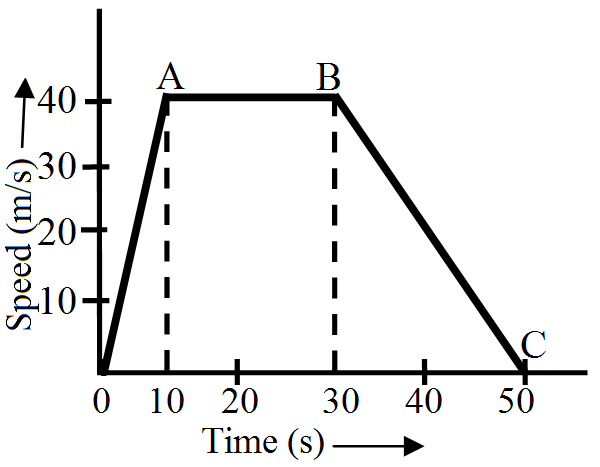
Study the speed-time graph of a car given alongside and answer the following questions:
  1. What type of motion is represented by OA?
  2. What type of motion is represented by AB?
  3. What type of motion is represented by BC?
  4. What is the acceleration of car from O to A?
  5. What is the acceleration of car from A to B?
  6. What is the retardation of car from B to C?
Give the chemical formulae for the following compounds and compute the ratio by mass of the combining elements in each one of them.
  1. Ammonia
  2. Carbon monoxide
  3. Hydrogen chloride
  4. Aluminium fluoride
  5. Magnesium sulphide