Question
Explain the role played by India in maintaining Afro–Asian unity.

Answer

Role played by India in maintaining Afro–Asian unity:-
  1. Under the leadership of Nehru India convened the Asian Relation Conference in March 1947.
  2. India was a staunch supporter of the decolonization process and firmly opposed racism especially apartheid in South Africa.
  3. India made earnest efforts for the early realization of an international conference in 1949 to support its freedom struggle.
  4. The Afro–Asian conference held in the Indonesian city of Bandung in 1955, commonly known as Bandung Conference, marked the zenith of India’s engagement with newly independent Asian and African nations.
  5. The Bandung Conference later led to the establishment of the NAM.

Need a full question paper?

Generate a complete, print-ready paper with questions like this in minutes — across 16+ boards, with answer keys.
Start Generating Free

Similar questions

Globalisation does not always reduce state capacity. The primacy of the state continues to be the unchallenged basis of the political community. The old jealousies and rivalries between countries have not ceased to matter in world politics. The state continues to discharge its essential functions ( law and order, national security) and consciously withdraws from certain domains from which its wishes to. State continue to be important.
Indeed, in some respect state capacity has received a boost as a consequence of globalisation, with enhanced technologies available at the disposal of the state to collect information about its citizens.
Read the passage given above carefully and answer the following questions:
  1. What are the two most essential functions of the state?
  2. How do enhanced technologies enable the state to rule better?
  3. Justify with the help of an example that globalisation gives a boost to the state capacity.
Why is technology considered to be a critical element of globalisation? Explain.
Describe any three reasons for the superpower to have military alliances with smaller countries during the Cold War Period.
Read the passage given below carefully and answer the following questions:
Just as both internal and external factors guide the behavior of an individual or a family, both domestic and international environment influence the foreign policy of a nation. The developing countries lack the required resources to effectively advocate their concerns in the international system. So, they pursue more modest goals than the advanced states. They focus more on peace and development in their own neighbourhood. Moreover, their economic and security dependence on the more powerful states occasionally influences their foreign policy. In the period immediately after the Second World War, many developing nations chose to support the foreign policy preferences of the powerful countries, who were giving them aid or credits. This resulted in the division of countries of the world into two clear camps.
  1. Give one example each of the domestic as well as international environment that has influenced the foreign policy of India.
  2. Why do the developing countries focus more on peace and development in their own neighbourhood?
  3. Mention the two super blocs the world was divided into.
Describe the role played by insurgency and separatism in aggravating the political crisis in Jammu and Kashmir.
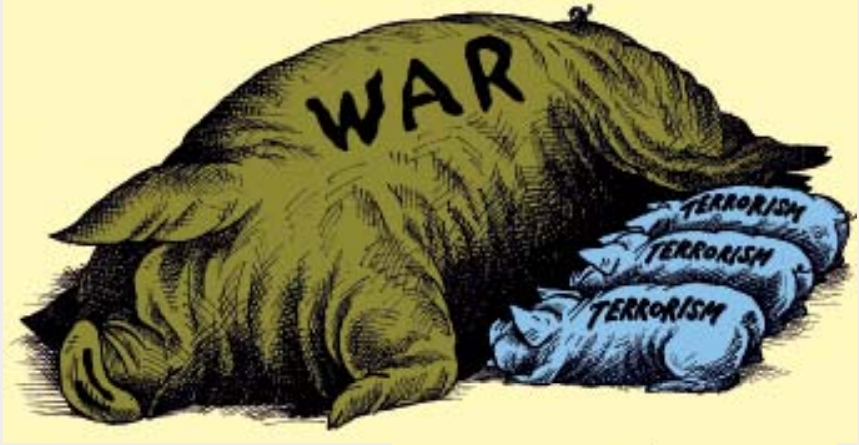
Read the cartoon below and write a short note in favour or against the connection between war and terrorism depicted in this cartoon.
Study the following passage carefully and answer the questions based on it that follow:
Since the Cold War did not eliminate rivalries between the two alliances, mutual suspicions led them to arm themselves to the teeth and to constantly prepare for war. Huge stocks of arms were considered necessary to prevent wars from taking place. The two sides understood that war might occur in spite of restraint.
  1. Name the two rival alliances.
  2. Why were huge stocks of arms considered to be necessary to prevent war?
  3. How could war occur in spite of restraints?
Mention any six steps which should be taken to make the U.N. more relevant in the changing context as decided by heads of all the member states in September 2001.
How far did the U.N. perform its role successfully in maintaining peace in the World? Explain.
Which three major developments took place in Indian politics during the last decade of the 20th century? Describe.