Questions · Page 1 of 2

5 Marks Question

🎯

Test yourself on this topic

50 questions · timed · auto-graded

Question 15 Marks
Explain the Nuclear Policy of India.
Answer
India’s Nuclear Policy:
  1. India has faith in science and technology for rapidly building a modern India. An important components of her industrialization plans was the nuclear programme initiated under the guidance of Homi J. Bhabha.
  2. India is in favour of using of atomic energy for peaceful purposes.
  3. Nehru was against nuclear weapons.
  4. India did not sign the Nuclear Non-Proliferation Treaty (NPT) of 1968 because it considered it as discriminatory.
  5. India also opposed the C.T.B.T. in 1995.
  6. After conducting its first nuclear test, India termed it as peaceful explosion.
View full question & answer
Question 25 Marks
Describe any four long-term implications of the conflict of 1962 between India and China.
Answer
Long term implications of Indo-China conflict of 1962:-
  1. Diplomatic relations between the two countries were downgraded until 1976.
  2. Relations between two countries began to improve slowly.
  3. China’s policy became more pragmatic and less ideological.
  4. China agreed to put off the contentious issues.
  5. Series of talks to resolve the border issues were initiated in 1981.
View full question & answer
Question 35 Marks
Examine the sequence of events related to the formation of governments in Bangladesh from 1971 to 1990.
Answer
The sequence of events related to the formation of governments in Bangladesh from 1971 to 1990:
  1. Bangladesh became an independent country in 1971.
  2. Bangladesh drafted its constitution.
  3. In 1975 Sheikh Mujib got the constitution amended to shift from the parliamentaryto presidential form of government.
  4. He abolished all parties except his own, the Awami League. This led to conflicts and tensions.
  5. He was assassinated in a military uprising in August 1975.
  6. The new military ruler, Ziaur Rahman, formed his own Bangladesh National Party and won elections in 1979.
  7. He was also assassinated and another military takeover followed under the leadership of Lt Gen H. M. Ershad.
  8. The people of Bangladesh soon rose in support of the demand for democracy. Students were in the forefront.
  9. Ershad was forced to allow political activity on a limited scale. He was later elected as President for five years. Public protests forced him to step down in 1990.
  10. Elections were held in 1991. Since then representative democracy based on multiparty elections, has been working in Bangladesh.
View full question & answer
Question 45 Marks
Explain the role played by India in maintaining Afro–Asian unity.
Answer
Role played by India in maintaining Afro–Asian unity:-
  1. Under the leadership of Nehru India convened the Asian Relation Conference in March 1947.
  2. India was a staunch supporter of the decolonization process and firmly opposed racism especially apartheid in South Africa.
  3. India made earnest efforts for the early realization of an international conference in 1949 to support its freedom struggle.
  4. The Afro–Asian conference held in the Indonesian city of Bandung in 1955, commonly known as Bandung Conference, marked the zenith of India’s engagement with newly independent Asian and African nations.
  5. The Bandung Conference later led to the establishment of the NAM.
View full question & answer
Question 55 Marks
Describe Indo-China relations from 1947 to 1962.
Answer
Indo-China relations from 1947-1962:-
  1. After the Chinese revolution in 1949, India was one of the first countries to recognize the communist government of China.
  2. When China annexed Tibet in 1950, both the countries developed some differences.
  3. In 1954, joint enunciation of Panchsheel was made by Indian Prime Minister Pt. Jawahar Lal Nehru and Chinese Premier Zhou Enlai.
  4. In 1959, India gave political asylum to Dalai Lama,which annoyed China.
  5. In 1962, China invaded the territory of India and relations between both the countries got strained.
View full question & answer
Question 65 Marks
Two developments strained this relationship. China annexed Tibet in 1950 and thus removed a historical buffer between the two countries. Initially, the government of India did not oppose this openly. But as more information came in about the suppression of Tibetan culture, the Indian government grew uneasy. The Tibetan spiritual leader, the Dalai Lama, sought and obtained political asylum in India in 1959. China alleged that the government of India was allowing anti-China activities to take place within India.
Read the above passage carefully and answer the following questions:-
  1. What is meant by 'historical buffer'?
  2. Why didn't the Government of India oppose the annexation of Tibet by China?
  3. How far was it justified on the part of India to grant political asylum to the Dalai Lama and thousands of Tibetan refugees?
Answer
  1. 'Historical buffer' means the country or area lies between two large and powerful countries, which acts like an insulator.
  2. India was a newly independent country and did not want to get involved with China unnecessarily. It was an internal matter of China, so India did not want to spoil its relation with China. But on later stage, India realised its mistake.
  3. It was fully justified to help them on humanitarian grounds as well as a good neighbour country.
View full question & answer
Question 75 Marks
Give any three suitable arguments in favour of ‘‘India being a staunch supporter of the decolonisation process and in firm opposition to racialism’’.
Answer
Supporting arguments:-
  1. Under the leadership of Nehru India convened the Asian Relation Conference in March 1947. India was a staunch supporter of the decolonization process and firmly opposed racism especially apartheid in South Africa.
  2. India made earnest efforts for the early realization of an international conference in 1949 to support its freedom struggle.
  3. The Afro– Asian Conference held in the Indonesian city of Bandung in 1955, commonly known as Bandung Conference, marked the zenith of India’s engagement with newly independent Asian and African nations. The Bandung Conference later led to the establishment of the NAM.
View full question & answer
Question 85 Marks
Do you agree with the statement that ‘‘the foreign policy of independent India has pursued the dream of a peaceful world’’? Support your answer with any three suitable arguments.
Answer
Yes, we agree with the statement. Suitable arguments for this are:-
  1. The foreign policy of independent India vigorously pursued the dream of a peaceful world by advocating the policy of non-alignment, by reducing the Cold War confederation and by contributing human resources to the UN peacekeeping operations.
  2. India did not join either of the two camps during the Cold War era. India wanted to keep distance from the military alliances led by US and by the Soviet Union against each other.
  3. During the Cold War, the US-led North Atlantic Treaty Organisation (NATO) and the Soviet-led Warsaw Pact came into existence. India advocated Non-alignment as the ideal foreign policy approach. This was a difficult balancing act and sometimes the balance did not appear perfect.
  4. In 1956 when Britain attacked Egypt over the Suez Canal issue, India led the world protest against this neo-colonial invasion. In the same year, when the USSR invaded Hungary, India did not join its public condemnation. Despite such situation, by and large India did take an independent stand on various international issues.
View full question & answer
Question 95 Marks
Describe India - China relations from 1947 to 1962.
Answer
Indo-China relations from 1947-1962:
  1. After the Chinese revolution in 1949, India was one of the first countries to recognise the communist government of China.
  2. When China annexed Tibet in 1950, both the countries developed some differences.
  3. In 1954, joint enunciation of Panchsheel was made by Indian Prime Minister Pt. Jawahar Lal Nehru and Chinese Premier Zhou Enlai.
  4. In 1959, India gave political asylum to Dalai Lama. This annoyed China.
  5. In 1962, China invaded the territory of India and relations between both the countries got strained.
View full question & answer
Question 105 Marks
Explain the circumstances that forced the Tibetans to leave China. Highlight India's role in helping the Tibetan refugees.
Answer
  1. China annexed Tibet in 1950 and started the suppression of Tibetans.
  2. The large section of the Tibetan population opposed this takeover. So, in 1958, there was an armed uprising in Tibet against China's occupation. This was suppressed by the Chinese forces.
  3. Under these circumstances, a large number of Tibetans sought refuge in India as well as many other countries of the world.
  • Many political leaders and parties in India supported the cause of Tibet's independence.
  • Many places like Delhi and Dharamshala became the largest refugee settlements of Tibetan refugees.
  • The Government of India as well as many state governments extended help to resettle the Tibetan refugees.
View full question & answer
Question 115 Marks
Read the given passage carefully and answer the following questions:
Non-alignment as a strategy evolved in the Cold War context..... with the disintegration of USSR and the end of Cold War in 1991, non-alignment, both, as an international movement and as the core of India's foreign policy, lost some of its earlier relevance and effectiveness.
  1. Why did India adopt non-alignment?
  2. Explain any two reasons for the loss of its relevance by the Non-Aligned Movement.
  3. How far do you agree that the Non-Aligned Movement has become an international movement?
Answer
  1. India adopted Non-alignment to make international policies and decisions in a free manner and to actively intervene in world affairs to soften 'Cold War Rivalries.'
  2.  
  • Due to the end of cold war.
  • A disintegration of USSR.
  1. NAM has become an international movement because it is based on a resolve to democratise the international system. It provides an alternative world in order to redress the existing inequalities in various countries, especially the newly independent countries.
View full question & answer
Question 125 Marks
Suppose there had been no Cold War, how would that situation have affected India's foreign policy?
Answer
If the Cold War had not taken place, it would have affected Indian foreign policy in the following manners:
  1. India would have retained the adopted independent foreign policy.
  2. Since the rivalry between many major powers would have increased hatred and enmity, India would have been compelled to join the arms race to become a strong nation to defend its independence and sovereignty.
  3. India would have become a super power in Asia because of her large territory, human resource and strategic location.
View full question & answer
Question 135 Marks
Explain India’s nuclear policy.
Answer
India has opposed the International treaties aimed at non-prolif-eration since they were selectively applicable to the non-nuclear power and legitimised the monopoly of the live nuclear weapons powers. Thus, India opposed the indefinite extension of the NPT in 1995 and also refused to sign the Comprehensive Test Ban Treaty. (CTBT)
India conducted a series of nuclear tests in May 1998, demonstrating its capacity to use nuclear energy for military purposes. Pakistan soon followed, thereby increasing the vulnerability of the region to a nuclear exchange. The international community was extremely critical of the nuclear tests in the subcontinent and sanctions were imposed on both India and Pakistan, which were subsequently waived. India’s nuclear doctrine of credible minimum nuclear deterrence professes "no first use" and reiterates India’s commitment to global, verifiable and non-discriminatory nuclear disarmament leading to a nuclear weapons free world.
View full question & answer
Question 145 Marks
Describe India’s relations with China from Independence to 1962.
Answer
Indo-China relations from 1947-1962:
  1. After the Chinese revolution in 1949, India was one of the first countries to recognise the communist government of China.
  2. When China annexed Tibet in 1950, both the countries developed some differences.
  3. In 1954, joint enunciation of Panchsheel was made by Indian Prime Minister Pt. Jawahar Lal Nehru and Chinese Premier Zhou Enlai.
  4. In 1959, India gave political asylum to Dalai Lama. This annoyed China.
  5. In 1962, China invaded the territory of India and relations between both the countries got strained.
View full question & answer
Question 155 Marks
Explain India’s Nuclear policy.
Answer
  1. Nuclear programme was initiated in the late 1940 under the guidance of Homi J. Bhabha.
  2. Indian Nuclear policy advocates 'no first use' and reiterates India's commitment to global, verifiable and non-discriminatory nuclear disarmament leading to a Nuclear Weapons Free World.
  3. India refused to sign the NPT and CTBT due to their discriminatory nature.
View full question & answer
Question 165 Marks
Why is the policy of non-alignment of india criticized? Explain any two reasons.
Answer
Non-alignment was an international movement which took particular care in staying away from two alliances and raising voice against the newly independent countries becoming part of these alliances.
Criticism: First, non-alignment was said to be ‘unprincipled’. In the name of pursuing its national interest, India, it was said, often refused to take a firm stand on crucial international issues.
Second, it is suggested that NAM was inconsistent and took contradictory postures. Having criticised others for joining alliances, India signed the Treaty of friendship in August 1971 with the USSR for 20 years. This was regarded, particularly by outside observers, as virtually joining he Soviet alliance system. The Indian government’s view was that India needed diplomatic and possibly military support during the Bangladesh crisis and that in any case the treaty did not stop India from having good relations with other countries including the US.
View full question & answer
Question 175 Marks
Explain any two features of Indian nuclear policy.
Answer
  1. Nuclear programme was initiated in the late 1940 under the guidance of Homi J. Bhabha.
  2. Indian Nuclear policy advocates 'no first use' and reiterates India's commitment to global, verifiable and non-discriminatory nuclear disarmament leading to a Nuclear Weapons Free World.
  3. India refused to sign the NPT and CTBT due to their discriminatory nature.
View full question & answer
Question 185 Marks
"Foreign Policy is always dictated by national interests." Do you agree with this view. Support your answer with any two suitable arguments.
Answer
Yes, Foreign policy is always dictated by national interests. India's leadership pursued the national interests with in the prevailing international situation.
  1. Distance from the two camps.
  2. Afro-Asianunity.
View full question & answer
Question 195 Marks
Highlight any two issues of co-operation as well as confrontation each between India and Bangladesh.
Answer
Issues of co-operation:
  • A full scale war in Dec. 1971. India surrounded Dhaka. Pakistani Army surrendered. India recognised East Pakistan as Bangladesh.
  • India and Bangladesh signed an agreement to share the water of Ganga.
  • Further in 1974 and 1992 more agreements were signed between the two countries.
Issues of confrontation:
  • Migration of large scale Bangladeshis still continue to infiltrate into India.
  • As a reaction to the demolition of Babri Masjid in India, Bangladeshis destroyed Hindu temples over there.
  • Pakistan’s secret agency ISI is using Bangladesh as a base to promote terrorism in India.
  • In April 2001, soldiers of Bangladesh Rifles captured one village of East Khasi Hill Distt., captured soldiers of BSF and later killed them.
View full question & answer
Question 205 Marks
Explain any four Directive Principles of State Policy related to the promotion of international peace and security.
Answer
Directive Principles for the promotion of International Peace and Security:
  1. To promote international peace and security
  2. To maintain just and honourable relations between nations.
  3. To encourage settlement of international disputes by arbitration.
  4. To foster respect for international law and treaty obligations in the dealing of organised people with one another.
View full question & answer
Question 215 Marks
What is Non-Aligned Movement? Examine any two points of its criticism. Also. explain any two of its value points and enduring ideas.
Answer
Non-alignment represents an important force in shaping the nature of international relations. It is a policy of keeping out of alliances. In other words, it is disassociation from the two super powers led by the U.S. and the USSR. The vast majority of new nations of Asia, Africa and Latin America decided to keep distance from both the power blocs.
Criticism:
  1. There is no infrastructure of NAM such as the office of Commonwealth or United Nations.
  2. The member states do not co-operate with each other.
  3. The members in each and every Summit used to criticize the U.S. and the U.S.S.R.
  4. Critics of NAM feel that in a unipolar world, NAM is gradually becoming irrelevant.
Value points and enduring ideas of Non-Alignment:
  • NAM nations continue to oppose colonialism, imperialism, neocolonialism etc.
  • Raised the voice and demanded New International Economic Order (NIEO) which was endorsed by the U.N. General Assembly.
  • Due to the change in the attitude from political to economic agenda, NAM certainly occupies the centre stage.
  • The core values of adopting democratic system, to pursue independent foreign policy, thinking about an alternative world order, future of NAM appears to be bright.
View full question & answer
Question 225 Marks
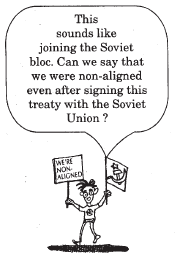
Look at the given cartoon and answer the following questions:
  1. The cartoon refers to which treaty?
  2. How can we say that we were non-aligned even after signing this treaty with the Soviet Union?
  3. This treaty was signed to counteract which rival forces of India?
Answer
  1. The cartoon refers to the Treaty of Friendship signed in 1971 between India with the USSR.
  2.  
  1. The Indian government’s view was that India needed diplomatic and military support during the Bangladesh crisis and U.S.S.R was willing to help.
  2. Also this treaty did not stop India from having good relations with other countries including the U.S.
  1. This was to counter the growing nexus between China, U.S. and Pakistan.
View full question & answer
Question 235 Marks
What steps should be taken to strengthen the U.N.O.?
Answer
The various steps are:
  1. The Security Council should be made more representative of the contemporary political realities.
  2. To abolish the Veto system.
  3. Increase the number of permanent members in the Security Council.
  4. To make representation in the Security Council more equitable in terms of geographical representation.
View full question & answer
Question 245 Marks
What was Bandung Conference? Describe its outcomes.
Answer
It was a conference on Afro-Asian unity held at Bandung (Indonesia), in 1955. It marked the peak of India’s engagement with the newly independent Afro-Asian countries. It led to the establishment of NAM. Nehru was the co-founder of NAM.
View full question & answer
Question 255 Marks
How does the political leadership of a nation affect its foreign policy? Briefly explain with the help of two examples from India’s foreign policy.
Answer
Political leadership affects the foreign policy of a nation because of its strong belief regarding some particular issue related to foreign affairs.
Jawahar Lal Nehru -Non-alignment.
Lal Bahadur Shastri -Indo-Pakistan War.
Indra Gandhi -Bangla Desh War.
  -20 years Treaty of Friendship with USSR.
  -Shimla Agreement.
Atal Bihari Vajpayee -Nuclear Test.
  -Confidence building measures with Pakistan.
  -Bus service between India and Pakistan.
Man Mohan Singh -Indo-U.S. Nuclear Deal.
View full question & answer
Question 265 Marks
Explain how the Indian government has been pursuing the path of democratic negotiation to solve the Kashmir issue.
Answer
A brief description of Kashmir problem. Kashmir a princely state, wanted to remain independent. Tribal attack from Pakistan on Kashmir in 1947 led the ruler Hari Singh to seek help from India. Acceded to India formally and with an agreement that after the situation normalizes the views of the people would be ascertained about their future. The infiltrators were driven back. The territory under the occupation of Pakistan was named as Azad Kashmir.
It has two dimensions:
External: Pakistan has always claimed that Kashmir valley should be a part of Pakistan. Since 1947 Kashmir has remained a major issue of conflict. Armed attack in J. and K. by Pakistan in 1965. The people of valley did not help Pakistan, Counter- offensive on Punjab border of West Pakistan. Tashkant Agreement between Lal Bahadur Shastri + Ayup Khan. Simla Agreement between Zulfikar Ali Bhutto and Indira Gandhi. Cross border militancy and terrorist activities. Dialogue between President Mushraff and Indian leaders.
Internal:
  • Started negotiations with various separatist groups.
  • Providing extra facilities to local Kashmiris.
  • Holding elections to elect their representatives.
  • Talks with rulers of Pakistan to end terrorism.
  • Assess the demands of the people, and to resolve them speedily.
View full question & answer
Question 275 Marks
Describe any four significant changes in the Indo-China relations that have taken place since the end of Cold War.
Answer
  1. India – China relations now have a strategic as well as an economic dimension.
  2. Both the countries view themselves as rising powers in global politics and both would like to play a major role in the Asian economy and politics.
  3. Increasing bilateral trade between India and China has developed a more positive perspective to each other.
  4. At global level, India and China have adopted similar policies in international economic institutions like the World Trade Organisation (WTO).
View full question & answer
Question 285 Marks
Evaluate India’s Foreign Policy from 1946 to 1964 under Jawaharlal Nehru.
Answer
India’s foreign policy under the leadership of Pt. Jawahar Lal Nehru was very successful and beneficial for the country. The policy of-
  1. Non- alignment.
  2. To remain equidistant from both the super powers.
  3. Panchsheel.
  4. Afro – Asian unity
Was welcome – but in 1962 when China attacked the borders of India– it was felt that the foreign policy of India failed and the country was in a critical condition. Every body was critical of the foreign policy but if we look at the holistic aspect of policy– it did help the country to progress and to have benefits from both the super powers.
View full question & answer
Question 295 Marks
Describe any three broad components of India’s security strategy.
Answer
  1. Strengthening its military capabilities because India has been involved in conflicts with its neighbours – Pakistan in 1947-48, 1965, 1971 and 1999; and China in 1962.
  2. To strengthen international norms and international institutions to protect its security interests.
  3. Meeting security challenges within the country. Several militant groups from areas such as the Nagaland, Mizoram, the Punjab and Kashmir among others have, from time to time, sought to break away from India. India has tried to preserve national unity by adopting a democratic political system.
  4. Attempt to develop its economy to alienate poverty, misery and huge economic inequalities.
View full question & answer
Question 305 Marks
How did the political leadership of India affect its foreign policy? Explain with the help of examples from India.
Answer
India’s foreign policy earned the consent of most of the leaders belonging to different political parties. No major shift in the foreign policy of India is evident. The policy adopted by Pt. Nehru was retained by Shastri ji & Indira Gandhi except that the India started to enrich its stock of weapons and worked to safeguards its borders. Even the leaders of Janta party like Atal Bihari Vajpayee also continued to toe the same line. Good and peaceful relations with the neighbours is the main point of this policy which is still respected.
  1. Having independent Foreign policy and not joining any power bloc is still respected.
  2. Friendship with Russia (USSR) is still given importance even by BJP leaders.
View full question & answer
Question 315 Marks
Describe any four long term implications of the conflict of 1962 between India and China.
Answer
Long term implications of the conflict of 1962:
  1. Diplomatic relations downgraded 1976.
  2. After that relations began to improve.
  3. With the change in political leadership in China Mid to late 1970’s, contentious issues were put off while improving relations.
  4. A series of talks to resolves the border issue was infiltrated in 1981.
View full question & answer
Question 325 Marks
Read the passage given below carefully and answer the following questions:
Just as both internal and external factors guide the behavior of an individual or a family, both domestic and international environment influence the foreign policy of a nation. The developing countries lack the required resources to effectively advocate their concerns in the international system. So, they pursue more modest goals than the advanced states. They focus more on peace and development in their own neighbourhood. Moreover, their economic and security dependence on the more powerful states occasionally influences their foreign policy. In the period immediately after the Second World War, many developing nations chose to support the foreign policy preferences of the powerful countries, who were giving them aid or credits. This resulted in the division of countries of the world into two clear camps.
  1. Give one example each of the domestic as well as international environment that has influenced the foreign policy of India.
  2. Why do the developing countries focus more on peace and development in their own neighbourhood?
  3. Mention the two super blocs the world was divided into.
Answer
  1. For a newly independent country like India it was essential to maintain our sovereignty, so we wanted to be free from any foreign influence. We decided to include the principle of Non-alignment in our foreign policy to maintain the friendly relations with neighbouring countries, panchsheel was inducted with the aim of co-existence and friendly relation.
  2. Peace and development in neigbourhood accelerates the rate of economic growth besides the money saved from defence expenditure can be transferred to welfare activities.
  3. Both the power blocs US and USSR.
View full question & answer
Question 335 Marks
Analyse any three different views within India about the type of relationship India should have with the U.S.
Answer
Different views about Indo-US relations:
  1. India should maintain its aloofness from Washington and increase its own national power.
  2. India should adopt a strategy to take advantage of U.S hegemony.
  3. India should take a lead in forming a coalition of developingcountries.
  4. The complexity of Indo-US relations requires India to develop an appropriate mix of foreign policy to deal with US.
View full question & answer
Question 345 Marks
Analyse the differences in relationship between India and Bangladesh.
Answer
Differences in relationship between India and Bangladesh:
  1. Sharing of Ganga and Bhahamputra river waters.
  2. Illegal immigration of Bangladeshi’s to India.
  3. Bangladesh’s support to anti-Indian Islamic fundamental groups.
  4. Bangladesh’s refusal to allow Indian troops to move through its territory to north-eastern India.
  5. Bangladesh’s refusal to export natural gas to India.
  6. Bangladesh refusal to allow Myanmar to supply gas to India through its territory.
  7. Bangladesh governments have felt that the Indian Government behaves like regional bully over the sharing of river water and encouraged rebellion in the Chittangong Hill tracts, trying to extract its natural gas and being unfair in trade.
View full question & answer
Question 355 Marks
How far has India been successful in conducting its foreign policy peacefully and avoiding international conflicts? Explain with the help of examples.
Answer
There were many international developments at the time India attained independence:
  1. Jawaharlal Nehru, the Prime Minister of India was also the Foreign Minister. He played an important role in the formulation and implementation of India’s foreign policy.
  2. Nehru wished to achieve our national goals through the policy of NAM.
  3. India’s foreign policy favoured the dream of a peaceful world.
  4. It advocated the policy of NAM to reduce cold war tensions.
  5. India provided human resources to United Nations Peace Keeping Force.
  6. India did not join Super Power blocs.
  7. 1956, India protested against British action on the issue of Suez Canal.
  8. India did not take an independent stand in case of USSR mission on Hungary.
  9. Pakistan’s alliance with US and India’s leaning towards USSR, were the main points in deciding our foreign relations.
  10. India has always stood for Non-alignment and world peace.
View full question & answer
Question 365 Marks
Analyse the impact on Sino-Indian relations since 1962 onwards.
Answer
Sino-Indian Relations since 1962:
  1. It took more than a decade for India-China to resume normal relations.
  2. Atal Bihari Vajpayee was the first top leader (the Foreign Minister) to visit China in 1979.
  3. Later, Rajiv Gandhi, them PM also visited China in 1988.
  4. Since then, the emphasis is more on improving relations and trade with China.
  5. Bilateral agreements have been signed on cultural exchanges and cooperation in science and technology.
  6. Talks to resolve the boundary questions have continued without interruption and military-to-military cooperation is increasing.
  7. Indian and Chinese leaders and officials visit Beijing and New Delhi with greater frequency.
  8. Increasing transport & communication links/opening of border posts/adoption of similar policies in international economic institutions like WTO is helping to establish a more positive relationship.
  9. China was seen as contributing to the buildup of Pakistan’s nuclear programme.
  10. China’s military relations with Bangladesh and Myanmar were viewed as hostile to India’s interest in South Asia.
View full question & answer
Question 375 Marks
Read the following passage carefully and answer the following questions:
When India conducted its first nuclear test, it was termed as peaceful explosion. India argued that it was committed to the policy of using nuclear power only for peaceful purposes. The period when the nuclear test was conducted was a difficult period in domestic politics. Following the Arab-Israel War of 1973, the entire world was affected by the Oil Shock due to the massive hike in the oil prices by the Arab nations. It led to economic turmoil in India resulting in high inflation.
  1. When did India conduct its first nuclear test and why?
  2. Why was the period, when the nuclear test was conducted in India, considered to be a difficult period in domestic politics?
  3. Which international event of the 1970s was responsible for high inflation in India?
Answer
  1. In May 1974. - To use nuclear energy for peaceful purposes.
  2. Prices were rising due to Arab - Israel war. There was a hike in oil prices So, India was facing difficulties on the economic front.
  3. The Arab-Israel war of 1973.
View full question & answer
Question 385 Marks
Analyse the three different views within India about the type of relationship India should have with the United States of America.
Answer
  1. India should maintain its aloofness from the U.S. and focus upon increasing its own comprehensive national power.
  2. India should take advantage of U.S. hegemony and national understandings to establish best possible options for itself. Opposing the U.S. would be a futile exercise and will only hurt India in long run.
  3. India should take the lead in establishing a coalition of countries from the developing world.
View full question & answer
Question 395 Marks
Why did India distance itself from the two camps led by the U.S. and the Soviet Union? Explain.
Answer
India distanced itself from both the camps led by the US and USSR:
  1. To serve its national interests rather than the interests of the Super Powers.
  2. To upkeep the sovereignty of the nation and to take independent decisions.
  3. To follow and advocate the policy of Non-Alignment.
View full question & answer
Question 405 Marks
Assess the positive and negative aspects of India's relations with Bangladesh.
Answer
  1. Positive Aspects of India's relations with Bangladesh:
Relations between India and Bangladesh are based on the moral support given by India during the freedom struggle of Bangladesh. India had to bear the influx of more than 80 lakh refugees. But the rapid change of governments and assassination of Mujib impacted the strong relations between the two. But still some positive aspects do exist:
  1. Bangladesh is a part of 'Look East Policy.'
  2. On disaster management and environmental issues the two states have been cooperating regularly.
  3. A few differences have been resolved amicably.
  4. Both sides are trying to identify the common threats and areas of cooperation.
  1. Negative Aspects of India's relations with Bangladesh:
  1. Illegal migration of Bangladesh in the states of India.
  2. Dispute over sharing of Ganga and Brahamputra river waters.
  3. Islamic fundamentalist groups are against having good relations with India.
  4. Bangladesh government has felt the Indian government as a regional bully.
View full question & answer
Question 415 Marks
Examine any three major areas of conflict between India and Pakistan.
Answer
Issue of conflict between India & Pakistan:
  1. The issue of Jammu & Kashmir.
  2. Arms Race between the two countries.
  3. Militancy and Terrorism
  4. Shaving of River Water.
  5. Disagreement over demarcation live in Sir Creek in the Rann of Kutch.
  6. Control over Siachen Glacier.
View full question & answer
Question 425 Marks
Describe any two major objectives of Nehru‘s foreign policy. Objectives of Nehru‘s foreign Policy.
Answer
  1. To preserve the hard earned sovereignty of India.
  2. To protect territorial integrity.
  3. To promote rapid economic development.
View full question & answer
Question 435 Marks
Explain any two points of conflict between India and Bangladesh.
Answer
India and Bangladesh are closely attached in both historical and geographical contexts. Naturally, the presence of either as a neighbour has significantly affected diplomatic relation on both sides. Geologically, India and Bangladesh co-occupy approximately180 km of maritime borderline. However, due to constantly changing river courses from soil erosion and frequent floods, both nations have claimed overlapping maritime boundary.
During the aftermath of the Bhola Cyclone in 1971, a small island unexpectedly emerged in the Ganges Delta region of the Bay of Bengal. Because the island emerged approximately 3.5 Km from the mouth of the Hariabhanga River, which serves as the river border between Bangladesh and India, its geological location prompted both nations to claim the island under their jurisdiction. Soon, the concern regarding sovereignty of the island reignited and escalated the long neglected border dispute between the two nations, which is today known as the Indo-Bangladesh maritime boundary dispute. The disputed island was named ‘New Moore’ by India, and ‘South Talpatti’ by Bangladesh.
To delimit their maritime boundary, India applies the equidistance principle and Bangladesh claims one based on equity principle. This has resulted in overlapping maritime boundary between the two nations and highlight the fact that concept of maritime boundary demarcation refers not only to the settling of the outer limit of maritime zones, but also overlapping maritime zones with opposite or adjacent nations.
View full question & answer
Question 445 Marks
List any four 'Directive Principles of State Policy‘ given in the Constitution of India for the promotion of international peace and security.
Answer
Directive Principles of State Policy 'for the promotion of international peace and security:-
The state shall endeavour-
  1. Promote international peace and security.
  2. Maintain just and honourable relations between nations.
  3. Foster respect for international law and treaty obligations in the dealings of organised with one another.
  4. Encourage settlement of international disputes by arbitrations.
View full question & answer
Question 455 Marks
Describe any two major issues of conflict between India and Pakistan leading to the War of 1971.
Answer
  1. The support extended to freedom struggle of East Pakistan.
  2. India had to hear the burden of lacks of refugees.
View full question & answer
Question 465 Marks
What is the rationale of Non-aligned Movement after the end of Cold War?
Answer
  1. Non-aligned Movement encourages independent initiative which is relevant for all time.
  2. Afro-Asian unity is still relevant which was one of the objectives of NAM.
  3. Mutual co-operation among developing countries continues to be relevant.
View full question & answer
Question 475 Marks
Highlight the developments in lndia's nuclear programme.
Answer
  1. First nuclear explosion by India in1974.
  2. Nehru's faith in science and technology for building a modern India.
  3. Generation of Atomic energy for peaceful purposes as Nehru was against
    nuclear weapons.
  4. India pleaded with Super powers for Comprehensive Nuclear Disarmament.
  5. India considered the Non-proliferation Treatyas discriminatory and hence refused to sign it.
View full question & answer
Question 485 Marks
Explain any four characteristics of the Non-Aligned Movement.
Answer
Characteristics of NAM:
  • Independent stand on international issues rather than a pre-determined.
  • Keeping aloof from military pacts.
  • Not to join the power blocks.
  • Promote rapid economic development.
  • Opposed to the use of force, favours abolition of nuclear weapons.
View full question & answer
Question 495 Marks
Evaluate any six consequences of the disintegration of the Soviet Union.
Answer
Consequences of disintegration of the former Soviet Union:
  • End of the Cold War.
  • Coming up of unipolar world.
  • Dominance of U.S.
  • Erstwhile socialist countries turned to capitalism.
  • European Union strengthened it self.
  • Some socialist nations got divided.
  • World bank and IMF started helping the erstwhile republics who adopted democracy.
View full question & answer
Question 505 Marks
Examine India’s relationship with the former Soviet Union during the Cold War.
Answer
  1. India had friendly relations with former USSR during the cold war period.
  2. India had signed the Treaty of Peace and Friendship in 1971.
  3. USSR supported India on Kashmir issue in UN throughout.
View full question & answer
5 Marks Question - Political Science STD 12 Humanities Questions - Vidyadip