Question
Explain the root mean square value of alternating current.

Answer

Root mean square value : The square root of the mean square of the instantaneous value of alternating curent is called the root mean square value $I_{\text {rms }}$ of the current. Root mean square value of alternating current is equal to the magnitude of direct current which shows the same heating effect as shown by alternating current. It is denoted by $I _{ rms }$.
$I _{ rms }=\frac{ I _0}{\sqrt{2}}$
$I _{ rms }=0.707 I _0$
It is clear from expression (1) that root mean square value of alternating current is $70.7 \%$ of its peak value.

Need a full question paper?

Generate a complete, print-ready paper with questions like this in minutes — across 16+ boards, with answer keys.
Start Generating Free

Similar questions

Derive an expression for the work done in rotating a dipole from the angle $\theta_{0}$ to $\theta_{1}$ in a uniform electric field E.
An iron needle is attracted to the ends of a bar magnet but not to the middle region of the magnet. Is the material making up the ends of a bar magnet different from that of the middle region?
A tightly closed metal lid of a glass bottle can be opened more easily if it is put in hot water for some time. Explain.
A resistance is connected to an AC source. If a capacitor is included in the series circuit, will the average power absorbed by the resistance increase or decrease? If an inductor of small inductance is also included in the series circuit, will the average power absorbed increase or decrease further?
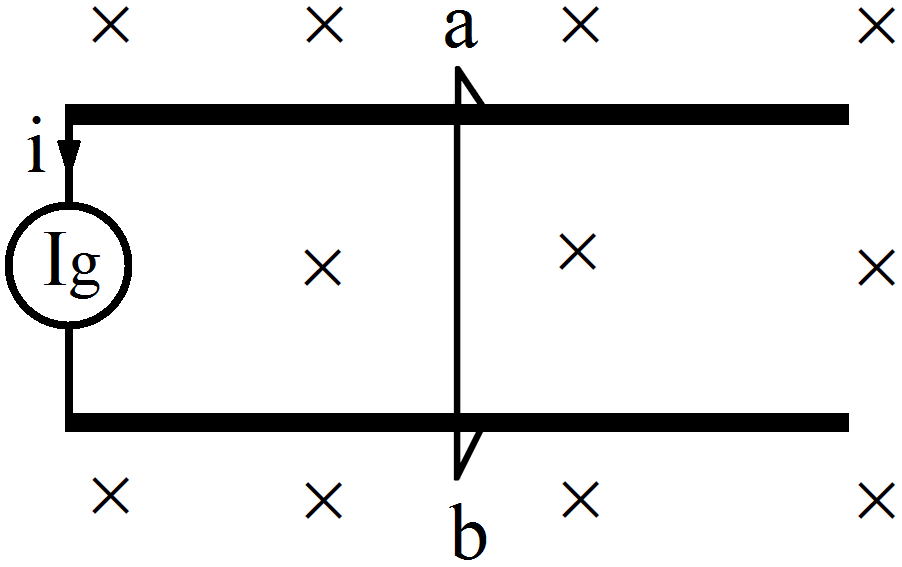
The current generator $I_g$ shown in figure, sends a constant current i through the circuit. The wire ab has a length l and mass m and can slide on the smooth, horizontal rails connected to $I_g.$  The entire system lies in a vertical magnetic field B. Find the velocity of the wire as a function of time.
Draw and explain the phasor diagram and the graph of $v$ and $i$ versus $\omega$t, for an AC circuit having pure inductor.
Given a uniform electric field$\overrightarrow{\text{E}}: 4 \times 10^3  \hat{i}$ N/C, find the flux of this field through a square of 5cm on a side whose plane is parallel to the y-z plane. What would be the flux through the same square if the plane makes a $30^{\circ}$ angle with the x-axis?
Write down the difference between a half wave rectifier and a full wave rectifier.
A voltmeter consists of a $25\Omega$ coil connected in series with a $575\Omega$ resistor. The coil takes 10mA for full scale deflection. What maximum potential difference can be measured by this voltmeter?
i. Define the terms: impact parameter and distance of closest approach for an -particle in the GeigerMarsden scattering experiment.
ii. What will be the value of the impact parameter for scattering angle (I) $\theta=0^{\circ}$ and (II) $\theta=180^{\circ}$ ?