Bihar BoardEnglish MediumSTD 12 SciencePhysicsELECTROSTATIC POTENTIAL AND CAPACITANCE3 Marks
Question
Explain the series connection of capacitors.
✓
Answer
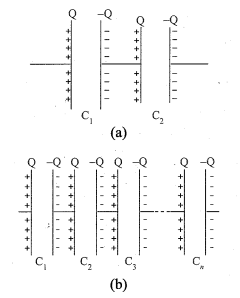
→As shown in fig. (a), two capacitors $C _1$ and $C _2$ are connected in series. →The left plate of $C _1$ and the right plate of $C _2$ are connected to two terminals of a battery, and have charges $Q$ and $-Q$ on them, respectively. →Consequently the right plate of $C _1$ has charge $-Q$ and left plate of $C_2$ has charge $Q$ induced on it. →Like this, even though the capacitors may have different capacitance, the charge on them (the charge on each capacitor plate) is same. →Suppose, the potential difference between two terminals of $C_1$ and $C_2$ is $V_1$ and $V_2$ respectively.
→The total potential drop V across the combination will be : $\begin{aligned} V & = V _1+ V _2 \\ \text { but } C _1 & =\frac{ Q }{ V _1} \\ \therefore V _1 & =\frac{ Q }{ C _1} \end{aligned}$
Similarly we get $V_2=\frac{Q}{C_2}$ $\begin{array}{l} \therefore \text { From eq }{ }^{ n } \text { (1) } \\ V =\frac{ Q }{ C _1}+\frac{ Q }{ C _2} \\ \therefore \quad \frac{ V }{ Q }=\frac{1}{ C _1}+\frac{1}{ C _2} \\ \end{array}$
→Suppose, the equivalent capacitance for the given combination of capacitors is C , then, $\begin{array}{l} \therefore C =\frac{ Q }{ V } \\ \therefore \quad \frac{1}{ C }=\frac{ V }{ Q } \end{array}\$ $\therefore$ From equation (2) and (3) $\therefore \frac{1}{ C }=\frac{1}{ C _1}+\frac{1}{ C _2}$
→As shown in fig. (b), n capacitors are connected in series. →Their capacitance are $C _1, C _2, C _3$ $C _n$ respectively. Electric charge on each of those, is Q . →Suppose the p.d. across these capacitors, are $V _1$, $V _2, V_3 \ldots . V _n$
→The total p.d. of the series combination will be : $\begin{aligned} V & = V _1+ V _2+ V _3+\ldots .+ V _n \\ \therefore V & =\frac{ Q }{ C _1}+\frac{ Q }{ C _2}+\frac{ Q }{ C _3}+\ldots .+\frac{ Q }{ C _n} \\ \therefore \frac{ V }{ Q } & =\frac{1}{ C _1}+\frac{1}{ C _2}+\frac{1}{ C _3}+\ldots .+\frac{1}{ C _n} \end{aligned}$
→Suppose, the equivalent (/ effective) capacitance for the given series combination of capacitors is C . $\begin{array}{l} \therefore C =\frac{ Q }{ V } \\ \therefore \frac{1}{ C }=\frac{ V }{ Q } \end{array}$
→From equations (4) and (5), $\therefore \frac{1}{ C }=\frac{1}{ C _1}+\frac{1}{ C _2}+\frac{1}{ C _3}+\ldots .+\frac{1}{ C _n}$
→Suppose, the capacitance of each capacitor is same. Then we get the equivalent capacitance. $C _{\text {eq }}=\frac{ C }{n}$
Need a full question paper?
Generate a complete, print-ready paper with questions like this in minutes — across 16+ boards, with answer keys.