Question
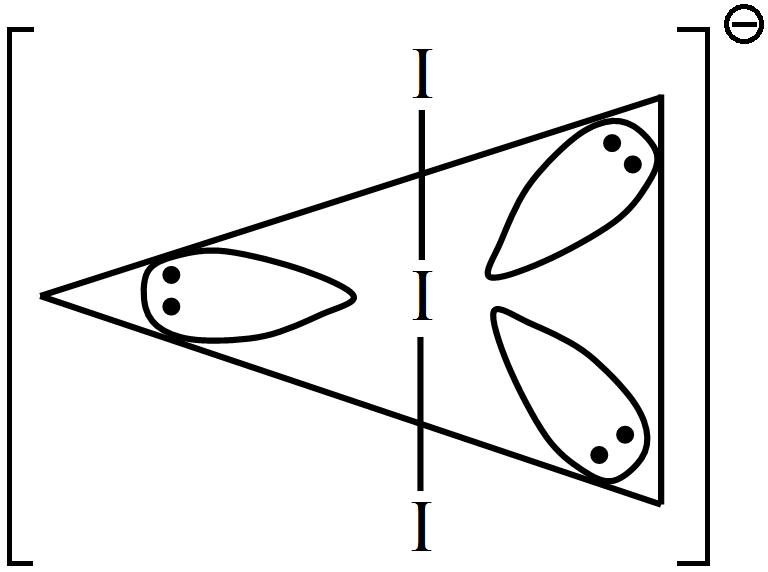
  1. Explain the shape of $\text{I}^-_3$ ion.
  2. Why is $\mathrm{KO}_2$ paramagnetic?

Answer

  1. ‘l' atom has 7 valence electrons. It forms one covalence bond with another iodine atom and coordinate bond with lion in which empty orbital accepts a lone pair. The central atom has 2 bonded pair and 3 lone pair it is linear.
  1. $\mathrm{KO}_2$ is paramagnetic because $\text{O}^-_2$ has one unpaired electron.
$\text{O}^-_2(17)=\sigma\text{l}^2\ \sigma*\text{ls}^2\ \sigma2\text{s}^2\ \sigma*\text{2s}^2\ \sigma\text{2p}_\text{z}^2\ \pi2\text{p}_\text{x}^2\ \pi2\text{p}_\text{y}^2\ \pi*2\text{p}_\text{x}^2\ \pi*\text{2p}_\text{s}^1$

Need a full question paper?

Generate a complete, print-ready paper with questions like this in minutes — across 16+ boards, with answer keys.

Start Generating Free

Similar questions

Write two equations to show the amphiprotic (acid as well as base) property of water.
Standard molar enthalpy of formation, $\Delta_\text{f}\text{H}^\ominus$ is just a special case of enthalpy of reaction, $\Delta_\text{r}\text{H}^\ominus$. Is the $\Delta_\text{r}\text{H}^\ominus$ for the following reaction same as $\Delta_\text{f}\text{H}^\ominus$? Give reason for your answer.$\text{CaO}(\text{s})+\text{CO}_2(\text{g})\rightarrow\text{CaCO}_3(\text{s});$ $\Delta_\text{f}\text{H}^\ominus=-178.3\text{kJ}\ \text{mol}^{-1}$
The value of $\Delta_\text{f}\text{H}^\ominus$ for $NH_3$ is $-91.8kJ mol^{-1}$. Calculate enthalpy change for the following reaction:$2\text{NH}_3(\text{g})\rightarrow\text{N}_2(\text{g})+3\text{H}_2(\text{g})$
$\text{H}_2\text{O}_2$ is a better oxidizing agent than water. Explain.
Arrange the elements N, P, O and S in the order of:
  1. Increasing first ionisation enthalpy.
  2. Increasing non metallic character. Give reason for the arrangement assigned.
Describe the general trends in the following properties of the elements in Groups 13 and 14.
Ionisation enthalpy.
  1. Which pair of element show similar properties with following atomic number?
$[13, 31], [11, 21]$
  1. Which of the following elements has most positive electron gain enthalpy?
$F, N and Ne$​​​​​​​
  1. Lithium shows diagonal relationship with which element and why?
  1. How can you say that sugar is solid and water is liquid?
  2. Oxygen is prepared by catalytic decomposition of potassium chlorate ($KClO_3$​​​​​​​). Decomposition of potassium chlorate gives potassium chloride (KCl) and oxygen ($O_2​​​​​​​$​​​​​​​)· If 2.4mol of oxygen is needed for an experiment, how many grams of potassium chlorate must be decomposed?
(At. mass of K = 39, Cl = 35.5, O = 16)
A vessel contains 1.6g of dioxygen at STP ($273.15K, 1$ atm pressure). The gas is now transferred to another vessel at constant temperature, where pressure becomes half of the original pressure. Calculate
  1. Volume of the new vessel.
  2. Number of molecules of dioxygen.
What is the relationship between the members of following pairs of structures? Are they structural or geometrical isomers or resonance contributors?
What mass of hydrogen peroxide will be present in 2 litres of 5M solution?Calculate the mass of oxygen which will be liberated by 1ml this solution at STP?