Explain the significance of peristalsis.
Download our app for free and get started
Peristaltic movement is the type of movement in which there is the constriction and relaxation of muscles of the esophagus, intestine, and stomach. It is a wave-like structure, which starts in the esophagus when the bolus of food is swallowed.
The contraction and relaxation of the muscles during the peristaltic movement help in bringing down the food with the food pipe into the stomach. It is an important and automatic process which help in movement of food.
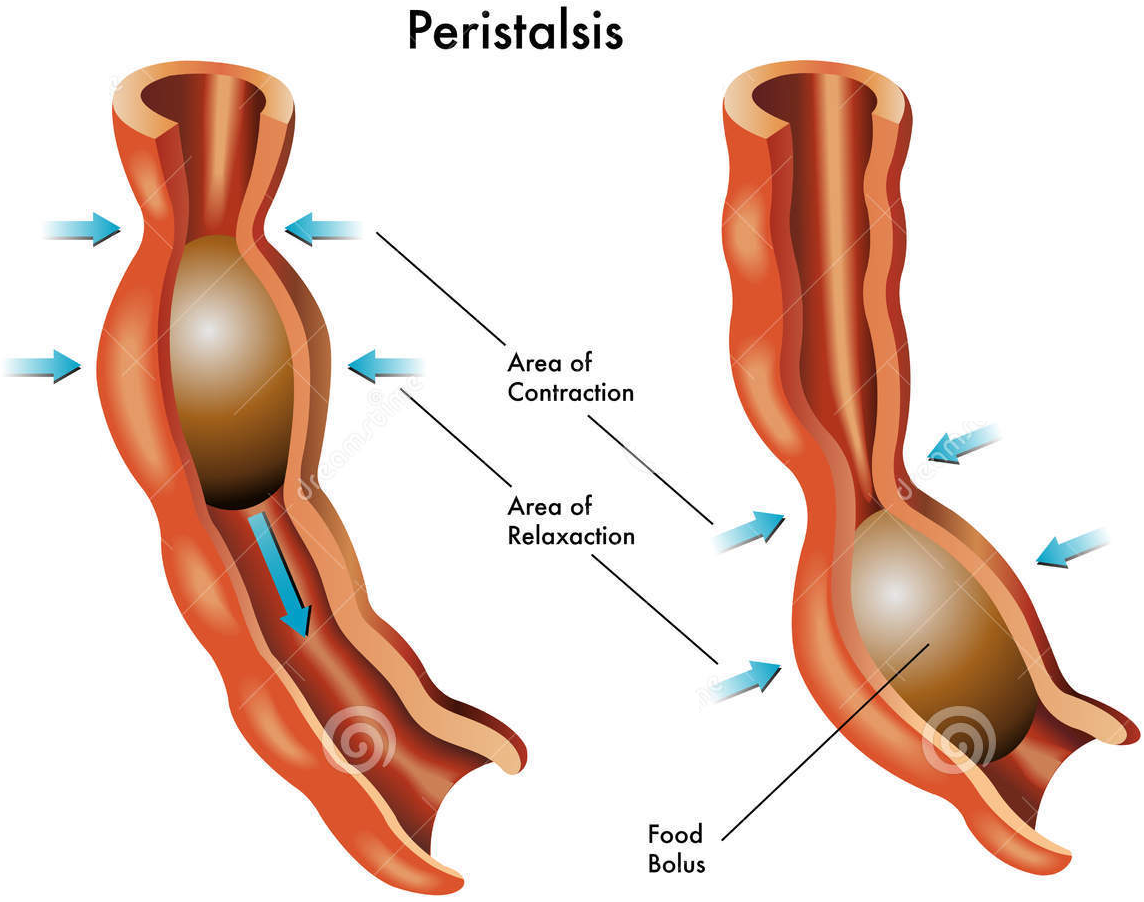
The contraction and relaxation of the muscles during the peristaltic movement help in bringing down the food with the food pipe into the stomach. It is an important and automatic process which help in movement of food.

Download our appand get started for free
Experience the future of education. Simply download our apps or reach out to us for more information. Let's shape the future of learning together!No signup needed.*
Similar Questions
- 1View SolutionDifferentiate between an autotroph and a heterotroph.
- 2View SolutionWhat are the different modes of nutrition? Explain with one example of each mode of nutrition.
- 3View SolutionSecond stage of urine formation is called selective re-absorption. Why?
- 4View SolutionWhen a person puts food in his mouth, then teeth cut it into small pieces, chew and grind it. The glands A in the mouth secrete a substance B which is mixed with the food by tongue. The substance B contains an enzyme C which starts the digestion of food in the mouth. The slightly digested food from the mouth goes down a tube D. The special type of movements E in the walls of tube D push the food into stomach for further digestion. The stomach wall secretes gastric juice containing three substance F, G and H. One of the functions of F is to kill bacteria which may enter the stomach with food. The substance G protects the inside layer of stomach from the damaging effect of substance F whereas substance H is and enzyme for digestion. The partially digested food then enters into small intestine for further digestion.
- What is Gland A, Substance B and Enzyme C?
- Name the tube D.
- What is the movement E known as?
- What are F, G and H?
- 5View Solution
- A gas is released during photosynthesis. Name the gas and also state the way by which the gas is evolved.
- What are stomata? What governs the opening and closing of stomata?
- 6View SolutionHow does food prepared by leaves is utilized by roots? Explain.
- 7View SolutionDescribe the structure and functioning of nephrons.
- 8View Solution
- Draw a diagram depicting Human Alimentary Canal and label on it, Gall Bladder, Liver and Pancreas.
- State the roles of Liver and Pancreas.
- Name the organ which performs the following functions in humans:
- Absorption of digested food.
- Absorption of water.
- 9View SolutionThere are five animals P, Q, R, S and T. The animal P always lives in water and has gills for breathing. The animal Q can stay in water as well as on land and can breathe both, through moist skin and lungs. The animal R lives in soil and breathes only through its skin. The animal S lives on land and breathes through spiracles and tracheae. And animal T lives in water and breathes through its cell membrane.
- Which of the animals could be Amoeba?
- Which of the animals could be frog?
- Which animal could be fish?
- Which animal could be grasshopper?
- Which animal could be earthworm?
- 10View SolutionWhat is the main difference between aerobic respiration and anaerobic respiration? Give one example of each.