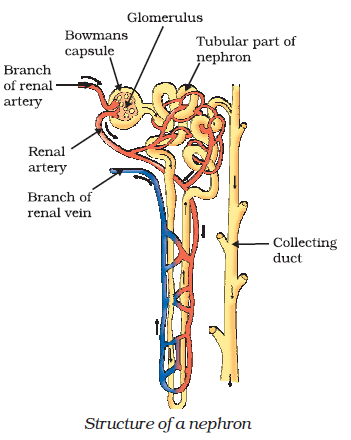
Describe the structure and functioning of nephrons.
Download our app for free and get startedPlay store
Each nephron is a cluster of very thin-walled blood capillaries. Each capillary cluster in the kidney called glomerulus is associated with the cup shaped Bowman's capsule that collects the filtered urine. Nephron filters the blood in order to remove nitrogenous waste. They also absorb some useful substance such as glucose, amino acids, minerals and major amount of water from filtrate.
art

Download our app
and get started for free

Experience the future of education. Simply download our apps or reach out to us for more information. Let's shape the future of learning together!No signup needed.*

Similar Questions

  • 1
    Water and dissolved minerals get into the root hair of a plant by a process called A and enter the conducting tissue B. The process C helps the water and dissolved minerals to move up through the tissue B in roots and stem, and reach the leaves of a plant. In the leaves food is made by a process D. This food is then transported to all the parts of a plant through tissue E. The process of distributing food made in the leaves to all the parts of the plants is called F.
    1. What are (i) A, (ii) B, (iii) C, (iv) D, (v) E, and (vi) F?
    2. Which tissue is made up of living cells: B or E?
    3. Which tissue, B or E, contains sieve tubes?
    4. Which tissue, B or E, contains tracheids?
    View Solution
  • 2
    1. Why is there a difference in the rate of breathing between aquatic organisms and terrestrial organisms? Explain.
    2. Draw a diagram of human respiratory system and label-pharynx, trachea, lungs, diaphragm and alveolar sac on it.
    View Solution
  • 3
    The process of ultra-filtration is essential in urine formation, where does this step occur in nephron?
    View Solution
  • 4
    Describe the exchange of gases which takes place in the leaves of a plant:
    1. During daytime.
    2. At night.
    View Solution
  • 5
    If the teeth are not cleaned regularly, they become covered with a sticky yellowish layer W of food particles and bacteria. Since layer W covers the teeth, the alkaline liquid X secreted by glands Y inside the mouth cannot reach the teeth surface to neutralise the acid formed by the action of organisms Z on sugary food, and hence tooth decay sets in.
    1. What is W known as?
    2. What is (i) X, and (ii) Y?
    3. What are organisms Z?
    4. State one way of removing layer W from the teeth.
    View Solution
  • 6
    How are fats digested in our bodies? Where does this process take place?
    View Solution
  • 7
    Distinguish between photosynthesis and respiration.
    View Solution
  • 8
    Second stage of urine formation is called selective re-absorption. Why?
    View Solution
  • 9
    1. Draw a diagram of human alimentary canal and label - gall bladder, pancreas, liver and small intestine on it.
    2. Give two reasons to explain why absorption of digested food occurs mainly in the small intestine.
    View Solution
  • 10
    An organism X having breathing organs A lives on land. When organism X goes under water, it cannot survive for a long time unless carrying an oxygen cylinder. On the other hand, the organism Y having breathing organs B always lives in water and if taken out of water, it dies after a short while. A third organism Z having breathing organs C and D which lives on the banks of ponds, lakes and rivers can survive on land as well as in water equally well.
    1. What could organism X be? Name the breathing organs A.
    2. What could organism Y be? Name the breathing organs B.
    3. What could organism Z be? Name the breathing organs C and D.
    4. Out of X, Y and Z, which organism is.
    1. Amphibian,
    2. Aquatic,
    3. Terrestrial?
    View Solution