Maharashtra BoardEnglish MediumSTD 12 ScienceBIOLOGYBiotechnology5 Marks
Question
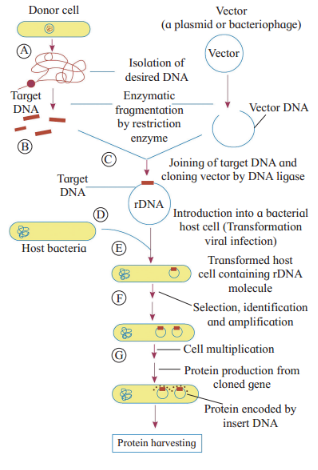
Explain the steps in process of r-DNA technology with suitable diagrams.
✓
Answer
The steps involved in gene cloning are as follows:
(1) Isolation of DNA (gene) from the donor organism:
To obtain the desired gene to be cloned, the cells of the donor organism are sheared with the blender and treated with suitable detergent. Genetic material is then isolated and purified.
Isolated purified DNA is then cleaved using restriction Endonucleases.
Restriction fragment containing desired gene is isolated and selected for cloning. This is now called foreign DNA or passanger DNA.
A desired gene can also be obtained directly from genomic library or c-DNA library.
(2) Insertion of desired foreign gene into a cloning vector (vehicle DNA):
The foreign DNA or passanger DNA is inserted into a cloning vector (vehicle DNA) like bacterial plasmids and the bacteriophages like lamda phage and M13. The most commonly used plasmid is pBR $322$.
Plasmids are isolated from the bacteria and are cleaved by using same RE which is used in the isolation of the desired gene from the donor.
Enzyme DNA ligase is used to join foreign DNA and the plasmid DNA.
Plasmid DNA containing foreign DNA is called recombinant DNA (r-DNA) or chimeric DNA.
(3) Transfer of r-DNA into suitable competent host or cloning organism:
The r-DNA is introduced into a competent host cell, which is mostly a bacterium.
Host cell takes up naked r-DNA by process of ‘transformation’ and incorporates it into its own chromosomal DNA which finally expresses the trait controlled by passenger DNA.
The transfer of r-DNA into a bacterial cell is assisted by divalent $Ca^{++}$.
The cloning organisms are E.coli and Agrobacterium tumifaciens.
The competent host cells which have taken up r-DNA are called transformed cells.
By using techniques like electroporation, microinjection, lipofection, shot gun, ultrasonification, biolistic method, etc. Foreign DNA can also be transferred directly into the naked cell or protoplast of the competent host cell, without using vector.
In plant biotechnology the transformation is through Ti plasmids of A. tumifaciens.
(4) Selection of the transformed host cell:
For isolation of recombinant cell from non-recombinant cell, marker gene of plasmid vector is employed.
For example, pBR $322$ plasmid vector contains different marker genes like ampicillin resistant gene and tetracycline resistant gene. When pstl RE is used, it knocks out ampicillin resistant gene from the plasmid, so that the recombinant cells become sensitive to ampicillin.
(5) Multiplication of transformed host cell:
The transformed host cells are introduced into fresh culture media where they divide.
The recombinant DNA carried by them also multiplies.
(6) Expression of gene to obtain desired product. Then desired products like enzymes, antibiotiocs etc. separated and purified through down stream processing using bioreactors.
Need a full question paper?
Generate a complete, print-ready paper with questions like this in minutes — across 16+ boards, with answer keys.