Question
Explain the structure of benzene with respect to molecular orbital theory.

Answer

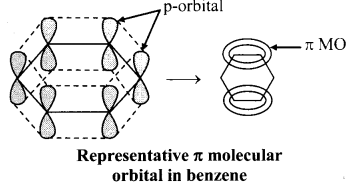
i. According to molecular orbital (MO) theory, the six p orbitals of six carbons give rise to six molecular orbitals of benzene.
ii. Shape of the most stable MO is as show in the figure below. Three of these π molecular orbitals lie above and the other below those of free carbon atom energies.Image
iii. The six electrons of the p orbitals cover all the six carbon atoms and are said to be delocalized. Delocalization of π electrons results in stability of benzene molecule.

Need a full question paper?

Generate a complete, print-ready paper with questions like this in minutes — across 16+ boards, with answer keys.

Start Generating Free

Similar questions

Write a short note on
a. Vapour pressure.
b. Surface tension
c. Viscosity.
Give reason: Balanced chemical equation is useful in solving problems based on chemical equations.
Identify the type of orbital overlap present in
a. $H _2$
b. $F_2$
c. H-F molecule.
Explain diagramatically.
Atomic mass of ${ }_{16}^{32} S$ is $31.97\ u$. If masses of neutron and $H$ atom are $1.0087 u$ and $1.0078\ u$ respectively. What is the mass defect?
Explain Friedel-Craft’s acylation reaction of benzene. Give example reactions.
Due to contamination by viruses, the hospital authorities had asked Ranjan, the ward boy, to keep cleaning the hospital lobby using some antiseptic. Ranjan would wipe the floor by adding Dettol to water and would always keep the premises clean. One of the active ingredients in Dettol is chloroxylenol $(4-$chloro$-3,5-$dimethylphenol$)$. Ranjan was also actively associated with an NGO, which was involved in Swachh Bharat campaign. Based on this passage, answer the following questions.
$i.$ Which functional groups are present in chloroxylenol?
$ii.$ Write the bond line and molecular formula of chloroxylenol.
$iii.$ Identify one group each in chloroxylenol which show $+I$ and $-I$ effect, respectively.
Classify the following as element and compound.
i. Mercuric oxide
ii. Helium gas
iii. Water
iv. Table salt
v. Iodine
vi. Mercury
vii. Oxygen
viii. Nitrogen
Describe hydrogenation reaction of vegetable oils.
State True or False. Correct the false statement.
i. According to MO theory, the formation of molecular orbitals from atomic orbitals is expressed in terms of Linear Combination of Atomic Orbitals (LCAO).
ii. An MO contains maximum two electrons with opposite spins.
iii. Interference of electron waves of combining atoms can only be constructive.
iv. In bonding molecular orbital, the large electron density is observed between the nuclei of the bonding atoms than the individual atomic orbitals.
v. In the antibonding molecular orbital, the electron density is nearly zero between the nuclei.
Describe the various methods used for preparation of calcium carbonate.