Question
Explain the structure of starch and cellulose.

Answer

self

Need a full question paper?

Generate a complete, print-ready paper with questions like this in minutes — across 16+ boards, with answer keys.

Start Generating Free

Similar questions

Specify the oxidation numbers of the metals in the following coordination entities:
i. $\left[ Co \left( H _2 O \right)( CN )( en )_2\right]^{2+}$
ii. $\left[ Pt ( Cl )_4\right]^{2-}$
iii. $K _3\left[ Fe ( CN )_6\right]$
iv. $\left[ Cr \left( NH _3\right)_3 Cl _3\right]$
Match the items of Column I with items of Column II and assign the correct code:
 
Column I
 
Column II
(A)
Cyanide process
(1)
Ultrapure Ge
(B)
Froth Floatation process
(2)
Dressing of ZnS
(C)
Electolytic reduction
(3)
Extraction of Al
(D)
Zone refinning
(4)
Extraction of Au
 
 
(5)
Purification of Ni
  1. A (4) B (2) C (3) D (1)
  2. A (2) B (3) C (1) D (5)
  3. A (1) B (2) C (3) D (4)
  4. A (3) B (4) C (5) D (1)
$i.$ Tert$-$Butylamine cannot be prepared by the action of $NH_3$ on tert$-$butyl bromic. Explain why?
$ii.$ Suggest a convenient method for the preparation of tert$-$butylamine.
Attempt any five of the following:
(a) Which sugar is present in milk?
(b) Why must vitamin C be supplied regularly in diet?
(c) What type of substance is phenylanine hydroxylate? Write its importance.
(d) Define denaturation of protein. What is the effect of denaturation on the structure of protein?
(e) Name the linkage connecting monosaccharide units in polysaccharides.
(f) How do you explain the presence of all six carbon atoms in glucose in a straight chain?
(g) Write the reactions showing the presence of following in the open structure of glucose:
i. a carbonyl group
ii. chain with six carbon atoms
  1. Describe the general trends in the following properties of the first series of the transition elements:
  1. Stability of +2 oxidation state.
  2. Formation of oxometal ions.
  1. Assign reason for each of the following:
  1. Transition elements exhibit variable oxidation states.
  2. Transition metal ions are usually coloured.
Why is the mass determined by measuring a colligative property in case of some solutes abnormal? Discuss it with the help of Van’t Hoff factor.

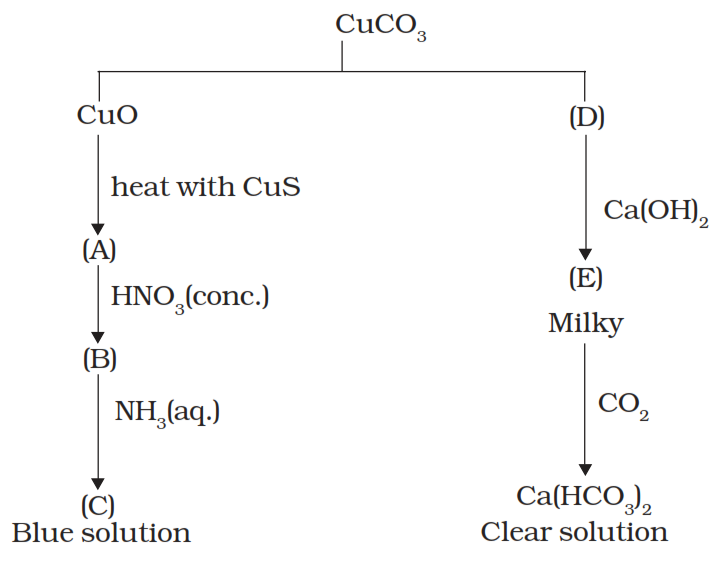
Identify $A$ to $E$ and also explain the reactions involved.
  1. Account for the following:
  1. Bond angle in $NH_4^+$is greater than that in $NH_3$.
  2. Reducing character decreases from $SO_2​​​​​​​$​​​​​​​ to $TeO_2$​​​​​​​.
  3. $HClO_4​​​​​​​$​​​​​​​ is a stronger acid than $HClO$.
  1. Draw the structures of the following :
  1. $H_2S_2O_8$
  2. $XeOF_4$
  1. Explain the following:
  1. $NF_3$ is an exothermic compound whereas $NCl_3$ is not.
  2. $F_2$ is most reactive of all the four common halogens.
  1. Complete the following chemical equations:
  1. $C + H_2SO_4 (conc.)\rightarrow $
  2. $P_4 + NaOH + H_2O\rightarrow $
  3. $Cl_2 + F_2 \rightarrow $
(excess)
Discus in detail the following $C - H$ bond cleavage reactions of ether :
(i) Peroxide formation
(ii) Halogenation