Skeleton and Movement — Biology STD 11 Science — Question
Maharashtra BoardEnglish MediumSTD 11 ScienceBiologySkeleton and Movement4 Marks
Question
Explain the structure of typical vertebra.
✓
Answer
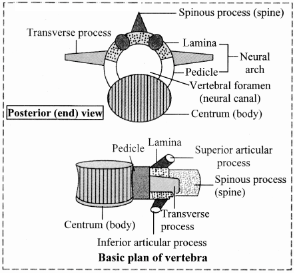
Each vertebra has prominent central body called centrum.
The centra of human vertebrae are flat in anterio-posterior aspect. Thus, human vertebrae are amphiplatyan.
From the either side of the centrum are two thick short processes which unite to form an arch like structure called neural arch, posterior to centrum.
Neural arch forms vertebral foramen which surrounds the spinal cord.
Vertebral foramina of all vertebrae form a continuous ‘neural canal’. Spinal cord along with blood vessels and protective fatty covering passes through neural canal.
The point where two processes of centrum meet, the neural arch is drawn into a spinous process called neural spine.
From the base of neural arch, two articulating processes called zygapophyses are given out on either side. The anterior is called superior zygapophyses and posterior called inferior zygapophyses.
In a stack of vertebrae, inferior zygapophyses of one vertebra articulates with superior zygapophyses of next vertebra. This allows slight movement of vertebrae without allowing them to fall.
At the junction of zygapophyses, a small opening is formed on either side of vertebra called intervertebral foramen that allows passage of spinal nerve.
From the base of neural arch, lateral processes are given out called transverse processes. Neural arch, neural spine and transverse processes are meant for attachment of muscles.
Need a full question paper?
Generate a complete, print-ready paper with questions like this in minutes — across 16+ boards, with answer keys.