Question
Explain the techniques of managerial control.

Answer

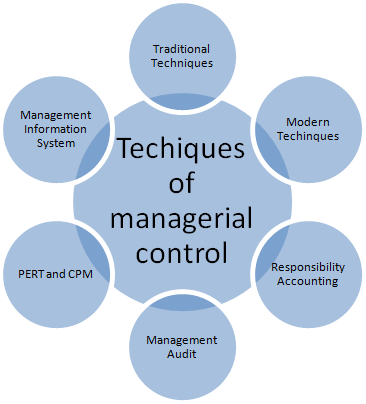
The various techniques of managerial control may be classified into broad categories:
  1. Traditional Techniques: Those techniques which have been used by the companies for a long time now are traditional techniques. However., these have not become obsolete and are still being used by companies.
  1. Personal Observation: Personal observation enables the manager to collect first hand information. It also creates a psychological pressure on the employees to perform well as they are aware that they are being observed personally in their job.
  2. Statistical Reports: Statistical analysis in the form of averages, percentages, ratios, correlation etc. Present useful information to the managers regarding performance of the organisation in various areas. Such information when presented in the form of charts, graphs, tables etc. enables the managers to read them more easily and allow a comparison to be made with performance in previous periods and also with the benchmarks.
  3. Break-even Analysis: It is a technique used by managers to study the relationship between costs, volume and profits. It determines the probable profits and losses at different levels of activity. The sales volume at which there is no profit. no loss is known as break-even point. It is a useful technique for the managers as it helps in estimating profits at different levels of activities.
  4. Budgetary Control: It is a technique of managerial control in which all operations are planned in advance in the form of budgets and actual results are compared with budgetary standards. This comparison reveals the necessary actions to be taken so that organisational goals are accomplished. A budget is a quantitative statement for a definite future period of time for the purpose of obtaining a given objective. It is also a statement which reflects the policy of that particular period. It will contain figures of forecasts both in terms of time and quantities.
  1. Modern Techniques Modern techniques of controlling are those which are of recent origin and are comparatively new in management literature. They provide a new thinking on the ways In which various aspects of an organisation can be controlled.
  1. Return on Investment: Return on Investment (ROI) is a useful technique which provides the basic yardstick for measuring whether or not invested capital has been used effectively for generating reasonable amount of return. It can be calculated as under
$\text{ROI}=\frac{\text{Net income}}{\text{Sales}}\times\frac{\text{Sales}}{\text{Total investment}}$
ROI provides top management an effective means of control for measuring and comparing performance of different departments. It also permits departmental managers to find out the problem which affects ROI in an adverse manner.
  1. Ratio Analysis: It refers to analysis of financial statements through computation of ratios. The most commonly used ratios are:
  • Liquidity Ratio: Which are calculated to determine short term solvency of business.
  • Solvency Ratios: Which are calculated to determine the long term solvency of business are known as Solvency ratios.
  • Profitability Ratio: Which are calculated to analyse the profitability position of a business.
  • Turnover Ratio: They are calculated to determine the efficiency of operations based on effective utilisation of resources.
  1. Responsibility Accounting: Responsibility accounting is a system of accounting in which different sections, divisions and departments of an organisation are set up as ‘responsibility centres’. The head of the centre is responsible for achieving the target set for his centre. Responsibility centres may be of the following types.
  1. Cost Centre: A cost or expense centre Is a segment of an organisation n which managers are held responsible for the cost Incurred in the centre but not for the revenues e.g., production department.
  2. Revenue Centre: A revenue centre is held responsible for generating revenue e.g.. marketing department.
  3. Profit Centre: A profit centre is responsible for both cost and revenue e.g., repair and maintenance department.
  4. Investment Centre: An investment centre is responsible not only for profits but also for investments made in the centre In the form of assets.
​​​​​​​
  1. Management Audit: Management audit refers to systematic appraisal of the overall performance of the management of an organisation. The purpose is to review the efficiency and effectiveness of management and to Improve its performance in future periods. It is helpful in identifying the deficiencies in the performance of management functions The main advantages are:
  1. Helps to locate weaknesses.
  2. It helps to improve control system.
  3. Ensures updating of existing managerial policies and strategies in the light of environmental changes.
  1. PERT and CPM: Programme evaluation and review technique and critical path method are important network techniques useful in planning and controlling These techniques are especially useful in planning, scheduling and Implementing time bound projects Involving performance of a variety of complex, diverse and inter-related activities These techniques deal with time scheduling and resource allocation for these activities and aims at effective execution of projects within given time schedule and structure of costs.
  2. Management Information System: MIS is a computer based Information system that provides information and support for effective managerial decision making A decision maker requires up-to-date accurate and timely information. MIS provides the required information to the managers by systematically processing a massive data generated In an organisation Thus, MIS is an important communication tool for managers.

Need a full question paper?

Generate a complete, print-ready paper with questions like this in minutes — across 16+ boards, with answer keys.

Start Generating Free

Similar questions

Explain the role of financial management.
Explain the factors that determine the choice of channels of distribution.
Explain the term 'Trading on Equity'. Why, when and how it can be used by a business organisation?
Explain the following functions of marketing:
  1. Product designing and development.
  2. Standardization and Grading.
  3. Customer Support Services.
  4. Pricing of products.
Coordination is the essence of management. Do you agree? Give reasons.
The organic food market in India is growing at 25-30 per cent which reflects a clear shift in consumer tastes and preferences. The current growth in the organic food market is driven by multiplicity of factors like rising health consciousness, changing lifestyles, increase in disposable income and growing availability of organic food products in shopping malls, retail outlets and online. Identify and explain the features of business environment being referred to here.
Explain the relationship between planning and controlling.
Explain the following principles in management:
  1. Discipline.
  2. Harmony, not discord.
Define Marketing. Explain its features.
On Your Marks is a good shoe manufacturing company. The company is the first to start a shoe having a unique technology giving it a long life. However the company knows that it exists in an environment where everything around it counts; so everything around it matters. Therefore, it is trying to observe every small aspect of the business environment. There are various factors which are closely related to each other and can't be understood in isolation like change in lifestyle which can be linked to the improved demand of technologically advanced shoes. However, the company can't be self satisfied. It will have to adjust to rapidly changing technology, fragmentation of market, changing brand loyalties, etc. It has got good man power and a very well established production department. It knows that various resources in the form of inputs have to be transformed into the best products and sold for increasing its revenue. However, there are various challenges which the company is facing. These are in the form of protests done by labour unions throughout the country which sometimes assume the form of strikes. The board of directors is keen to adapt to this difficult situation. Government is playing a very positive role, like it did a few years back, and is freeing the business environment from unnecessary restrictions and government controls. The company is hopeful of emerging as a winner under such government support.
i. Which features of business environment are highlighted in the above case?
ii. Identify the importance of business environment highlighted in the above case?
iii. Which dimension of business environment is highlighted above?
iv. Which economic reform is discussed in the last part of the case?