Question
  1. Explain the term impulse. Show that impulse of a variable force is equal to the area enclosed by the force-time curve.
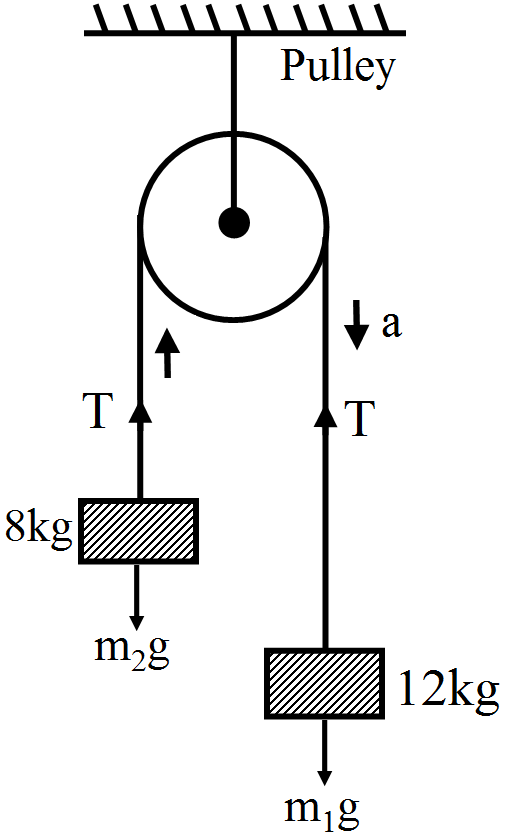
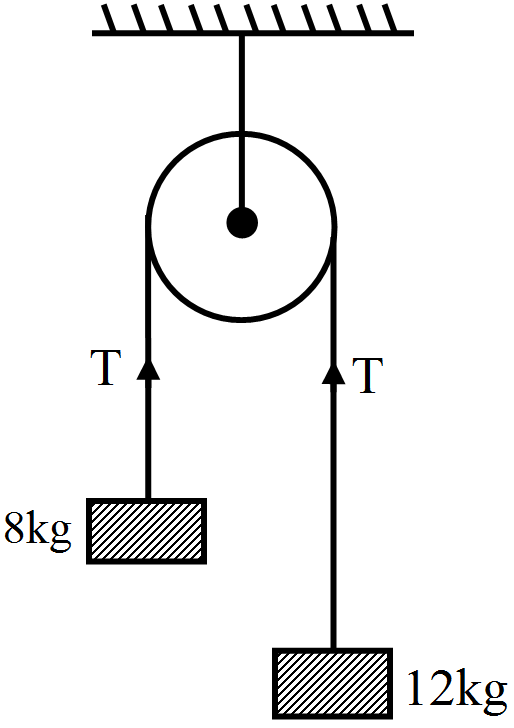
  2. Two masses $8kg$ and $12kg$ are connected at the two ends of a light inextensible string that passes over a frictionless pulley. Find the acceleration of the masses and tension in the string, when the masses are released.
Answer

  1. The product of the force and the time interval on which it acts or change in momentum is called impulse.
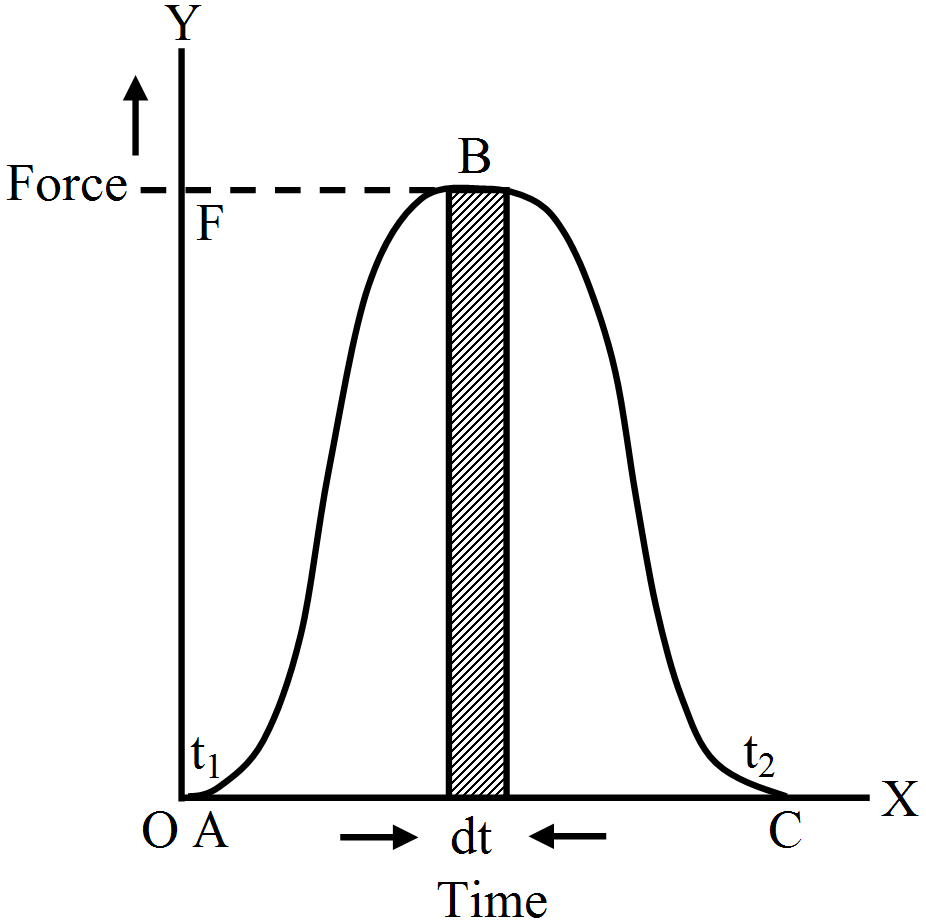
$\vec{\text{I}}-\vec{\text{F}}_\text{av}\times\text{t}=\text{dp}=\text{F.dt}=$ Area of shaded portion
Net impulse $=\int\limits_{\text{t}_1}^{\text{t}_2}\vec{\text{F}}\times\text{dt}=$ area under graph ABC and time axis.
  1. Consider two masses $m_1$ and $m_2$ are connected to the ends of an inextensible string passing over a smooth frictionless pulley.

Let T be the tension in the string which is uniform throughout.
The heavier mass $m_1$ moves downward with an acceleration a.
The resultant downward force while considering the heavier mass m, is given by
$m_1g - T = m_1a ...(i)$
The resultant upward force while considering the lighter mass $m_2$ is given by
$T - m_2g = m_2a ...(ii)$
Adding (i) and (ii), we have
$(m_1 - m_2)g = (m_1 + m_2)a$
$\Rightarrow\ \text{a}=\Big(\frac{\text{m}_1-\text{m}_2}{\text{m}_1+\text{m}_2}\Big)\text{g}\dots(\text{iii})$
Putting the value of a in (i) and simplifying we get
$\text{T}=\frac{2\text{m}_1\text{m}_2}{\text{m}_1+\text{m}_2}\text{g}\dots(\text{iv})$
Substituting the given values, we have
$\Rightarrow\ \text{a}=\Big(\frac{12-8}{12+8}\Big)\times9.8=1.96\text{ms}^{-2}$
$\text{T}=\frac{2\times12\times8\times9.8}{12+8}=\frac{1881.6}{20}$
$=64.08\text{N}$

Need a full question paper?

Generate a complete, print-ready paper with questions like this in minutes — across 16+ boards, with answer keys.

Start Generating Free

Similar questions

A trolley of mass $300kg$ carrying a sandbag of $25kg$ is moving uniformly with a speed of $27km/h$ on a frictionless track. After a while, sand starts leaking out of a hole on the floor of the trolley at the rate of $0.05 kgs^{-1}$. What is the speed of the trolley after the entire sand bag is empty?
Find the maximum revolution per minute of a body of 500 gram tied to a 1.5 m long string, if the string can bear a maximum tension of 40 N .
The force of surface tension acts tangentially to the surface whereas the force due to air pressure acts perpendicularly on the surface. How is then the force due to excess pressure inside a bubble balanced by the force due to the surface tension?
A person standing on the top of a cliff $171ft$ high has to throw a packet to his friend standing on the ground $228ft$ horizontally away. If he throws the packet directly aiming at the friend with a speed of $15.0ft/s$, how short will the packet fall?
Experiments show that the frequency (n) of a tuning fork depends upon the length (l) of the prong, the density (d) and the Young's modulus (Y) of its material. From dimensional considerations, find a possible relation for the frequency of a tuning fork.
A long, vertical wire carrying a current of 10A in the upward direction is placed in a region where a horizontal magnetic field of magnitude $2·0 \times 10^{-3}T$ exists from south to north. Find the point where the resultant magnetic field is zero.
State and explain Work-Energy theorem.
A cricket ball of mass $150g$ is moving with a velocity of $12ms^{-1}$, and is hit by a bat, so that the ball is turned back with a velocity of $20ms^{-1}​​​​​​​$. The force of the blow acts for $0.01s$ on the ball. Find the average force exerted by the bat on the ball.
An inclined plane $(\theta)$ has its topmost point at a height 'h'. Prove that the work done to bring a mass to the ground level either vertically or along the inclined surface is equal and is mgh. Also prove that the velocity of the mass at the lowermost point is $\sqrt{2\text{gh}}$.
What is the kinetic energy of an electron in electronvolts with mass equal to double its rest mass?