Question
Find the maximum revolution per minute of a body of 500 gram tied to a 1.5 m long string, if the string can bear a maximum tension of 40 N .

Answer

$\begin{array}{l}
m=\text { mass of body }=500 g=0.5 kg \\
R=\text { radius of circle }=1.5 m \\
F_c=\text { centripetal force }=40 N
\end{array}$
Now,
$\begin{aligned}
F_c & =\text { mass } \times \text { acceleration } \\
F_c & =m a_r \\
& =\frac{m v^2}{R}=\frac{m}{R}(R \omega)^2 \quad \because v=R \omega \\
& =\frac{m R^2 \omega^2}{R}=m R \omega^2 \\
& =m R(2 \pi f)^2=4 \pi^2 m R f^2 \\
f^2 & =\frac{F_c}{4 \pi^2 m R} \\
f & =\sqrt{\frac{F_c}{4 \pi^2 m R}}=\sqrt{\frac{40}{4 \times(3.14)^2 \times 0.5 \times 1.5}} \\
& =\sqrt{1.351}=1.162 revolution / sec \\
& =1.162 \times 60=69.74 rev / min
\end{aligned}$
Hence, the body can revolve at rate of 69 revolution/ minute without breakage of string.

Need a full question paper?

Generate a complete, print-ready paper with questions like this in minutes — across 16+ boards, with answer keys.

Start Generating Free

Similar questions

Find the frequency of note emitted by a string of length $10\sqrt{10}\text{cm},$ under tension of 3.14kg. Radius of string is 0.5mm and density = 9.8g/cc.
A table with smooth horizontal surface is placed in a cabin which moves in a circle of a large radius R (figure In). A smooth pulley of small radius is fastened to the table. Two masses m and 2m placed on the table are connected through a string going over the pulley. Initially the masses are held by a person with the strings along the outward radius and then the system is released from rest (with respect to the cabin). Find the magnitude of the initial acceleration of the masses as seen from the cabin and the tension in the string.
Calculate the velocity of sound in a gas, in which two wavelengths 2.04m and 2.08m produce 20 beats in 6 seconds.
Is the colour of 620nm light and 780nm light same? Is the colour of 620nm light and 621nm light same? How many colours are there in white light?
A body starts from a point $A$ and moves to $B$. If it returns to the same point, find the :
  1. Displacement.
  2. Distance.
  3. Velocity.
  4. Average speed.
$[$Given: $AB = s,$ velocity $= v]$
A constant retarding force of $50N$ is applied to a body of mass $20kg$ moving initially with a speed of $15ms^{-1}$. How long does the body take to stop?
Just as precise measurements are necessary in science, it is equally important to be able to make rough estimates of quantities using rudimentary ideas and common observations. Think of ways by which you can estimate the following (where an estimate is difficult to obtain, try to get an upper bound on the quantity): The number of air molecules in your classroom.
For three moving objects the distances are found to be directly proportional to the times $t, t^2$ and $t^3$. What is the nature of the net force on each object?
A simple microscope has a magnifying power of $3.0$ when the image is formed at the near point $(25\ cm)$ of a normal eye.
  1. What is its focal length?
  2. What will be its magnifying power if the image is formed at infinity?
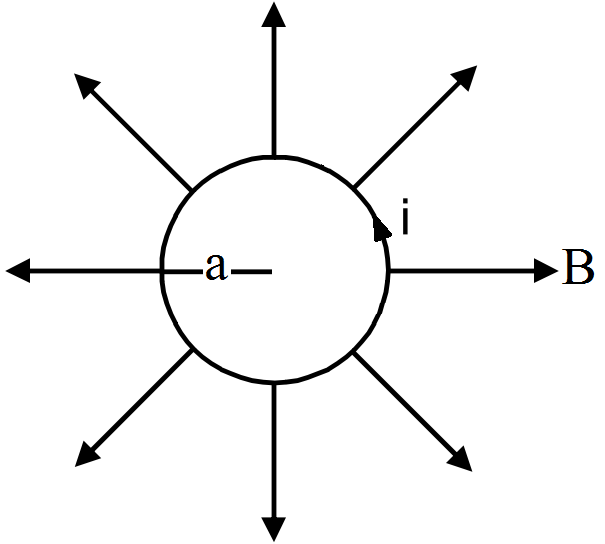
A circular loop of radius a, carrying a current i, is placed in a two-dimensional magnetic field. The centre of the loop coincides with the centre of the field The strength of the magnetic field at the periphery of the loop is B. Find the magnetic force on the wire.