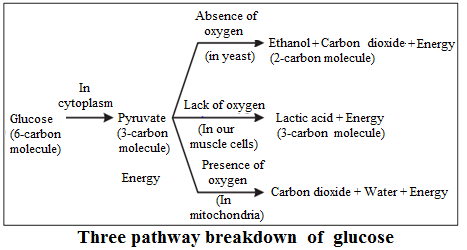
Explain the three pathways of breakdown in living organisms.
Download our app for free and get startedPlay store
Cellular respiration is the process of breakdown of food substances into simpler ones to release the stored energy. On the basis of presence or absence of oxygen, it can occur through aerobic or anaerobic pathway.
i. Aerobic respiration: Glucose in the presence of oxygen (air), breaks down to carbon dioxide and water with release of large amount of energy. It occurs in three steps, glycolysis, citric acid cycle and ETC.

Glycolysis is breakdown of glucose into pyruvate. It is oxygen independent pathway occurs in cytoplasm. Pyruvate is decarboxylated into acetyl coA in cytoplasm only.
Citric acid cycle is the second phase of cellular respiration in which acetyl Co are enzymatically oxidized into carbon dioxide and the released energy is stored in NADH and $FADH _2$.
Electron transport chain includes downhill flow of electrons to final electron acceptor (Oxygen, which is then reduced into water) through a chain of membranebound carriers to facilitate the uphill transport of protons across a proton-impermeable membrane and ATP synthesis.
Enzymes of citric acid cycle are present in mitochondrial matrix while the electron transport chain is present in inner mitochondrial membrane, hence, the last two phases of aerobic respiration takes place in mitochondria only.
ii. Anaerobic respiration: Glycolysis is breakdown of glucose into pyruvate. It is oxygen independent pathway and is common to both aerobic and anaerobic respiration. Fate of pyruvate depends on oxygen availability. Anaerobic respiration can occur via lactic acid fermentation or alcohol fermentation.
- Alcohol fermentation due to limited oxygen availability, pyruvate remains in cytoplasm where pyruvate decarboxylase and alcohol dehydrogenase enzymes carry out the second phase of anaerobic respiration and produce ethanol and carbon dioxide with limited amount of energy being released.
- Lactic acid fermentation due to limited oxygen availability, pyruvate remains in cytoplasm where it is broken down into lactic acid with limited amount of energy being released.
art

Download our app
and get started for free

Experience the future of education. Simply download our apps or reach out to us for more information. Let's shape the future of learning together!No signup needed.*

Similar Questions

  • 1
    1. Draw a diagram of excretory system in human beings and label on it: Aorta, Vena cava, Urinary bladder, Urethra.
    2. List two vital functions of the kidney.
    View Solution
  • 2
    With a schematic diagram, explain the overall process of respiration in animals.
    View Solution
  • 3
    There are five animals P, Q, R, S and T. The animal P always lives in water and has gills for breathing. The animal Q can stay in water as well as on land and can breathe both, through moist skin and lungs. The animal R lives in soil and breathes only through its skin. The animal S lives on land and breathes through spiracles and tracheae. And animal T lives in water and breathes through its cell membrane.
    1. Which of the animals could be Amoeba?
    2. Which of the animals could be frog?
    3. Which animal could be fish?
    4. Which animal could be grasshopper?
    5. Which animal could be earthworm?
    View Solution
  • 4
    Write the events that occur during the process of breathing in humans.
    View Solution
  • 5
    1. Draw a diagram of human alimentary canal and label on it: Oesophagus, Gallbladder, Liver and Pancreas.
    2. Explain the statement, ‘Bile does not contain any enzyme but it is essential for digestion.’
    View Solution
  • 6
    Water and dissolved minerals get into the root hair of a plant by a process called A and enter the conducting tissue B. The process C helps the water and dissolved minerals to move up through the tissue B in roots and stem, and reach the leaves of a plant. In the leaves food is made by a process D. This food is then transported to all the parts of a plant through tissue E. The process of distributing food made in the leaves to all the parts of the plants is called F.
    1. What are (i) A, (ii) B, (iii) C, (iv) D, (v) E, and (vi) F?
    2. Which tissue is made up of living cells: B or E?
    3. Which tissue, B or E, contains sieve tubes?
    4. Which tissue, B or E, contains tracheids?
    View Solution
  • 7
    A, B and C are three living organisms. The organism A is a unicellullar fungus which can live without air. It is used in the commercial production of an organic compound P from molasses. The organism B is a unicellular animal which lives in water and feeds and moves by using pseudopodia. It breathes through an organelle Q. The organism C is a tiny animal which acts as a carrier of malarial parasite. It breathes and respires through a kind of tiny holes R and air - tubes S in its body.
    1. What are organisms A, B and C?
    2. Name P, Q, R and S.
    3. Which organism/ organisms undergo aerobic respiration?
    4. Which organism/ organisms undergo anaerobic respiration?
    View Solution
  • 8
    What substances are contained in pancreatic juice? What are their functions?
    View Solution
  • 9
    Explain the mechanism of photosynthesis.
    View Solution
  • 10
    1. Name the organs that form the excretory system in human beings.
    2. Describe in brief how urine is produced in human body.
    View Solution