Question
Explain the three pathways of breakdown in living organisms.

Answer

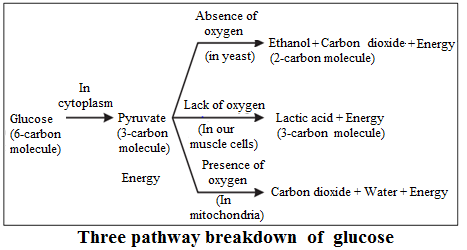
Cellular respiration is the process of breakdown of food substances into simpler ones to release the stored energy. On the basis of presence or absence of oxygen, it can occur through aerobic or anaerobic pathway.
  1. Aerobic respiration: Glucose in the presence of oxygen (air), breaks down to carbon dioxide and water with release of large amount of energy. It occurs in three steps, glycolysis , citric acid cycle and ETC.
Glycolysis is breakdown of glucose into pyruvate. It is oxygen independent pathway occurs in cytoplasm. Pyruvate is decarboxylated into acetyl coA in cytoplasm only.
Citric acid cycle is the second phase of cellular respiration in which acetyl Co are enzymatically oxidized into carbon dioxide and the released energy is stored in NADH and $FADH_2$.
Electron transport chain includes downhill flow of electrons to final electron acceptor (Oxygen, which is then reduced into water) through a chain of membrane-bound carriers to facilitate the uphill transport of protons across a proton-impermeable membrane and ATP synthesis.
Enzymes of citric acid cycle are present in mitochondrial matrix while the electron transport chain is present in inner mitochondrial membrane, hence, the last two phases of aerobic respiration takes place in mitochondria only.
  1. Anaerobic respiration: Glycolysis is breakdown of glucose into pyruvate. It is oxygen independent pathway and is common to both aerobic and anaerobic respiration. Fate of pyruvate depends on oxygen availability. Anaerobic respiration can occur via lactic acid fermentation or alcohol fermentation.
  • Alcohol fermentation due to limited oxygen availability, pyruvate remains in cytoplasm where pyruvate decarboxylase and alcohol dehydrogenase enzymes carry out the second phase of anaerobic respiration and produce ethanol and carbon dioxide with limited amount of energy being released.
  • Lactic acid fermentation due to limited oxygen availability, pyruvate remains in cytoplasm where it is broken down into lactic acid with limited amount of energy being released.

Need a full question paper?

Generate a complete, print-ready paper with questions like this in minutes — across 16+ boards, with answer keys.
Start Generating Free

Similar questions

$(i) '\ A\ '\  '\ B\ '$ are sodium salts of long$-$chain carboxylic acid and long chain Sulphonic acid respectively. Which one of $A$ or $B$ will you prefer as a cleansing agent while using underground water $($hand pump water$)$?
Give the reason for your answer.
$(ii)$ Elaborate on the process of cleansing action. Illustrate micelle with the help of labelled diagram.
$(iii)$ Write the chemical equation of the preparation of soap from an ester
$CH_3COOCH_3$. What is the name of this process?
  1. Name the following:
  1. Metal that can be cut by knife.
  2. Lustrous non-metal.
  3. Metal that exists in liquid state at room temperature.
  4. Most malleable and ductile metal.
  5. Metal that is best conductor of electricity.
  6. Non-metal that can exist in different forms.
  1. How are alloys better than metals? Give composition of solder and amalgam.
P and Q are two types of plants having weak stems which cannot stand upright on their own. The plants P and Q have organs R and S respectively which can grow towards any support which they happen to touch and wind around that support. It is observed that organ R originates from the leaves of the plant whereas organ S originates directly from the stem of the plant.
  1. What is (i) R, and (ii) S?
  2. What is the name of growth movement exhibited by the organs R and S?
  3. Name the stimulus involved in this case.
  4. State whether the behaviour of organs R and S is a tropic movement or a nastic movement.
  5. Name one plant like P and another plant like Q.
A compound $X$ is formed by the reaction of a carboxylic acid $C _2 H _4 O _2$ and an alcohol in presence of a few drops of $H _2 SO _4$. The alcohol on oxidation with alkaline $KMnO _4$ followed by acidification gives the same carboxylic acid as used in this reaction. Give the names and structures of:
a. Carboxylic acid.
b. Alcohol.
c. The compound X. Also, write the reaction.
An object of height $4.0 \ cm$ is placed at a distance of $30 \ cm$ from optical centre $O$ of a concave lens of focal length $20 \ cm.$ Draw a ray diagram to find the position and size of the image formed. Mark optical centre $O$ and principal focus $F$ on the diagram. Also, find the approximate ratio of size of the image to the size of the object.
The solid element A exhibits the property of catenation. It is also present in the form of a gas B in the air which is utilised by plants in photosynthesis. An allotrope C of this element is used in glass cutters.
  1. What is element A?
  2. What is the gas B?
  3. Name the allotrope C.
  4. State another use of allotrope C (other than in glass cutters).
  5. Name another allotrope of element A which exists as spherical molecules.
  6. Name a yet another allotrope of element A which conduct electricity.
Two lamps, one rated 40W at 220V and the other 60W at 220V, are connected in parallel to the electric supply at 220V.
  1. 10 Draw a circuit diagram to show the connections.
  2. Calculate the current drawn from the electric supply.
  3. Calculate the total energy consumed by the two lamps together when they operate for one hour.
List the new Cartesian sign convention for reflection of light by spherical mirrors. Draw a diagram and apply these conventions for calculating the focal length and nature of a spherical mirror which forms $\frac{1}{3}$ times magnified virtual image of an object placed 18cm if front of it.
Write the two causes of human population explosion. Explain with the help of suitable examples how this explosion can be checked.
One half of a convex lens of focal length 10 cm is covered with a black paper. Can such a lens produce an image of a complete object placed at a distance of 30 cm from the lens? Draw a ray diagram to justify your answer.
A 4 cm tall object is placed perpendicular to the principal axis of a convex lens of focal length 20 cm. The distance of the object from the lens is 15 cm. Find the nature, position and size of the image.