Question
Explain the unit of energy $e{V}$ (electron volt) and define 1 eV .

Answer

→$e V$ is a smallest unit of energy. It is commonly used in atomic and nuclear physics.
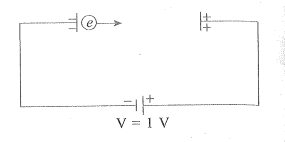
→The energy gained by accelerating an electron with a potential difference of 1 volt is called 1 eV Image
→Energy gained by electron,
$K =q V \quad(\because w=\Delta K = V q)$
$\therefore \quad K =e V \quad(\because q=e=$ charge of electron $)$
$K =1.6 \times 10^{-19} \times 1$
$\therefore \quad K =1.6 \times 10^{-19} J$
$\therefore \quad K =1 eV$
$\therefore 1 eV =1.6 \times 10^{-19} J$

Need a full question paper?

Generate a complete, print-ready paper with questions like this in minutes — across 16+ boards, with answer keys.
Start Generating Free

Similar questions

The magnetic force on a charged particle is always perpendicular to its velocity. Can the magnetic force change the velocity of the particle? Speed of the particle?
Define trans conductance of a transistor.
How does the maximum kinetic energy of electrons emitted vary with the work function of the metal?Maximum kinetic energy Ek = hν – W Clearly, smaller the work function W, greater is the Ek This means that when work function of a metal increases, maximum kinetic energy of photoelectrons decreases.
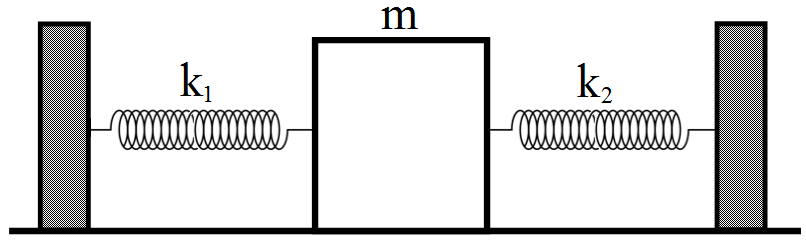
Both the springs shown in figure are unstretched. If the block is displaced by a distance x and released, what will be the initial acceleration?
An infinite line charge produces a field of $9 × 10^4$ N/C at a distance of 2 cm. Calculate the linear charge density.
Show that the electrostatic potential is constant throughout the volume of the conductor and has the same value (as inside) on its surface.
Explain the method of charging by friction briefly.
Answer the following question:
virtual image, we always say, cannot be caught on a screen.
Yet when we 'see' a virtual image, we are obviously bringing it on to the 'screen' (i.e., the retina) of our eye. Is there a contradiction?
The decay constant of $\text{ }^{197}_{80}\text{Hg}$ (electron capture to $\text{ }^{197}_{79}\text{Au}$) is $1.8 × 10^{-4}\ S^{-1}$.
  1. What is the half-life?
  2. What is the average-life?
  3. How much time will it take to convert 25% of this isotope of mercury into gold?
A simple microscope is rated 5 for a normal relaxed eye. What will be its magnifying power for a relaxed farsighted eye whose near point is 40cm?