Question
Explain the use of chock coil.

Answer

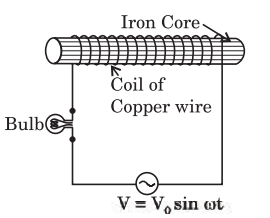
Chock Coil: It is a device which is used in a.c. circuits for varrying the value of current in the circuit which involves little loss of energy. It consists of a high inductance coil which is made of thick insulated copper wire wound closely in a large number of turns over a laminated core made of soft iron.
Image
Since thick copper wire is taken, its resistance R is almost zero, but due to large number of turns of the wire and high permeability of the iron-core, its inductance (L) is very high. The choke coil, therefore, offers a large inductive reactance $X_{L}=\omega L=2\pi fL$ and contributes to the impedance $Z=\sqrt{R^{2}+(\omega L)^{2}}$ of the circuit and current is reduced in the circuit. There is an arrangement to insert the core into the coil to any desired length. More is the length of the core in the coil greater will be inductance (L) of the coil, hence greater will be the impedance. In this way the choke coil can be used to vary the current in A.C. circuits.
The choke coil is put in series across an electrical appliance (say an electric bulb) of resistance R and is connected to an a.c. source. This forms an L-R circuit.
The average power dissipated per cycle in the circuit is given by
$P_{av}=V_{rms}I_{rms}cos \phi$ ...(1)
Hence power factor
$cos \phi=\frac{R}{Z}=\frac{R}{\sqrt{R^{2}+(\omega L)^{2}}}$ ...(2)
Ohmic resistance of the choke coil itself is nearly zero and its inductance L is very high, therefore $R<\omega L$ Hence $cos \phi\approx 0.$ Thus, the average power dissipated in choke coil will be nearly zero i.e. negligible.
As $Z=\sqrt{R^{2}+\omega^{2}L^{2}}$ is very large, so current is reduced without appreciable loss of energy i.e. without wastage of power. Thus working principle of choke coil is the principle of wattless current.
In practice the ohmic resistance of the choke coil is not exactly zero. That is why, in practice, some electrical energy is lost as heat. In addition to it, energy is also lost due to hysteresis-loss in the iron-core of the choke-coil. The loss of energy due to eddy currents is reduced by using laminated iron-core.

Need a full question paper?

Generate a complete, print-ready paper with questions like this in minutes — across 16+ boards, with answer keys.
Start Generating Free

Similar questions

A slide projector has to project a 35mm slide (35mm × 23mm) on a 2m × 2m screen at a distance of 10m from the lens. What should be the focal length of the lens in the projector?
A steel blade placed gently on the surface of water floats on it. If the same blade is kept well inside the water, it sinks. Explain.
A tungsten cathode and a thoriated-tungsten cathode have the same geometric dimensions and are operated at the same temperature. The thoriated-tungsten cathode gives 5000 times more current than the other cathode. Find the operating temperature. Take relevant data from the previous problem.
Radio waves are produced by the accelerated motion of charges in conducting wires. Microwaves are produced by special vacuum tubes. Infrared waves are produced by hot bodies and molecules also known as heat waves. UV rays are produced by special lamps and very hot bodies like Sun.
  1. Solar radiation is:
  1. Transverse electromagnetic wave.
  2. Longitudinal electromagnetic waves.
  3. Both longitudinal and transverse electromagnetic waves.
  4. None of these.
  1. What is the cause of greenhouse effect?
  1. Infrared rays.
  2. Ultraviolet rays
  3. X-rays.
  4. Radiowaves.
  1. Biological importance of ozone layer is:
  1. It stops ultraviolet rays.
  2. It layer reduces greenhouse effect.
  3. It reflects radiowaves.
  4. None of these.
  1. Ozone is found in.
  1. Stratosphere.
  2. Ionosphere.
  3. Mesosphere.
  4. Troposphere.
  1. Earth's atmosphere is richest in.
  1. Ultraviolet.
  2. Infrared.
  3. X-rays.
  4. Microwave.
The number of free electrons in a unit volume copper conductor estimated in Example 8.1 is 8.5 x 1028 per m3.How long does an electron take to drift from one end of a wire 3.0 m long to its other end? The area of cross-section of the wire is 2.0 x 10⁻⁶ m2and it is carrying a current of 3.0 A.
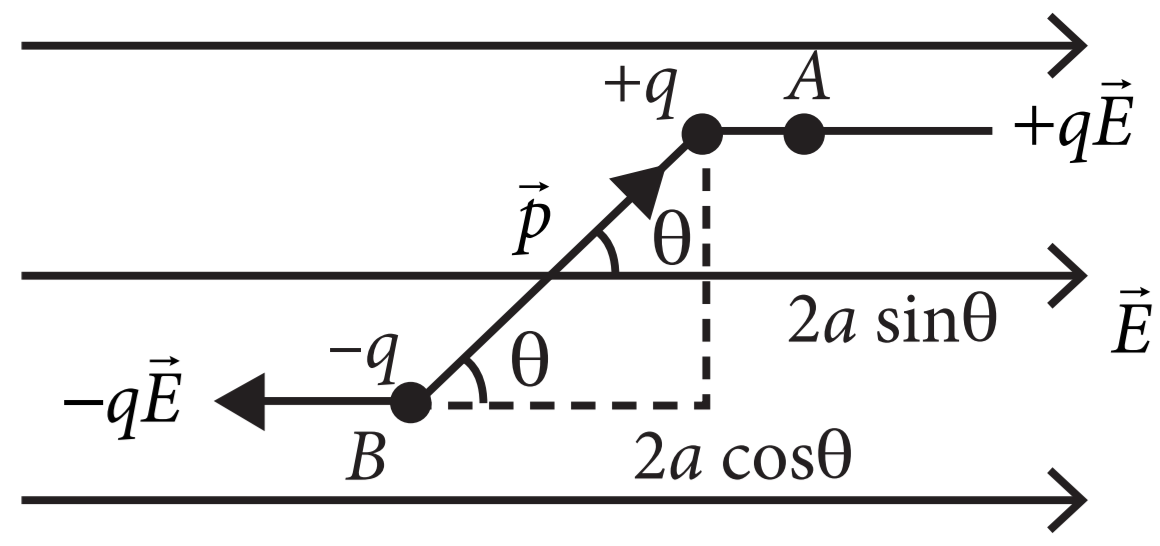
When electric dipole is placed in uniform electric field, its two charges experience equal and opposite forces, which cancel each other and hence net force on electric dipole in uniform electric field is zero. However, these forces are not collinear, so they give rise to some torque on the dipole. Since net force on electric dipole in uniform electric field is zero, so no work is done in moving the electric dipole in uniform electric field. However, some work is done in rotating the dipole against the torque acting on it.
  1. The dipole moment of a dipole in a uniform external field $\vec{\text{E}}$ is $\vec{\text{P}}.$ Then the torque $'i $ acting on the dipole is:
  1. $\text{pE}\sin\theta,-\text{pE}\cos\theta$
  2. $\text{pE}\sin\theta,-2\text{pE}\cos\theta$
  3. $\text{pE}\sin\theta,2\text{pE}\cos\theta$
  4. $\text{pE}\cos\theta,-2\text{pE}\sin\theta$
  5. An electric dipole of moment pis placed in an electric field of intensity $E.$ The dipole acquires a position such that the axis of the dipole makes an angle $\theta$ with the direction of the field. Assuming that the potential energy of the dipole to be zero when $\theta=90^\circ$ the torque and the potential energy of the dipole will respectively be:
  6. $\text{F}=0, \tau=0$
  7. $\text{F}\not=0, \tau\not=0$
  8. $\text{F}=0, \tau\not=0$
  9. $\text{F}\not=0, \tau=0$
  10. When an electric dipole is held at an angle in a uniform electric field, the net force $F$ and torque t on the dipole are:
  11. $0^\circ$
  12. $90^\circ$
  13. $180^\circ$
  14. Both $(a)$ and $(c)$
  15. Torque on a dipole in uniform electric field is minimum when $\theta$ is equal to:
  16. $0.2 \times 10^{-3}Nm$
  17. $1 \times 10^{-3}Nm$
  18. $2 \times 10^{-3}Nm$
  19. $4 \times 10^{-3}Nm$
  20. An electric dipole consists of two opposite charges, each of magnitude $1.0\mu\text{C}$ separated by a distance of $2.0\ cm$.
  21. The dipole is placed in an external field of $10^5N C^{-1}$.
  22. The maximum torque on the dipole is:
  23. $\vec{\tau}=\vec{\text{P}}\times\vec{\text{E}}$
  24. $\vec{\tau}=\vec{\text{P}}\cdot\vec{\text{E}}$
  25. $\vec{\tau}=2(\vec{\text{P}}+\vec{\text{E}})$
  26. $\vec{\tau}=(\vec{\text{P}}+\vec{\text{E}})$
Two fat astronauts each of mass 120kg are travelling in a closed spaceship moving at a speed of 15km/s in the outer space far removed from all other material objects. The total mass of the spaceship and its contents including the astronauts is 660kg. If the astronauts do slimming exercise and thereby reduce their masses to 90kg each, with what velocity will the spaceship move?
No part of India is situated on the equator. Is it possible to have a geostationary satellite which always remains over New Delhi?
The magnetic field due to the earth has a horizontal component of $26\mu\text{T}$ at a place where the dip is 60°. Find the vertical component and the magnitude of the field.
(a) What will be the charge on $12.5 \times 10^8$ electrons?(b) Which is larger between 1 Coulomb charge and 1 electron charge? How many electronic charges will there be in one Coulomb charge?