Question
Explain the use of motor starter.

Answer

Motor Starter : In a motor, the resistance of the armature is kept very small to reduce copper losses. Therefore, when the full supply emf is applied to the armature in the beginning (when the back emf is zero), a very large current will flow through the armature causing damage to the insulation of the windings. Further, if electric supply fails by chance, while the motor is running, the large induced emf produced at break can damage the armature.
Image
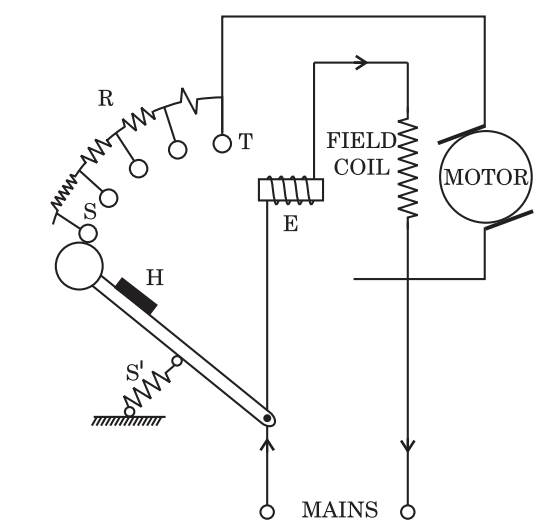
These possible damages to the armature are prevented by introducing a large variable resistance R, called 'starter resistance' in series with the armature and the mains.
The motor is started with the handle H on the first stud S so that whole of the resistance R is in the circuit. The current through the armature is thus small. As the armature gains speed, the back emf is progressively developed. The resistance R is now gradually withdrawn by moving the handle to the stud T. The handle is held in this position by the electromagnet E, which is in series with the field coil. If the main electric supply fails, the spring S' brings the handle back to the off position.
Need a full question paper?

Generate a complete, print-ready paper with questions like this in minutes — across 16+ boards, with answer keys.

Start Generating Free

Similar questions

The product of the hole concentration and the conduction electron concentration turns out to be independent of the amount of any impurity doped. The concentration of conduction electrons in germanium is $6 \times 10^{19}$ per cubic metre. When some phosphorus impurity is doped into a germanium sample, the concentration of conduction electrons increases to $2 \times 10^{23}$ per cubic metre. Find the concentration of the holes in the doped germanium.
(a) In Example 3.1, the electron drift speed is estimated to be only a few $mm s ^{-1}$ for currents in the range of a few amperes? How then is current established almost the instant a circuit is closed?
(b) The electron drift arises due to the force experienced by electrons in the electric field inside the conductor. But force should cause acceleration. Why then do the electrons acquire a steady average drift speed?
(c) If the electron drift speed is so small, and the electron's charge is small, how can we still obtain large amounts of current in a conductor?
(d) When electrons drift in a metal from lower to higher potential, does it mean that all the 'free' electrons of the metal are moving in the same direction?
(e) Are the paths of electrons straight lines between successive collisions (with the positive ions of the metal) in the (i) absence of electric field, (ii) presence of electric field?
A charged particle having a charge of $-2.0 \times 10^{-6}C$ is placed close to a nonconducting plate having a surface charge density $4.0 \times 10^{-5}Cm^{-2}.$ Find the force of attraction between the particle and the plate.
Give explanation of Conductor, Semiconductor and insulator on the basis of band theory.
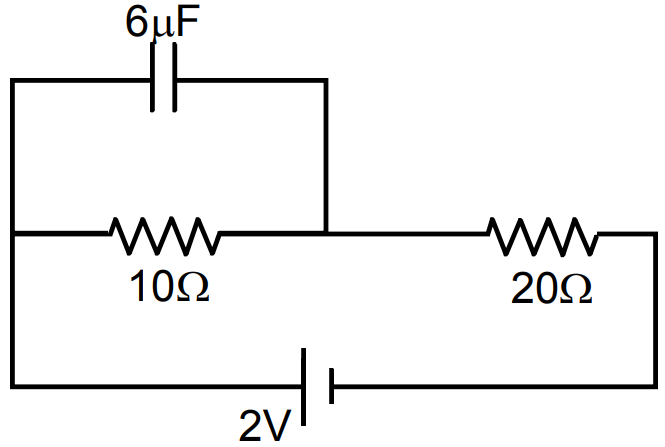
Find the charge on the capacitor shown in figure.
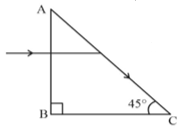
A light ray entering a right $-$ angled prism undergoes refraction at the face $AC$ as shown in Figure
$(I)$ What is the refractive index of the material of the prism in Figure?

Image
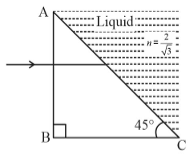
$(II) (a)$ If the side $AC$ of the above prism is now surrounded by a liquid of refractive index $\frac{2}{\sqrt{3}}$ as shown in Figure, determine if the light ray continues to graze along the interface $AC$ or undergoes total internal reflection or undergoes refraction into the liquid.

Image
$(b)$ Draw the ray diagram to represent the path followed by the incident ray with the corresponding angle values.
$($Given $,\sin ^{-1}\left(\frac{\sqrt{2}}{\sqrt{3}}\right)=54.6^{\circ} )$
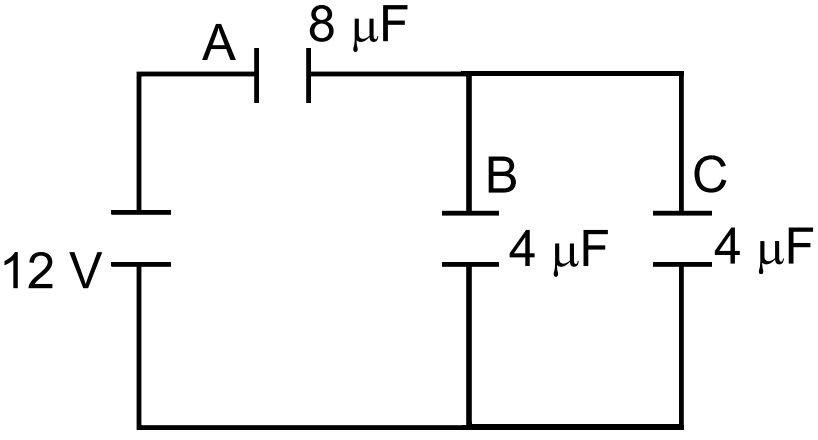
Find the charge appearing on each of the three capacitors shown in figure.
A straight horizontal wire of mass 10mg and length 1.0m carries a current of 2.0A. What minimum magnetic field B should be applied in the region, so that the magnetic force on the wire may balance its weight?
A storage battery of emf $8.0 V$ and internal resistance $0.5\ \Omega$ is being charged by a $120 V\  dc$ supply using a series resistor of $15.5\ \Omega.$ What is the terminal voltage of the battery during charging? What is the purpose of having a series resistor in the charging circuit?
In a common emitter mode of a transistor, the d.c. current gain is 20, the emitter current is 7mA. Calculate (i) base current and (ii) collector current.