Question 13 Marks
Explain the use of motor starter.
Answer
View full question & answer→Motor Starter : In a motor, the resistance of the armature is kept very small to reduce copper losses. Therefore, when the full supply emf is applied to the armature in the beginning (when the back emf is zero), a very large current will flow through the armature causing damage to the insulation of the windings. Further, if electric supply fails by chance, while the motor is running, the large induced emf produced at break can damage the armature.
These possible damages to the armature are prevented by introducing a large variable resistance R, called 'starter resistance' in series with the armature and the mains.
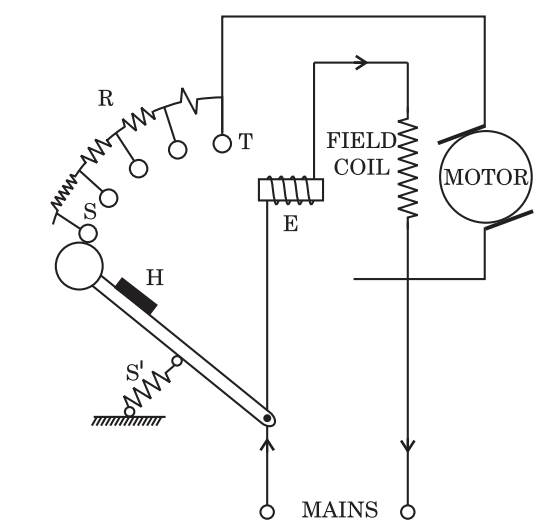
The motor is started with the handle H on the first stud S so that whole of the resistance R is in the circuit. The current through the armature is thus small. As the armature gains speed, the back emf is progressively developed. The resistance R is now gradually withdrawn by moving the handle to the stud T. The handle is held in this position by the electromagnet E, which is in series with the field coil. If the main electric supply fails, the spring S' brings the handle back to the off position.
These possible damages to the armature are prevented by introducing a large variable resistance R, called 'starter resistance' in series with the armature and the mains.
The motor is started with the handle H on the first stud S so that whole of the resistance R is in the circuit. The current through the armature is thus small. As the armature gains speed, the back emf is progressively developed. The resistance R is now gradually withdrawn by moving the handle to the stud T. The handle is held in this position by the electromagnet E, which is in series with the field coil. If the main electric supply fails, the spring S' brings the handle back to the off position.