Question
Explain the uses of Polaroid.

Answer

Uses of Polaroid :
1. To remove glare : Polaroid is used to reduce the glare caused by reflection of light from extremely white or bright surfaces or wet roads or the scorching sun. Glare consists of partially polarized light. If polaroid glasses are worn on the eyes, it will cut off the horizontal vibrations of partially polarized light. Hence the glare will be eliminated.
2. To prevent accidents : When the light emitted from the headlights of motor cars and trucks falls on the hood of a motor car or truck coming from the other side, the reflected light reaches the eyes and causes glare. This not only causes pain to the eyes, but there is also a possibility of an accident. To overcome this, headlight cover glass and windscreen are made of polaroid.
3. In polaroid camera or photography : A polaroid is placed in front of the lens of the polaroid camera so that the polarized light coming in its background is blocked by the polaroid.
4. To determine the concentration of sugar: The concentration of sugar is determined by polari meter. Polaroids are used to produce and analyze plane polarized light in a polari meter.
5. In the study of optical properties of metals.
6. To study the effect of stresses.
Need a full question paper?

Generate a complete, print-ready paper with questions like this in minutes — across 16+ boards, with answer keys.

Start Generating Free

Similar questions

The short-wavelength limit shifts by 26pm when the operating voltage in an X-ray tube is increased to 1.5 times the original value. What was the original value of the operating voltage?
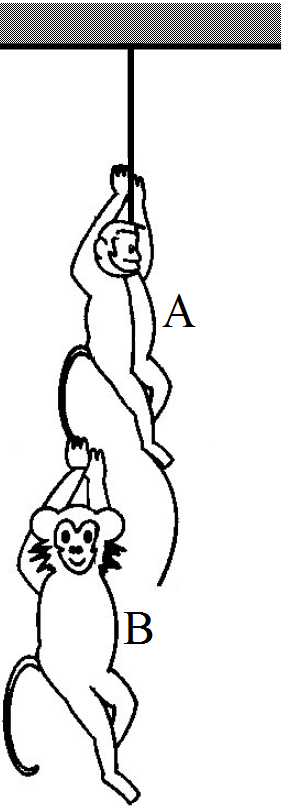
The monkey B shown in figure is holding on to the tail of the monkey A which is climbing up a rope. The masses of the monkeys A and B are 5kg and 2kg respectively. If A can tolerate a tension of 30N in its tail, what force should it apply on the rope in order to carry the monkey B with it? Take $g = 10m/s^2$
An electron is projected horizontally with a kinetic energy of 10keV. A magnetic field of strength $1.0 \times 10^{-7}T$ exists in the vertically upward direction.
  1. Will the electron deflect towards the right or left of its motion?
  2. Calculate the sideways deflection of the electron while travelling through 1m. Make appropriate approximations.
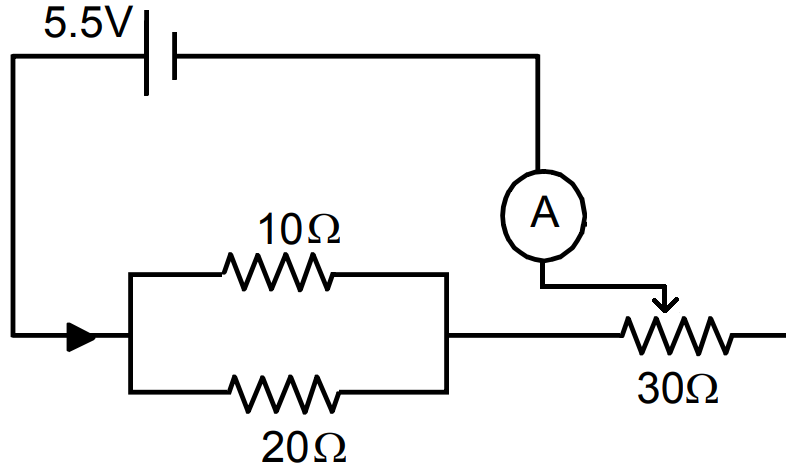
The resistance of the rheostat shown in the figure. is $30\Omega.$ Neglecting the meter resistance, find the minimum and maximum currents through the ammeter as the rheostat is varied.
A particle executes a simple harmonic motion of amplitude 1.0cm along the principal axis of a convex lens of focal length 12cm. The mean position of oscillation is at 20cm from the lens. Find the amplitude of oscillation of the image of the particle.
Two particles A and B, having opposite charges $2.0 \times 10^{-6}C$ and $2.0 \times 10^{-6}C,$ are placed at a separation of 1.0cm.
  1. Write down the electric dipole moment of this pair.
  2. Calculate the electric field at a point on the axis of the dipole 1.0m awa.y from the centre.
  3. Calculate the electric field at a point on the perpendicular bisector of the dipole and 1.0m away from the centre.
The amount of charge that passes in time t through a cross-section of a wire is,
$Q(t) = At^2 + Bt + C.$​​​​​​​
  1. Write the dimensional formulae for A, B and C.
  2. If the numerical values of A, B and C are 5, 3 and 1, respectively, in S.I units, find the value of the current at t = 5s.
Answer the following question:
Optical and radiotelescopes are built on the ground but X - ray astronomy is possible only from satellites orbiting the earth. Why?
It is desired to measure the magnitude of field between the poles of a powerful loud speaker magnet. A small flat search coil of area $2cm^2$ with 25 closely wound turns, is positioned normal to the field direction, and then quickly snatched out of the field region. Equivalently, one can give it a quick 90º turn to bring its plane parallel to the field direction). The total charge flown in the coil (measured by a ballistic galvanometer connected to coil) is 7.5mC. The combined resistance of the coil and the galvanometer is 0.50Ω. Estimate the field strength of magnet.
A compound microscope consists of an objective lens of focal length 2.0 cm and an eyepiece of focal length 6.25 cm separated by a distance of 15 cm. How far from the objective should an object be placed in order to obtain the final image at (a) the least distance of distinct vision (25 cm), and (b) at infinity? What is the magnifying power of the microscope in each case?