Question
Explain the variation of conductivity with temperature for:
  1. A metallic conductor.
  2. Ionic conductors.
  3. Semiconductors.

Answer

Conductivity of a metallic conductor $\sigma=\frac{1}{\rho}=\frac{\text{ne}^2\tau}{\text{m}}.$

Where m = mass of charge carrier, e = charge on each carrier

$\tau$ = relaxation time, n = number density of charge carriers

  1. With rise of temperature, the collision of electrons with fixed lattice ions/ atoms increases so that relaxation time $(\tau)$ decreases. Consequently, the conductivity of metals decreases with rise of temperature.
  2. Conductivity of ionic conductor increases with increase of temperature because with increase of temperature, the ionic bonds break releasing positive and negative ions which are charge carriers in ionic conductors.
  3. In the case of a semiconductors, when temperature increases, covalent bonds break and charge carriers (electrons and holes) become free i.e., n increases, so conductivity increases with rise of temperature.

Need a full question paper?

Generate a complete, print-ready paper with questions like this in minutes — across 16+ boards, with answer keys.
Start Generating Free

Similar questions

Two car garages have a common gate which needs to open automatically when a car enters either of the garages or cars enter both. Devise a circuit that resembles this situation using diodes for this situation.
A room has a window fitted with a single 1.0m × 2.0m glass of thickness 2mm.
  1. Calculate the rate of heat flow through the closed window when the temperature inside the room is 32°C and that outside is 40°C.
  2. The glass is now replaced by two glasspanes, each having a thickness of 1mm and separated by a distance of 1mm. Calculate the rate of heat flow under the same conditions of temperature. Thermal conductivity of window glass = 1.0Js-1m-1°C-1 and that of air = 0.025Js-1m-1°C-1.
A long cylindrical wire carries a positive charge of linear density 2.0 × 10⁻⁸Cm-1. An electron revolves around it in a circular path under the influence of the attractive electrostatic force. Find the kinetic energy of the electron. Note that it is independent of the radius.
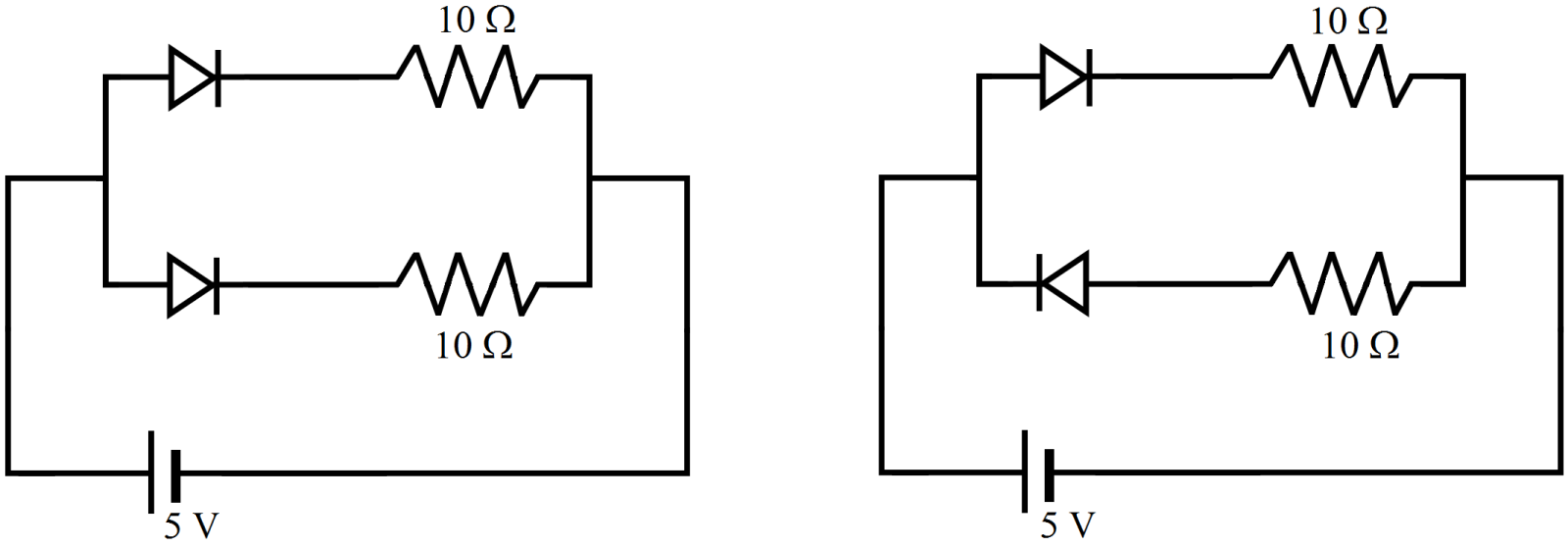
Find the current through the battery circuits shown in figure.

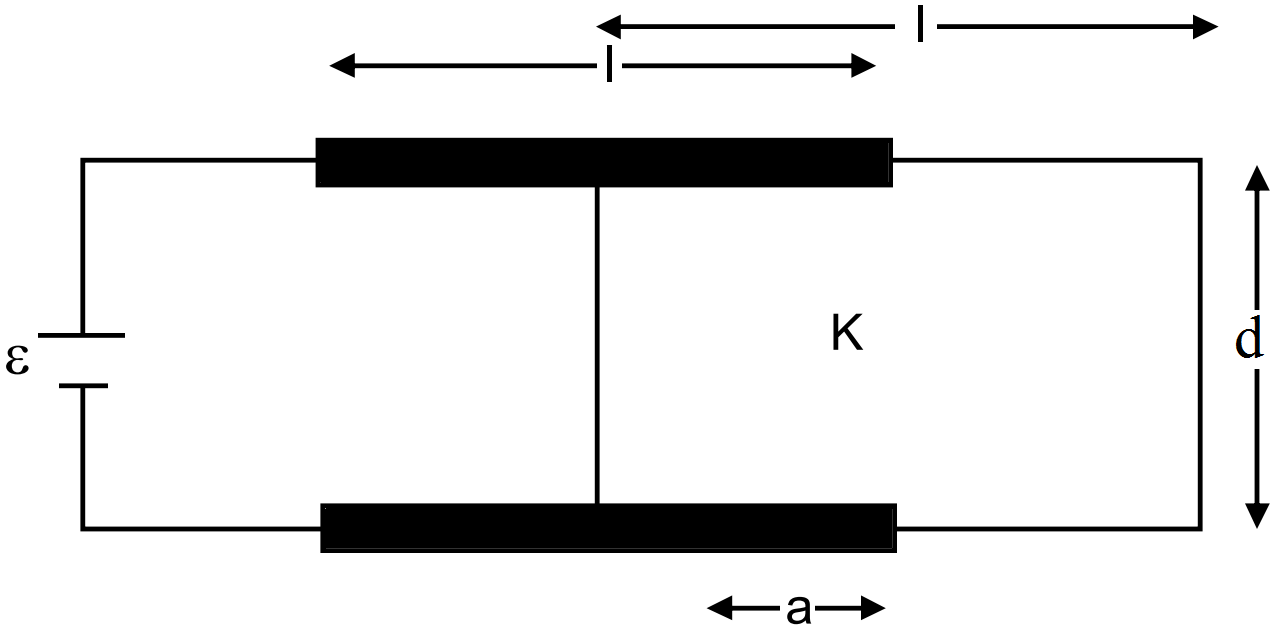
Consider the situation shown in figure. The plates of the capacitor have plate area A and are clamped in the laboratory. The dielectric slab is released from rest with a length a inside the capacitor. Neglecting any effect of friction or gravity, show that the slab will execute periodic motion and find its time period.

The conduction band of a solid is partially filled at 0K. Will it be a conductor, a semiconductor or an insulator?
Consider a circular current-carrying loop of radius R in the x-y plane with centre at origin. Consider the line intergral $\Im(\text{L})=\begin{vmatrix}\int\limits_{-\text{L}}^{\text{L}}\text{B.dl} \end{vmatrix}$ taken along z-axis.
  1. Show that $\Im(\text{L})$ monotonically increases with L.
  2. Use an appropriate Amperian loop to show that $\Im(\infty)=\mu_0\text{I}$, where I is the current in the wire.
  3. Verify directly the above result.
  4. Suppose we replace the circular coil by a square coil of sides R carrying the same current I. What can you say about $\Im(\text{L})$ and $\Im(\infty)$?
Consider a non-conducting plate of radius r and mass m that has a charge q distributed uniformly over it. The plate is rotated about its axis with an angular speed $\omega.$ Show that the magnetic moment $\mu$ and the angular momentum of the plate are related as $\mu=\frac{\text{q}}{2\text{m}}\text{l}.$
A metal ball of mass 1kg is heated by means of a 20W heater in a room at 20°C. The temperature of the ball becomes steady at 50°C.
  1. Find the rate of loss of heat to the surrounding when the ball is at 50°C.
  2. Assuming Newton's law of cooling, calculate the rate of loss of heat to the surrounding when the ball is at 30°C.
  3. Assume that the temperature of the ball rises uniformly from 20°c to 30°C in 5 minutes. Find the total loss of heat to the surrounding during this period.
  4. Calculate the specific heat capacity of the metal.
A lady uses +1.5D glasses to have normal vision from 25cm onwards. She uses a 20D lens as a simple microscope to see an object. Find the maximum magnifying power if she uses then microscope
  1. Together with her glass
  2. Without the glass. Do the answers suggest that an object can be more clearly seen through a microscope without using the correcting glasses?