Question
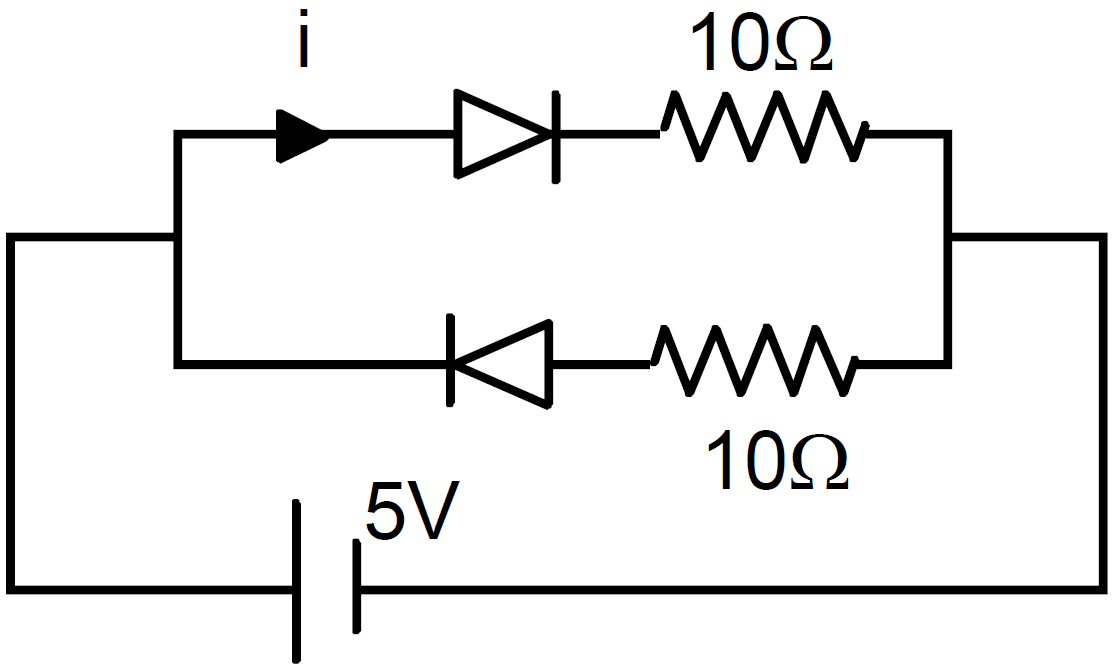
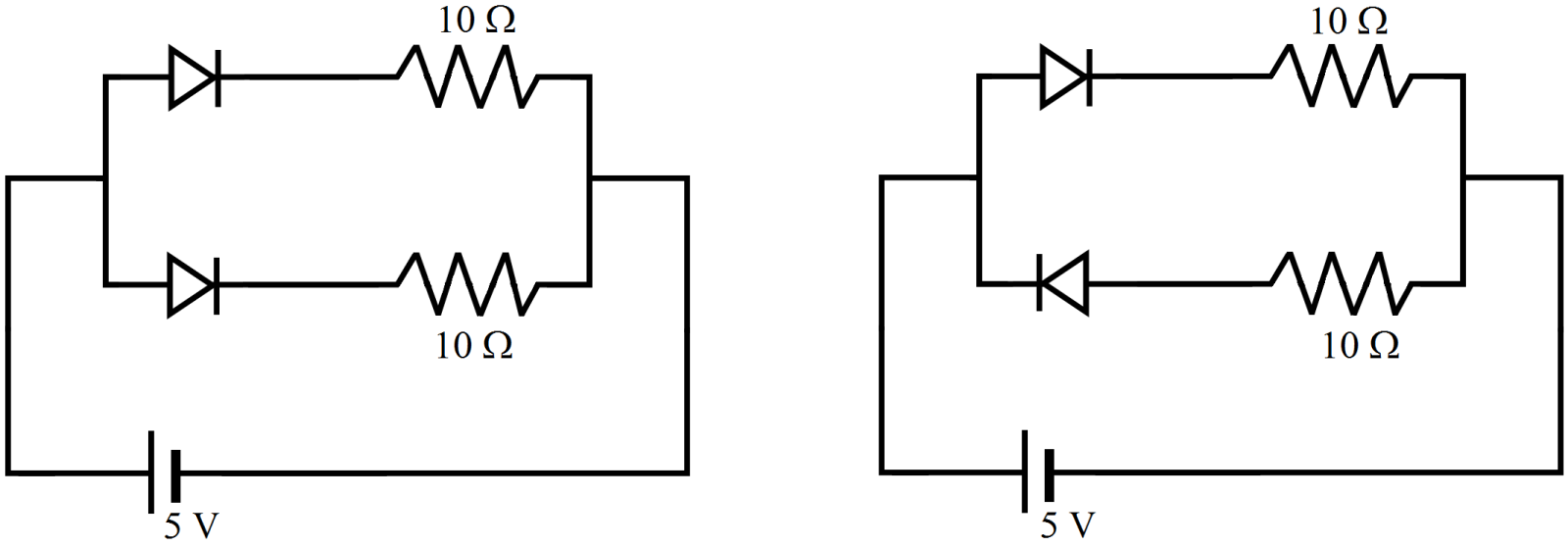
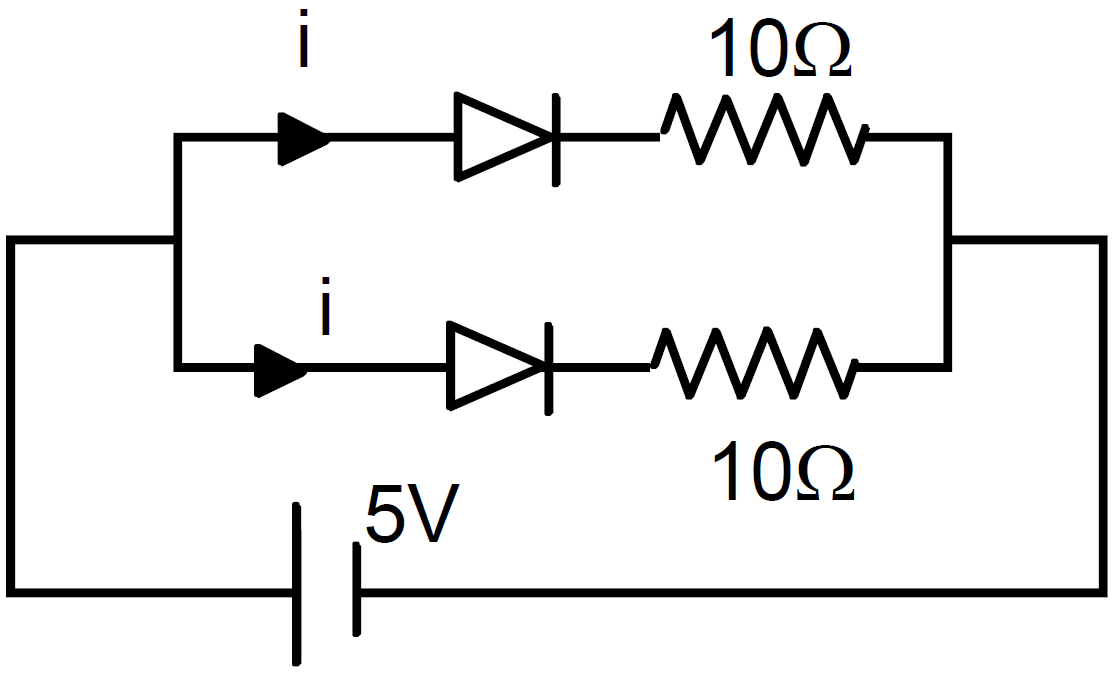
Find the current through the battery circuits shown in figure.

Answer

Both diodes are forward biased. Thus the net diode resistance is 0.

$\text{i}=\frac{5}{\frac{10\times10}{10+10}}=\frac{5}{5}=1\text{A}$
One diode is forward biased and other is reverse biased.

$\text{i}=\frac{\text{V}}{\text{R}_\text{net}}=\frac{5}{10+0}=\frac{1}{2}=0.5\text{A}$

Need a full question paper?

Generate a complete, print-ready paper with questions like this in minutes — across 16+ boards, with answer keys.
Start Generating Free

Similar questions

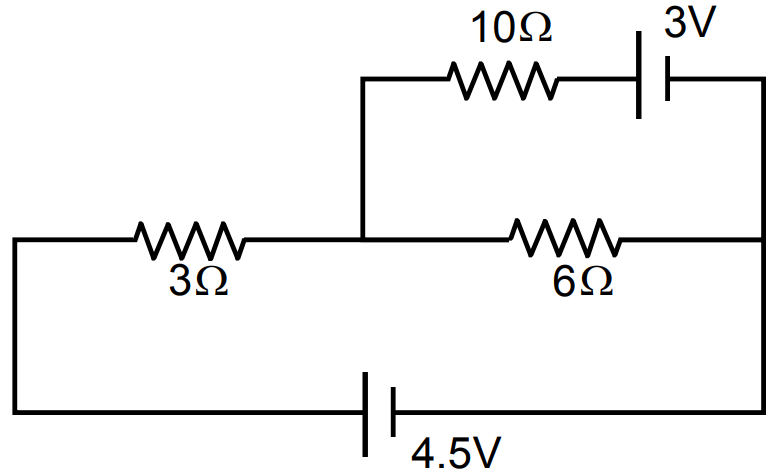
Find the current through the $10\Omega$ resistor shown in figure.

A uniform electric field $\vec{\text{E}}=\text{E}_\text{x}\hat{\text{i}}$ N/ C for x > 0 and $\vec{\text{E}}=-\text{E}_\text{x}\hat{\text{i}}$ N/ C for x < 0 are given. A right circular cylinder of length l cm and radius r cm has its centre at the origin and its axis along the X-axis. Find out the net outward flux. Using Gauss’s law, write the expression for the net charge within the cylinder.
The energy of a silver atom with a vacancy in K shell is 25.31keV, in L shell is 3.56keV and in M shell is 0.530keV higher than the energy of the atom with no vacancy. Find the frequency of $\text{K}_\alpha\text{K}_\beta$ and $\text{L}_\alpha$ X-rays of silver.
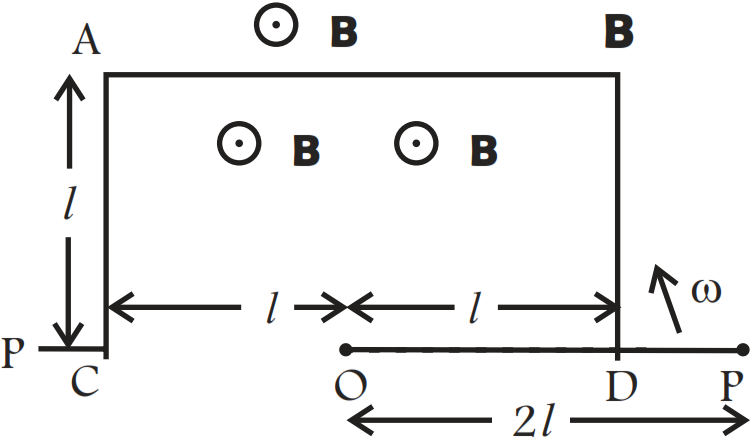
ODBAC is a fixed rectangular conductor of negilible resistance (CO is not connnected) and OP is a conductor which rotates clockwise with an angular velocity $\omega$ (Fig). The entire system is in a uniform magnetic field B whose direction is along the normal to the surface of the rectangular conductor ABDC. The conductor OP is in electric contact with ABDC. The rotating conductor has a resistance of $\lambda$ per unit length. Find the current in the rotating conductor, as it rotates by 180º.

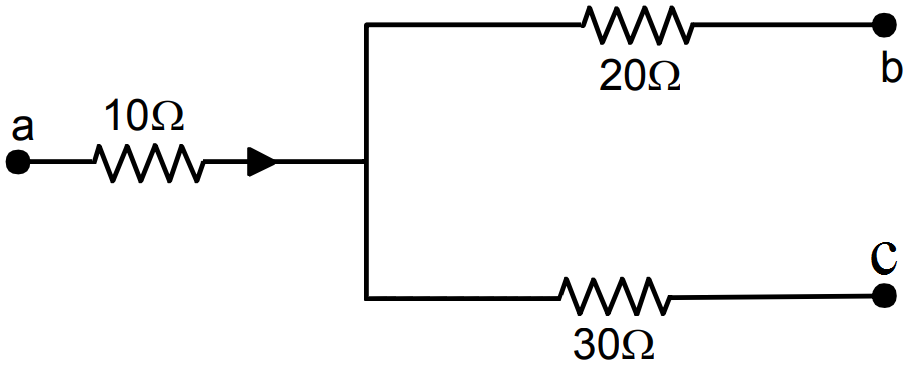
Figure. showa a part of an electric circuit. The potentials at the point a, b and c are 30V, 12V and 2V respectively. Find the currents through the three resistors.

A block of mass 2.0kg moving at 2.0m/s collides head on with another block of equal mass kept at rest.
  1. Find the maximum possible loss in kinetic energy due to the collision.
  2. If the actual loss in kinetic energy is half of this maximum, find the coefficient of restitution.
Two objects A and B are thrown upward simultaneously with the same speed. The mass of A is greater than the mass of B. Suppose the air exerts a constant and equal force of resistance on the two bodies:
  1. The two bodies will reach the same height.
  2. A will go higher than B.
  3. B will go higher than A.
  4. Any of the above three may happen depending on the speed with which the objects are thrown.
Consider a straight piece of length x of a wire carrying a current i. Let P be a point on the perpendicular bisector of the piece, situated at a distance d from its middle point. Show that for d >> x, the magnetic field at P varies as $\frac{1}{\text{d}^2}$ whereas ford d << x, it varies as $\frac{1}{\text{d}}.$
A thin convex lens of focal length 25cm is cut into two pieces 0.5cm above the principal axis. The top part is placed at (0, 0) and an object placed at (-50cm, 0). Find the coordinates of the image.
A parallel beam of light of wavelength 100nm passes through a sample of atomic hydrogen gas in ground state. (a) Assume that when a photon supplies some of its energy to a hydrogen atom, the rest of the energy appears as another photon. Neglecting the light emitted by the excited hydrogen atoms in the direction of the incident beam, what wavelengths may be observed in the transmitted beam? (b) A radiation detector is placed near the gas to detect radiation coming perpendicular to the incident beam. Find the wavelengths of radiation that may be detected by the detector.