Question
Explain the Watson and Crick model of DNA.
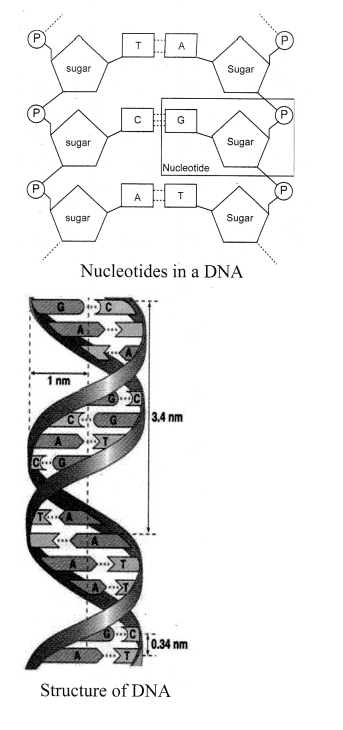
Adenine [A] links Thymine [T] with two hydrogen bonds (A = T)
Cytosine [C] links Guanine [G] with three hydrogen bonds (C = G). This is called complementary base pairing.
Hydrogen bonds between the nitrogenous bases make the DNA molecule stable.
Each turn of the double helix is 34 A° (3.4 nm). There are ten base pairs in a complete turn.
Nucleotides in a helix are joined together by phosphodiester bonds.
Generate a complete, print-ready paper with questions like this in minutes — across 16+ boards, with answer keys.