Questions

[7 marks Questions]

🎯

Test yourself on this topic

6 questions · timed · auto-graded

Question 17 Marks
Explain in detail, the various steps of DNA replication.
Answer
Replication of DNA:
Replication of DNA occurs within a cell. DNA molecule produces exact copies of its own structure during replication.
The two strands of a DNA molecule have complementary base pairs, the nucleotides of each strand, provide the information needed to produce its new strand. The two resulting daughter cells contain exactly the same genetic information as the parent cell.
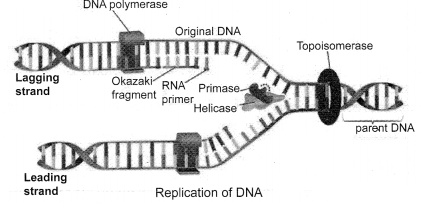
Image

DNA replication involves the following steps:
(a) Origin of replication: The points on the DNA, where replication begins, is the site of origin of replication. The two strands open and separate at this point, forming the replication fork.

(b) An unwinding of DNA molecule: The enzyme, helicase, bind to the origin of a replication site. Helicase separates the two strands of DNA. The enzyme called topoisomerase separates the double helix above the replication fork and removes the twists formed during the unwinding process.

(c) Formation of RNA primer: An RNA primer is a short segment of RNA nucleotides. The primer is synthesized by the DNA template, close to the origin of a replication site.

(d) Synthesis of the new complementary strand from the parent strand: After the formation of RNA primer, nucleotides are added with the help of an enzyme DNA polymerase, a new complementary strand of DNA is formed from each of the parent strands. The daughter strand is synthesized as a continuous strand, which is called the leading strand.

The short segments of DNA are synthesized, in the other strand and called lagging strand. The short segments of DNA are called Okazaki fragments. The enzyme DNA ligase joins the fragments. The replication fork of the two sides meets at a site called terminus, which is stimulated opposite to origin of a replication site.
View full question & answer
Question 27 Marks
Explain the Watson and Crick model of DNA.
Answer
Watson and Crick model of DNA:
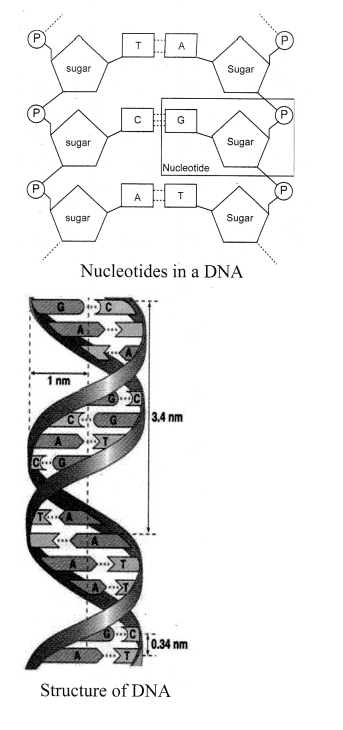
DNA molecules consist of two polynucleotide chains. These chains form a double helix. Structure, with two strands, which run anti-parallel to one another. Nitrogenous bases in the centre are linked to sugar – phosphate units, which form the backbone of the DNA. Pairing between the nitrogenous bases is very specific and is always between purine and pyrimidine linked by hydrogen bonds.

Adenine [A] links Thymine [T] with two hydrogen bonds (A = T)
Cytosine [C] links Guanine [G] with three hydrogen bonds (C = G). This is called complementary base pairing.
Hydrogen bonds between the nitrogenous bases make the DNA molecule stable.
Each turn of the double helix is 34 A° (3.4 nm). There are ten base pairs in a complete turn.
Nucleotides in a helix are joined together by phosphodiester bonds.

Image

View full question & answer
Question 37 Marks
Explain Mendel’s laws of heredity with the results of a dihybrid cross.
Answer
 Mendel crossed pea plants having round yellow seeds (dominant) with pea plants having wrinkled green seeds. In the $F_1$ generation, round shape, yellow colour of the seeds were dominant over the wrinkled green colour seeds. When the hybrids of the $F_1$ generation were cross-bred by self-pollination, the dihybrid cross, produced four types of $F _2$ offsprings in the ratio of 9 , with two dominant traits, 3 with one dominant trait and one recessive trait, 3 with another dominant trait and another recessive trait and 1 with two recessive traits.
Two new combinations of traits with round green and wrinkled yellow had appeared in the dihybrid cross. [F $F_2$ generation] Mendel's law of heredity:
(i) Law of dominance: When two homozygous individuals with contrasting characters are crossed, the characters, that appear in the $F_1$ hybrid are dominant and those do not appear in $F_1$ are recessive characters.
(ii) Law of segregation or Law of purity of gametes: When a pair of contrasting factors or genes are brought together, in a heterozygote the contrasting pair remain together without, mixing and when gametes are formed, the two separate out so that only one enters each gamete.
(iii) Law of Independent Assortment: In case of inheritance of two or more pairs of characters simultaneously, the factors or genes of one pair assort out independently of the other pair.
View full question & answer
Question 47 Marks
Explain the monohybrid cross, with a diagram and describe the interpretation of Mendel oh monohybrid cross.
Answer
Crosses involving the inheritance of only one pair of contrasting characters are called monohybrid cross. It is a cross between two forms of a single trait like a cross between tall and dwarf plant. In a monohybrid cross, a pure breeding tall plant and a pure breeding dwarf plant, results, tall and monohybrids in the F1 generation.In the F2 generation, selfing of the F1 monohybrids resulted in tall and dwarf plants in the ratio of 3 : 1. The external expression of a particular trait is known as the phenotype. So the phenotypic ratio is 3 : 1.
In the F2 generations, 3 different types were obtained.
Tall Homozygous – TT (pure) – 1
Tall Heterozygous – Tt – 2
Dwarf Homozygous – tt – 1
So the genotypic ratio 1 : 2 : 1.
A genotype is the genetic expression of an organism.
Mendel’s interpretation on monohybrid cross:
Factors are passed on from one generation to another, factors are referred to as genes. Tallness and dwarfism are determined by a pair of contrasting factors tall plant T, a dominant character and a plant is dwarf’s’, recessive character in pairs. Pure breeding tall plants (TT) and pure dwarf plants (tt) are called homozygous. If they are unlike, (Tt) they are referred to as heterozygous.

https://pg-data.sgp1.digitaloceanspaces.com/chapter_wise/17666/science%2010.png" alt="Image" width="400" height="" />

(i) Two factors make up a pair of contrasting characters are called alleles or allelomorphs. One member of each pair is contributed by one parent.(ii) When two factors of a trait are brought together, by fertilization, only one expresses itself (tallness), masking the expression of the other (dwarfness). The character which expresses itself is called dominant and the character, which is masked is called recessive.(iii) The factors for tallness [T] and dwarfness (t) are separate entities, and in a gamete either T or t is present. When F1 hybrids are self crossed the two entities separate and then unite independently, forming tall and dwarf plants.
View full question & answer
Question 57 Marks
Given an account of the Laws of Mendel.
Answer
 Mendel proposed three important laws which are now called as Mendel's Laws of Heredity.
(i) Law of Dominance: "When two homozygous individuals with one or more sets of contrasting characters are crossed, the characters that appear in the $F_1$ hybrid are dominant and those that do not appear in $F _1$ are recessive characters".
(ii) Law of Segregation or Law of purity of gametes : "When a pair of contrasting factors or genes or allelomorphs are brought together in a heterozygote or hybrid, the two members of the allelic pair remain together without mixing and when gametes are formed, the two separate out, so that only one enters each gamete."
(iii) Law of independent assortment : "In case of inheritance of two or more pairs of characters simultaneously, the factors or genes of one pair assort out independently of the other pair."
View full question & answer
Question 67 Marks
Explain the regions of chromosomes with a neat labelled diagram.
Answer
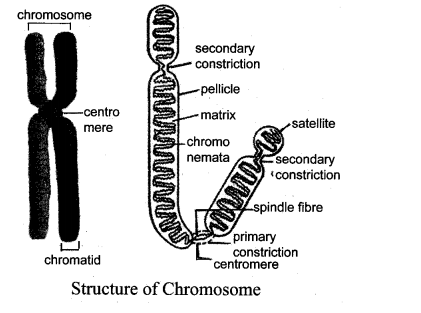
The chromosomes are thin, long and thread-like structures, with two identical strands called chromatids. They are held together by a centromere. The chromatid is made up of spirally coiled, a thin structure called chromonema, which has a number of bead-like structures along its length called chromomeres.

A chromosome consists of the following regions:

  1. Primary constriction: The two arms of a chromosome meet at a point called primary constriction or centromere. The centromere is the region, where spindle fibres attach to the chromosome during cell division.
  2. Secondary constriction: Some chromosomes have a secondary constriction at any point of the chromosome, called the nuclear zone or nucleolar organizer. (Formation of the nucleolus in the nucleus).
  3. Telomere: The end of the chromosome is called telomere. Each extremity of the chromosome has a polarity and prevents it from joining the adjacent chromosome. It maintains and provides stability to the chromosomes.
  4. Satellite: Some of the chromosomes have an elongated knob-like appendage at one end of the chromosome, known as a satellite. The chromosomes with satellites are called as sat- chromosomes.

Image

View full question & answer