Maharashtra BoardEnglish MediumSTD 12 SciencePhysicsElectromagnetic Induction3 Marks
Question
Explain the working of a transistor as a switch.
✓
Answer
Working of transistor as a switch:
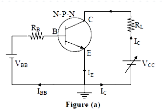
a) A base-biased N-P-N common emitter transistor is as shown in figure (a).
b) On applying Kirchhoff ’s law in input circuit, we get,
$V_{BB} − I_BR_B = V_{BE}$
$\therefore V_{BB} = V_{BE} + I_BR_B$
c) Considering VBB as the d.c input voltage $‘Vi’$ then the above equation may be written as $V_i = V_{BE} + I_BR_B ….(i)$
Applying Kirchhoff’s law in output circuit, we get,
$V_{CE} = V_{CC} − I_CR_L$
d) Considering V_{CC} as the dc output voltage $‘Vo’$ then the above equation may be written as,
$V_o = V_{CC} − I_CR_C ….(ii)$
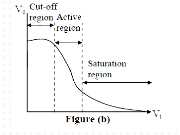
As Vi is increased from $0$ to $0.6 V$ (for silicon transistor),$ I_C = 0$ and the transistor is said to be in the cut-off state.
\therefore I_C = 0
From equation (ii),
V_o = V_{CC} = constant
f) As $‘V_i’$ is increased from $0.6 V$ to $1 V$, transistor will be in active state therefore IC increases linearly. From equation (ii) $‘V_o’$ decreases linearly. The transistor in this range is called in active state.
g) If $‘V_i’$ is increased further, $‘V_o’$ becomes non-linear and decreases further and tends to become zero, though its value nearly reaches zero. The transistor in this range is said to be in saturation state. The above characteristics are shown in figure (b).
h) When $V_i$ is low $(< 0.6 V), V_o$ is high and when $V_i$ is high $(> 1 V), V_o$ is low. By defining low voltage state as cut off state and high voltage level as saturation state, transistor can be used as a switch.
i) A low voltage input keeps the transistor in cut-off region (non-working) and the transistor is said to be switched off.
j) A high voltage input keeps the transistor in saturation state (working) and the transistor is said to be switched on.
Need a full question paper?
Generate a complete, print-ready paper with questions like this in minutes — across 16+ boards, with answer keys.