Question
Explain threshold frequency and stopping potential.###Define the following with respect to photoelectric effect :
(i) Work function (ii) Stopping potential

Answer

Threshold frequency : The minimum frequency below which photon is not capable of emitting an electron is called the threshold frequency. This is represented by $v_0$.
Stopping potential : The negative potential of plate C relative to P at which the photoelectric current becomes zero is called "stopping potential" or "cut off potential".
Work function : The minimum energy required for the emission of photoelectron from a metal is called the 'Work function' of that metal. Generally it represented by W or $\phi_0$. It is expressed in Joule and electron Volt.

Need a full question paper?

Generate a complete, print-ready paper with questions like this in minutes — across 16+ boards, with answer keys.
Start Generating Free

Similar questions

Water near the bed of a deep river is quiet while that near the surface flows. Give reasons.
Plot a graph showing the variation of photoelectric current with intensity of light. The work function for the following metals is given:
Na : 2.75 eV and Mo : 4.175 eV.
Which of these will not give photoelectron emission from a radiation of wavelength 3300 Å from a laser beam? What happens if the source of laser beam is brought closer?
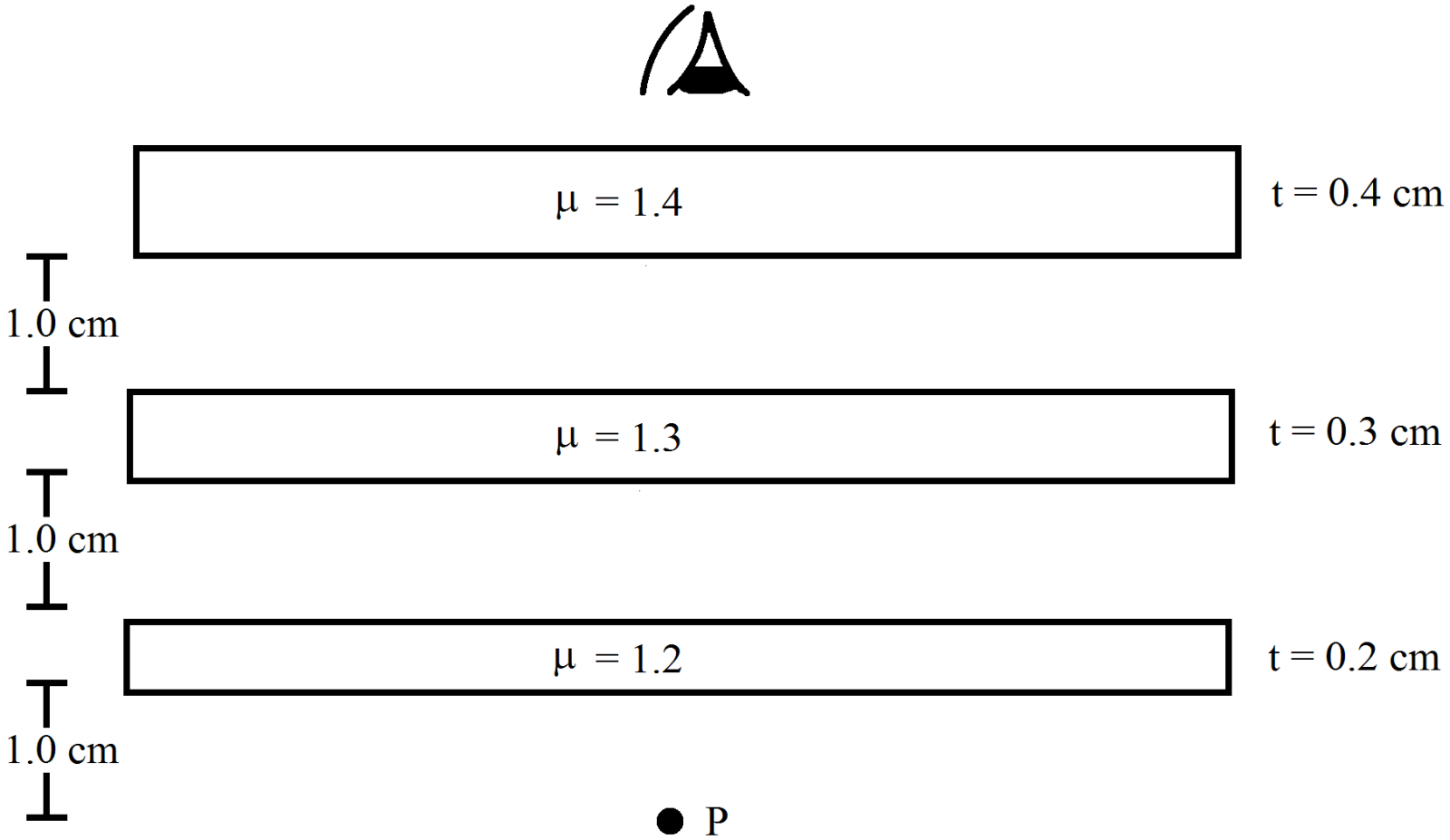
Locate the image of the point P as seen by the eye in the figure.

The number of electrons in an insulator is of the same order as the number of electrons in a conductor. What is then the basic difference between a conductor and an insulator?
A semiconducting material has a band gap of 1eV. Acceptor impurities are doped into it which create acceptor levels 1meV above the valence band. Assume that the transition from one energy level to the other is almost forbidden if kT is less than $\frac{1}{50}$ of the energy gap. Also, if kT is more than twice the gap, the upper levels have maximum population. The temperature of the semiconductor is increased from 0K. The concentration of the holes increases with temperature and after a certain temperature it becomes approximately constant. As the temperature is further increased, the hole concentration again starts increasing at a certain temperature. Find the order of the temperature range in which the hole concentration remains approximately constant.
Consider the situation of the previous problem. Define displacement resistance $\text{R}_\text{d}=\frac{\text{V}}{\text{i}_\text{d}}$ of the space between the plates, where V is the potential difference between the plates and id is the displacement current. Show that Rd varies with time as $\text{R}_\text{d}=\text{R}\big(\text{e}^{\text{t}/\tau}-1\big)$ 
A charge of 3.14 × 10⁻⁶C is distributed uniformly over a circular ring of radius 20.0cm. The ring rotates about its axis with an angular velocity of 60.0 rad/s. Find the ratio of the electric field to the magnetic field at a point on the axis at a distance of 5.00cm from the centre.
Define the current sensitivity of a galvanometer. Write its S.I. unit.
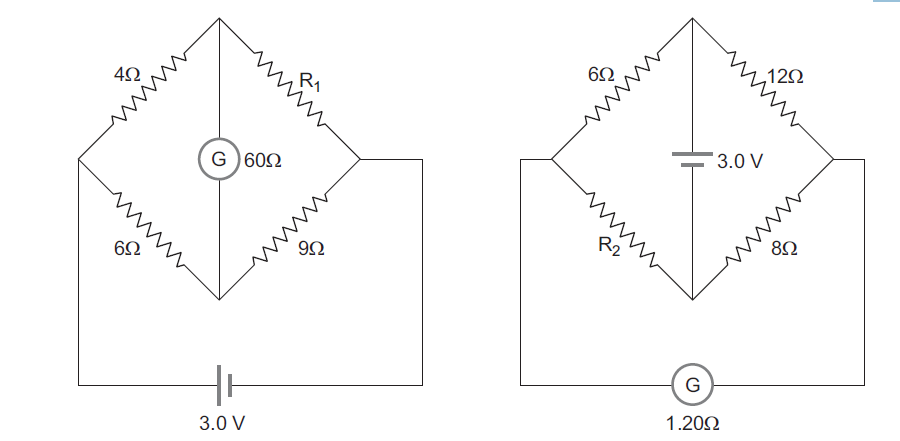
Figure shows two circuits each having a galvanometer and a battery of 3 V. When the galvanometers in each arrangement do not show any deflection, obtain the ratio R/ R2.

Can we find the mass of a photon by the definition p = mv?
  1. Write an expression of magnetic moment associated with a current (I) carrying circular coil of radius r having N turns.
  2. Consider the above mentioned coil placed in YZ plane with its centre at the origin. Derive expression for the value of magnetic field due to it at point (x, 0, 0).