Question
Explain threshold frequency and stopping potential.###Define the following with respect to photoelectric effect :
(i) Work function (ii) Stopping potential

Answer

Threshold frequency : The minimum frequency below which photon is not capable of emitting an electron is called the threshold frequency. This is represented by $v_0$.
Stopping potential : The negative potential of plate C relative to P at which the photoelectric current becomes zero is called "stopping potential" or "cut off potential".
Work function : The minimum energy required for the emission of photoelectron from a metal is called the 'Work function' of that metal. Generally it represented by W or $\phi_0$. It is expressed in Joule and electron Volt.

Need a full question paper?

Generate a complete, print-ready paper with questions like this in minutes — across 16+ boards, with answer keys.

Start Generating Free

Similar questions

An electric bulb of volume 250cc was sealed during manufacturing at a pressure of 10-3mm of mercury at 27°C. Compute the number of air molecules contained in the bulb. Avogadro constant = 6 × 10²³mol-1, density of mercury = 13600kg/ m-3 and g = 10ms-2.
  1. A radioactive nucleus 'A' undergoes a series of decays as given below:

$\text{A}\xrightarrow\alpha\text{A}_1\xrightarrow\beta\text{A}_2\xrightarrow\alpha\text{A}_3\xrightarrow\gamma\text{A}_4$

The mass number and atomic number of A2 are 176 and 71 respectively. Determine the mass and atomic numbers of A4 and A.

  1. Write the basic nuclear process underlying $\beta+$ and $\beta-$ decays.
Using Gauss’s law in electrostatics, deduce an expression for electric field intensity due to a uniformly charged infinite plane sheet. If another identical sheet is placed parallel to it, show that there is no electric field in the region between the two sheets.
Find the energy liberated in the reaction:
223Ra → 209Pb + 14C.
The atomic masses needed are as follows.
223Ra 209Pb 14C
22.018u 208.981u 14.003u
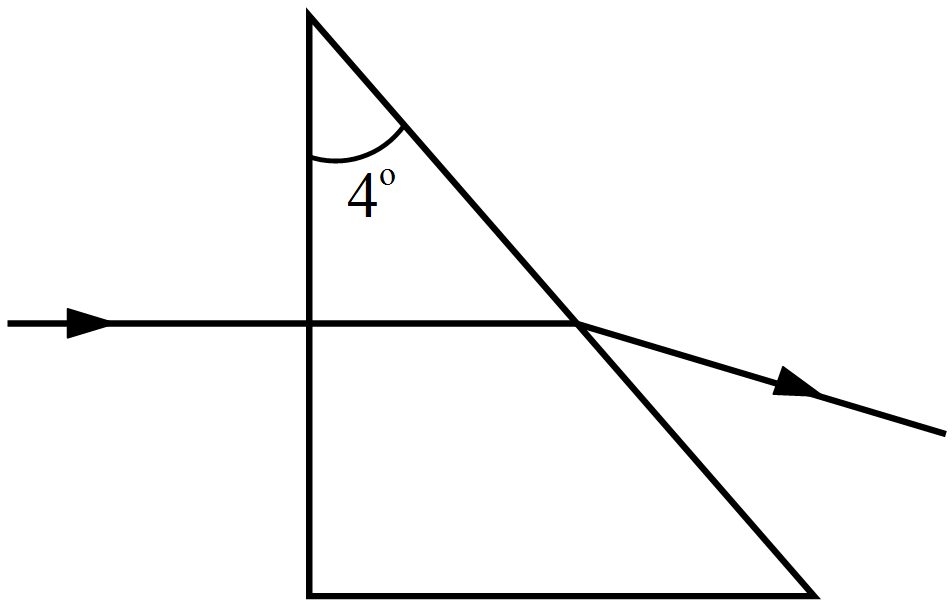
Find the angle of deviation suffered by the light ray shown in figure. The refractive index $\mu=1.5$ for the prism material.

A square loop of side $10 cm$ and resistance $0.5 \Omega$ is placed vertically in the east-west plane. A uniform magnetic field of $0.10 T$ is set up across the plane in the north-east direction. The magnetic field is decreased to zero in $0.70 s$ at a steady rate. Determine the magnitudes of induced emf and current during this time-interval.
In a plot of photoelectric current versus anode potential, how does?

  1. The saturation current vary with anode potential for incident radiations of different frequencies but same intensity?
  2. The stopping potential vary for incident radiations of different intensities but same frequency?
  3. Photoelectric current vary for different intensities but same frequency of incident radiations?

Justify your answer in each case.

Draw a graph showing the variation of binding energy per nucleon with mass number for different nuclei. Explain, with the help of this graph, the release of energy by the process of nuclear fusion.
State the principle of working of a galvanometer.
A galvanometer of resistance G is converted into a voltmeter to measure upto V volts by connecting a resistance R1 in series with the coil. If a resistance R2 is connected in series with it, then it can measure upto V/2 volts. Find the resistance, in terms of R1 and R2, required to be connected to convert it into a voltmeter that can read upto 2 V. Also find the resistance G of the galvanometer in terms of R1 and R2.
The energy flux of sunlight reaching the surface of the earth is 1.388 × 103 W/m2. How many photons (nearly) per square metre are incident on the Earth per second? Assume that the photons in the sunlight have an average wavelength of 550 nm.