Question
Explain through an activity that soil has moisture in it.
Answer


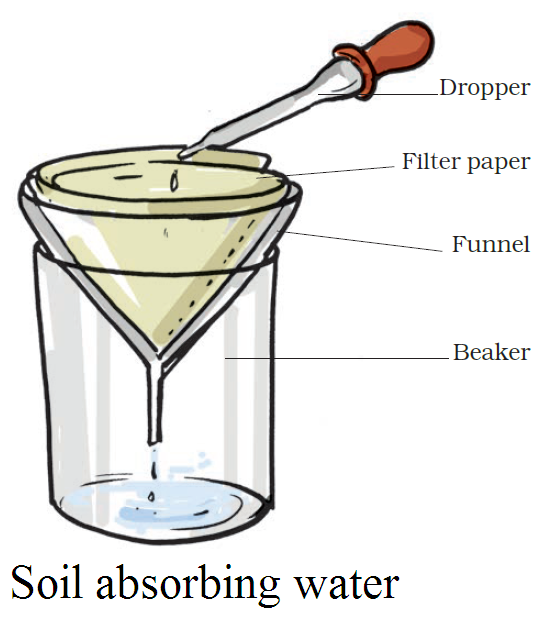
Take a plastic funnel and a filter paper. Fold the filter paper and place it in a plastic funnel. Now keep the funnel (with filter paper) in a beaker. Take some dry powdered soil and weigh it on a balance.
Note the mass of the soil taken. Now pour this weighed soil into the filter paper fixed in a funnel.

Take a measuring cylinder and fill it with water. Note the initial volume of water in the measuring cylinder. Take water from measuring cylinder with the help of a dropper and pour it drop by drop on the soil kept in the funnel. Be careful that water should not fall at one spot on the soil but should be poured uniformly all over the soil. Keep pouring water till it starts dripping from the lower end of the funnel.
Dripping of water from funnel shows that the soil taken on the filter paper has absorbed the maximum amount of water. Note the final volume of water that is left unused in the measuring cylinder.
By substracting the amount of water left in the measuring cylinder from the amount of initial volume of water taken in the measuring cylinder. We will get the volume of water absorbed by the soil which was taken on filter paper in the funnel. The difference in two reading gives the amount of water retained by the soil.
The calculation can be done as follows:
Suppose, the mass of the soil taken $= 50\ g$
Let the initial volume of water $U = 100\ mL$
and final volume of water $V = 60\ mL$
Therefore, the volume of water absorbed by the soil $= (U - V)\ mL = (100 - 60)\ mL = 40\ mL$
and weight of the water absorbed by the soil $= (U - V)\ Q = (100 - 60)\ g = 40\ g$
Therefore, the percentage of water absorbed
$=\Big(\frac{\text{U}-\text{V}}{50}\times100\Big)=\frac{40}{50}\times100=80\%<\text{br}/>$
When we perform this activity with different soil samples, we will see that.
  • Sandy soil will absorb less water and allows more water to percolate.
  • Clayey soil will absorb more water but allow less water to percolate.
  • Sandy soil will absorb less water than clayey soil because of the large spaces between the soil particles. The area where, there is a lot of clay in the soil, stagnant water collects above the soil whenever it rains.

Need a full question paper?

Generate a complete, print-ready paper with questions like this in minutes — across 16+ boards, with answer keys.

Start Generating Free

Similar questions

Paheli noticed water being pulled up by a motor pump to an overhead tank of a five storeyed building. She wondered how water moves up to great heights in the tall trees standing next to the building. Can you tell how?
State few characteristics of magnetic field lines.
Match the items given in Column I with those in Column II:
Column I Column II
Chlorophyll Bacteria
Nitrogen Heterotrophs
Amarbel Pitcher plant
Animals Leaf
Insects Parasite
The mountaineers carry oxygen with them because:
  1. At an altitude of more than $5\ km$ there is no air.
  2. The amount of air available to a person is less than that available on the ground.
  3. The temperature of air is higher than that on the ground.
  4. The pressure of air is higher than that on the ground.
A student performs an experiment where he uses a heating coil to heat the water as shown in the figure. The initial temperature of the water is measured as $10^{\circ} C$. After switching it ON for 5 min, the student records the temperature of the water as $18^{\circ} C$.
Image

The water is allowed to return back to its initial temperature. The activity is then repeated with another heating coil having half the length of the original heating coil. He notices that after 5 min, the temperature of the water reads $14^{\circ} C$. Which statement can be concluded based on the activity?
(a) Reading on thermometer reduces with time.
(b) Temperature of water drops with every repetition.
(c) Length of the material affects the amount of heating.
(d) Temperature of the water increases after a certain period of time.
Match structures given in Column $I$ with functions given in Column $II.$
  Column $I$   Column $II$
$(i)$ Stomata $(a)$ Absorption of water
$(ii)$ Xylem $(b)$ Transpiration
$(iii)$ Root hairs $(c)$ Transport of food
$(iv)$ Phloem $(d)$ Transport of water
    $(e)$ Synthesis of carbohydrates
Read the following terms given below.
root hairs
xylem
urethra
arteries
kidneys
veins
atria
capillaries
hear
ureter
phloem
urinary bladder
Group the terms on the basis of the categories given below:
  1. Circulatory system of animals.
  2. Excretory system in human.
  3. Transport of substances in plants.
Match the organisms given in Column $I$ with their mode of nutrition given in Column $II.$
  Column I   Column II
$(a)$ Mango tree $(i)$ Insectivorous plant
$(b)$ Mushroom $(ii)$ Heterotroph
$(c)$ Pitcher plant $(iii)$ Autotroph
$(d)$ Cuscuta $(iv)$ Saprophyte
$(e)$ Elephant $(v)$ Parasitic
Draw the symbols in your notebook to represent the following components of electrical circuits: connecting wires, switch in the OFF position, bulb, cell, switch in the ON position and battery.
Illustrate how metals and non-metals are classified based on conduction.