Question
Explain unimolecular nucleophilic substitution (SN1) reaction with mechanism.
Answer

→ SN1 reactions are generally carried out in polar protic solvents (like water, alcohol, acetic acid etc.)
→ The reaction between tert- butyl bromide and hydroxide ion yields tert-butyl alcohol and follows the first order kinetics,
→ The rate of reaction depends upon the concentration of only one reactant, which is tert- butyl bromide.
→ Rate = K[(CH3)3 C Br]
$
\left( CH _3\right)_3 CBr +{ }^{-} OH \longrightarrow\left( CH _3\right)_3 COH + Br{-}
$
2-Bromo-2-methylpropane 2-methylpropane-2-01
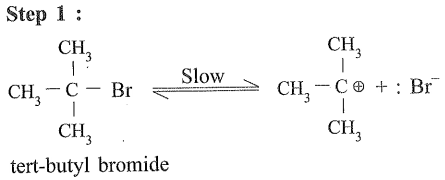
→ It occurs in two steps. In step I, the polarised C-Br bond undergoes slow cleavage to produce a carbocation and a bromide ion.
Image
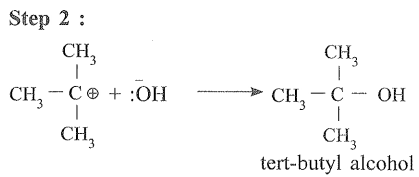
→ The carbocation formed is then attacked by nucleophile in step II to complete the substitution reaction.
Image
→ Step I is the slowest and reversible. It involves the C-Br bond breaking for which the energy is obtained through solvation of halide ion with the proton of protic solvent.
→ Since the rate of reaction depends upon the slowest step, the rate of reaction depends only on the concentration of alkyl halide and not on the concentration of hydroxide ion.
→ Further, greater the stability of carbocation, greater will be its ease of formation from alkyl halide and faster will be the rate of reaction. In case of alkyl halides, 3º alkyl halides undergo SN1 reaction very fast because of the high stability of 3º carbocations.
→ Reactivity order for SN1 reaction
→ 3º - halide 2º - halide > 1º - halide > CH3 - X

Need a full question paper?

Generate a complete, print-ready paper with questions like this in minutes — across 16+ boards, with answer keys.
Start Generating Free

Similar questions

A reaction is first order in A and second order in B.
(i) Write the differential rate equation.
(ii) How is the rate affected on increasing the concentration of B three times?
(iii) How is the rate affected when the concentration of both A and B are doubled?
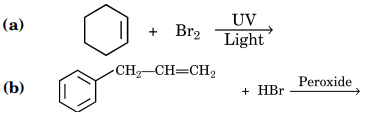
Write the major monohalo product(s) in each of the following reactions :
Image
One half-cell in a voltaic cell is constructed from a silver wire dipped in silver nitrate solution of unknown concentration. The other half-cell consists of a zinc electrode in 1.0 M solution of Zn(NO3)2. A voltage of 1.48 V is measured for this cell. Use this information to calculate the concentration of silver nitrate solution.
[ Given, $E_{\mathrm{Zn}^{2+} / \mathrm{Zn}}^{\circ}=-0.763 \mathrm{~V}$ and $E_{\mathrm{Ag}^{+} / \mathrm{Ag}}^{\circ}=+0.80 \mathrm{~V}$ ].
Write down rules to write the formulas of Mononuclear coordination entities.
How do the oxides of transition elements in lower oxidation states differ from those in higher oxidation state in the nature of metal-oxygen bonding and why?
  1. Define crystal field splitting energy. On the basis of crystal field theory, write the electronic configuration for d4 ion if $\triangle_0$< P.
  2. [Ni(CN)4]2– is colourless whereas [Ni(H2O)6]2+ is green. Why? (At. no. of Ni = 28)
The monoamino monocarboxylic acids have two pKa values.
An organic compound (A) has characteristic odour. On treatment with NaOH, it forms compounds (B) and (C). Compound (B) has molecular formula C7H8O which on oxidation gives back (A). The compound (C) is a sodium salt of an acid. When (C) is treated with soda-lime, it yields an aromatic compound (D). Deduce the structures of (A), (B), (C) and (D). Write the sequence of reactions involved.
Nalorphene (C19H21NO3), similar to morphine, is used to combat withdrawal symptoms in narcotic users. Dose of nalorphene generally given is 1.5 mg. Calculate the mass of 1.5 – 10–3 m aqueous solution required for the above dose.
Complete the following reactions :

  1. $\text{C}_6\text{H}_5-\text{COO}^-\text{NH}^+_4\xrightarrow{\text{ }\text{ }\text{ }\text{ }\text{ }\text{ }\text{ }\text{ }\triangle\text{ }\text{ }\text{ }\text{ }\text{ }\text{ }\text{ }\text{ }\text{ }}\text{A}\xrightarrow{\text{ }\text{ }\text{ }\text{ }\text{Br}_2/\text{KOH}\text{ }\text{ }\text{ }\text{ }}\text{B}\xrightarrow{\text{ }\text{ }\text{ }\text{ }\text{CH}_3\text{COC}l_3/\text{pyridine}\text{ }\text{ }\text{ }\text{ }}\text{C}$

  2. $\text{C}_6\text{H}_5\text{N}^+_2\text{BF}^-_4\xrightarrow[\triangle]{\text{ }\text{ }\text{ }\text{ }\text{ }\text{ }\text{ }\text{ }\text{NaNO}_2/\text{Cu}\text{ }\text{ }\text{ }\text{ }\text{ }\text{ }\text{ }\text{ }\text{ }}\text{A}\xrightarrow{\text{ }\text{ }\text{ }\text{ }\text{Sn}/\text{HC}l\text{ }\text{ }\text{ }\text{ }}\text{B}\xrightarrow[\triangle]{\text{ }\text{ }\text{ }\text{ }\text{CHC}l_3+\text{alc. KOH}\text{ }\text{ }\text{ }\text{ }}\text{C}$