Question
Explain use of juction diode as full wave rectifier.

Answer


Image

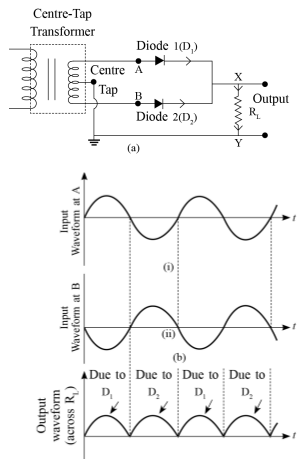
→ The circuit diagram of the full-wave rectifier is shown in the figure. In full wave rectifier, two $p-n$ junction diodes are used.
→ In this type of rectifier, the rectified output voltage is obtained during both the positive as well as negative half of ac cycle. Hence, it is known as full-wave rectifier.
→ As shown in fig., the $p$-side of the two diodes are connected to the ends of the secondary of the transformer. The $n$-side of the diodes are connected together and the output is taken between this common point of diodes and the mid-point of the secondary of the transformer. So for a full wave rectifier the secondary of the transformer is provided with a centre tapping and so it is called centre-tap transformer.
→ As can be seen from fig. (c), the voltage rectified by each diode is only half the total secondary voltage. Each diode rectifies only for half the cycle, but the two do so for alternate cycles. Thus the output between their common terminals and the centre tap of the transformer becomes a full-wave rectifier output.
→ Suppose the input voltage to $A$ with respect to centre tap at any instant is positive. At that instant, voltage B being out of phase should be negative. In this case, diode $D_1$ gets forward biased and conducts, while $D_2$ gets reverse biased and does not conduct. Hence, as shown in fig. c, output current is obtained between two terminals of $R_L$ during this half-cycle.
→ During the other half-cycle, voltage at $A$ is negative and voltage at $B$ is positive. In this case diode $D_1$ is in reverse bias condition and $D_2$ is in forward bias. Hence, in this part of cycle, $D_2$ conducts and output voltage is obtained.
→ Thus, we get output voltage during both positive as well as negative half of the cycle.

Need a full question paper?

Generate a complete, print-ready paper with questions like this in minutes — across 16+ boards, with answer keys.
Start Generating Free

Similar questions

Summarise any three experimental features and observation described in the experimental study of photoelectric effect.
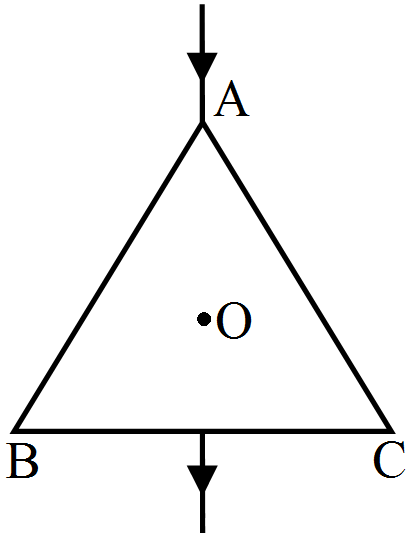
The. wire ABC shown in figure forms an equilateral triangle. Find the magnetic field B at the centre O of the triangle assuming the wire to be uniform.

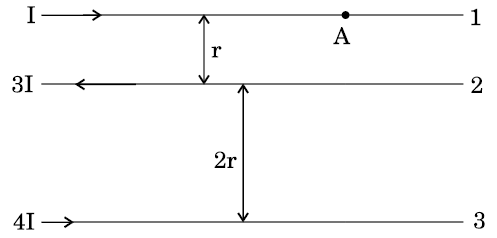
The figure shows three infinitely long straight parallel current carrying conductors. Find the:
  1. Magnitude and direction of the net magnetic field at point A lying on conductor 1.
  2. Magnetic force on conductor 2.

If three helium nuclei combine to form a carbon nucleus, energy is liberated. Why can't helium nuclei combine on their own and minimise the energy?
An electric bulb is designed to operate at 12 volts DC. If this bulb is connected to an AC source and gives normal brightness, what would be the peak voltage of the source?
A force $\overrightarrow{\text{F}}=\overrightarrow{\text{v}}\times\overrightarrow{\text{A}}$ is exerted on a particle in addition to the force of gravity, where v is the velocity of the particle and $\overrightarrow{\text{A}}$ is a constant vector in the horizontal direction. With what minimum speed a particle of mass m be projected so that it continues to move undeflected with a constant velocity?
A circular ring of radius r made of a nonconducting material is placed with its axis parallel to a uniform electric field. The ring is rotated about a diameter through 180°. Does the flux of electric field change? If yes, does it decrease or increase?
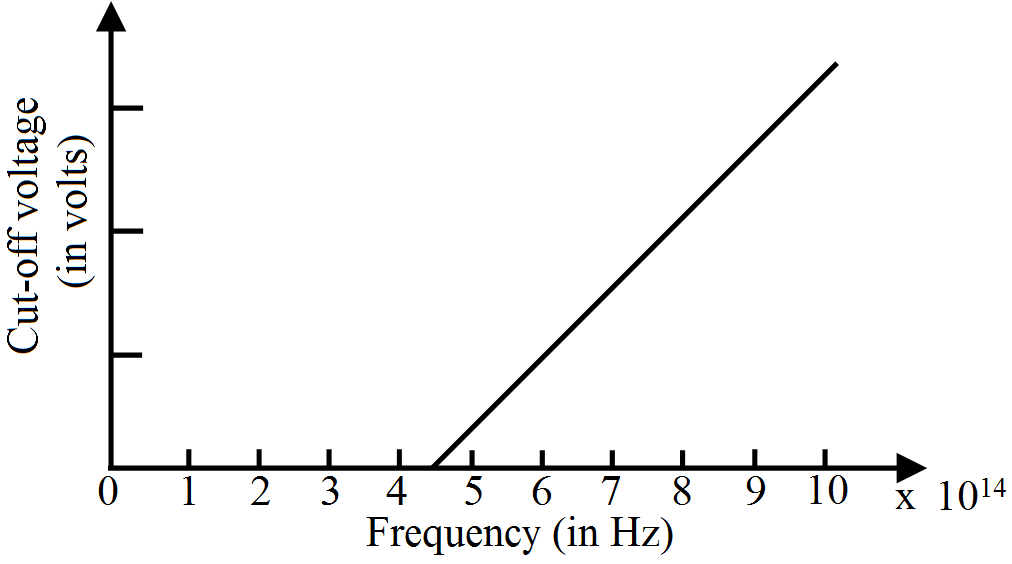
For photoelectric effect in sodium, the figure shows the plot of cut-off voltage versus frequency of incident radiation. Calculate,

  1. Threshold frequency.
  2. Work function for sodium.
What is space wave propagation? State the factors which limit its range of propagation. Derive an expression for the maximum line of sight distance between two antennas for space wave propagation.
A nucleus with mass number $A =240$ and binding energy per nucleon $=7.6 MeV$ breaks into two fragments each of $A =120$ with binding energy per nucleon $= 8.5 MeV $. Calculate the released energy.