A given coin has a mass of 3.0 g . Calculate the nuclear energy that would be required to separate all the neutrons and protons from each other. For simplicity assume that the coin is entirely made of ${ }_{29}^{63} Cu$ atoms (of mass 62.92960 u )
The work function of caesium is 2.14 eV . Find (a) The threshold frequency for caesium. (b) The wavelength of incident light if photocurrent is brought to zero by a stopping potential of $0.60 V .\left( h =6.625 \times 10^{-34} Js \right)$
Answer
$ \begin{array}{c} \varphi_0=2.14 eV \\ V_0=0.60 V \\ v_0=? \\ \lambda=? \end{array} $ → (a)The cut off or threshold frequency $ \begin{array}{l} \varphi_0=h v_0 \\ \therefore v_0=\frac{\phi_0}{h} \\ =\frac{2.14 \times 1.6 \times 10^{-19}}{6.625 \times 10^{-34}} \\ v_0=0.5163 \times 10^{15} Hz \\ v_0=5.16 \times 10^{14} Hz \end{array} $ → (b) Einstein's photoelectric equation is $\begin{array}{l} K _{\max }=h v-\varphi_0 \\ \text { but } K _{\max }=e V_0 \\ \therefore e V_0=\frac{h c}{\lambda}-\varphi_0( C =v \lambda) \\ \therefore \frac{h c}{\lambda}=e V_0+\varphi_0 \\ \therefore \frac{h c}{\lambda}=\left(1.6 \times 10^{-19} \times 0.60\right)+\left(2.14 \times 1.6 \times 10^{-19}\right) \\ \therefore \frac{h c}{\lambda}=1.6 \times 10^{-19}(0.60+2.14)\end{array}$ $\therefore \frac{h c}{\lambda}=4.384 \times 10^{-19}$ $\therefore \lambda=\frac{6.625 \times 10^{-34} \times 3 \times 10^8}{4.384 \times 10^{-19}}$ $\begin{array}{l}\therefore \lambda=4.54 \times 10^{-7} m \\ =454 \times 10^{-9} m \\ \lambda=454 nm\end{array}$
A sinusoidal voltage of peak value 283 V and frequency 50 Hz is applied to a series LCR circuit in which $R =3 \Omega, L=25.48 mH$ and $C =796 \mu F$. Find (a) The impedance of the circuit. (b) The phase difference between the voltage across the source and the current. (c) The power dissipated in the circuit.
Answer
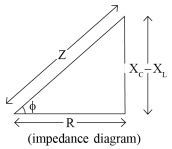
$ \begin{array}{l} V_m=283 V \\ R=3 \Omega \\ C=796 \mu F \\ \nu=50 Hz \\ L=25.48 mH \end{array} $ → (a) Impedence of the circuit ( Z ), → Inductive reactance $\left( X _{ L }\right)$ $ \begin{array}{l} X_{L}=\omega L=2 \pi v L \\ \therefore X_{L}=2 \times 3.14 \times 50 \times 25.48 \times 10^{-3} \\ \therefore X_{L}=8000.72 \times 10^{-3} \\ \therefore X_{L}=8 \Omega \end{array} $ → Capacitive reactance $\left( X _{ C }\right)$ $ \begin{array}{l} X_{C}=\frac{1}{\omega C}=\frac{1}{2 \pi v C} \\ \therefore X_{C}=\frac{1}{2 \times 3.14 \times 50 \times 796 \times 10^{-6}} \\ \therefore X_{C}=\frac{1000000}{249944} \\ \therefore X_{C}=4 \Omega \\ → Z=\sqrt{R^2+\left(X_{C}-X_{L}\right)^2} \\ \therefore Z=\sqrt{3^2+(4-8)^2} \\ \therefore Z=5 \Omega \end{array} $ (b) Phase difference ( $\varphi$ ) $ \begin{array}{l} \tan \varphi=\frac{X_{C}-X_{L}}{R} \\ \tan \varphi=\frac{4-8}{3} \\ \tan \varphi=-\frac{4}{3} \\ \tan \varphi=-1.3333 \\ \varphi=-53.1^{\circ} \\ (\because \tan (-\theta)=-\tan \theta) \end{array} $ Note : Here $\varphi$ is negative. So the current in the circuit is lagging behind the voltage between two terminals of the source. (c) Power dissipated in the circuit : $ \begin{array}{l} P=I^2 R \\ \text { But } I=\frac{I_m}{\sqrt{2}} \end{array} $ $ \begin{array}{l} \therefore I=\frac{V_{m}}{Z \sqrt{2}} \\ \therefore P=\frac{V_m^2}{Z^2(2)} \cdot R \\ \therefore P=\frac{(283)^2 \times 3}{25 \times 2} \\ \therefore P=4800 W \end{array} $ (d) Power factor, $ \begin{array}{l} \cos \varphi=\cos \left(-53.1^{\circ}\right)(\because \cos (-\theta)=\cos \theta) \\ =\cos 53.1^{\circ} \\ =0.6 \end{array} $
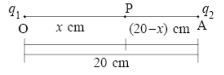
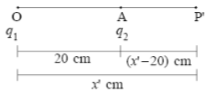
Two charge $5 \times 10^{-8} C$ and $-3 \times 10^{-8} C$ are located 20 cm apart. At what points(s) on the line joining the two charges is the electric potential zero? Take the potential at infinity to be zero.