Question
Explain water cycle.

Answer

The Water Cycle is the journey of water from the land to the sky and back again. There are six important processes that make up the water cycle.
  1. Condensation: The opposite of evaporation. Condensation occurs when a gas is changed into a liquid.
  2. Infiltration: Infiltration is an important process where rain water soaks into the ground, through the soil and underlying rock layers.
  3. Runoff: Much of the water that returns to Earth as precipitation runs off the surface of the land, and flows down hill into streams, rivers, ponds and lakes.
  4. Evaporation: the process where a liquid, in this case water, changes from its liquid state to a gaseous state.
  5. Precipitation: When the temperature and atmospheric pressure are right, the small droplets of water in clouds form larger droplets and precipitation occurs. The raindrops fall to Earth.
  6. Transpiration: As plants absorb water from the soil, the water moves from the roots through the stems to the leaves. Once the water reaches the leaves, some of it evaporates from the leaves, adding to the amount of water vapour in the air. This process of evaporation through plant leaves is called transpiration.

Need a full question paper?

Generate a complete, print-ready paper with questions like this in minutes — across 16+ boards, with answer keys.
Start Generating Free

Similar questions

Given below is a list of different types of movements in animals.
Running, jumping, walking, slithering, crawling, flying, swimming, creeping.
Write the types of movements seen in each animal.
  1. Duck.
  2. Horse.
  3. Kangaroo.
  4. Snail.
  5. Snake.
  6. Fish.
  7. Human beings.
  8. Cockroach.
Directions: Read the passage $(s)$ given below and answer the questions that follow. Passage - $1$ Look at the following food chain and then answer the questions that follow. Grain $\rightarrow $ grasshopper $\rightarrow $ frogs $\rightarrow $ snakes $\rightarrow $ owls bacteria Which organism in this food chain is responsible for recycling nutrients?
  1. Snakes.
  2. Bacteria.
  3. Owls.
  4. Grasshopper.
You are provided with a mixture of salt, sand, oil and water. Write the steps involved for the separation of salt, sand and oil from the mixture by giving an activity along with the diagram.
It was Paheli’s birthday, her brother Simba was helping her to decorate the house for the birthday party and their parents were also busy making other arrangements. Following were the activities going on at Paheli’s home:
  1. Simba blew balloons and put them on the wall.
  2. Some of the balloons got burst.
  3. Paheli cut colourful strips of paper and put them on the wall with the help of tape.
  4. She also made some flowers by origami (paper folding) to decorate the house.
  5. Her father made dough balls.
  6. Mother rolled the dough balls to make puries.
  7. Mother heated oil in a pan.
  8. Father fried the puries in hot oil.
Identify the activities at Paheli’s home as those that can be reversed and those which cannot be reversed.
Write short notes on the following.
  1. Skull.
  2. Chest bones.
  3. Backbone.
  4. Hip bone.
  5. The shoulder bone.
  6. Limb bone.
What can we do to minimise overuse of plastics and deal with garbage?
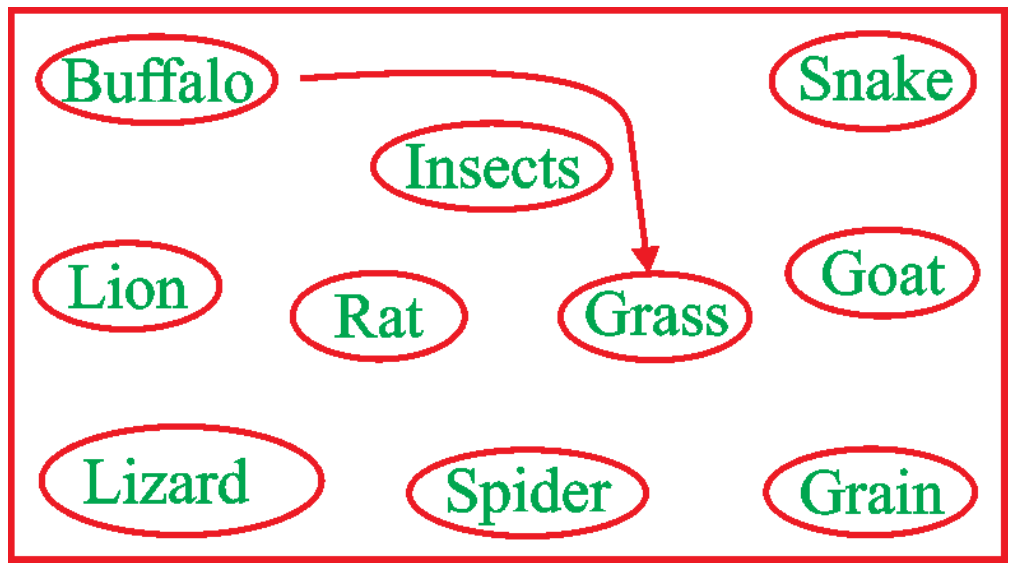
Connect the animal with the food it eats by an arrow using different colours in the figure given below. One is done for you.
Like many animals although a car also moves it is not considered as a living orgainism. Give 2-3 reasons.
Match the following items given in Column $A$ with that in Column $B$:
S.No.
Column $A$
S.No.
Column $B$
$(a)$
Cell
$(i)$
Allows electricity to pass through it.
$(b)$
Battery
$(ii)$
Either breaks or completes a circuit.
$(c)$
Conductor
$(iii)$
Converts electricity into light.
$(d)$
Insulator
$(iv)$
Glows when electricity passes in it.
$(e)$
Switch
$(v)$
A device which produces electricity.
$(f)$
Bulb
$(vi)$
Is a path of electricity.
$(g)$
Filament
$(vii)$
Does not allow electricity to pass.
$(h)$
Circuit
$(viii)$
A combination of cells.
Describe the steps involved in magnetising an iron strip with the help of a magnet.