Question
Explain Werner's Theory for Co-ordination Compound.

Answer

→ Alfred Werner a Swiss chemist was the first to formulate his ideas about the structures of coordination compounds.
→ Werner proposed the concept of a primary valence and a secondary valence for a metal ion.
→ Binary compounds such as CrCl3, CoCl2 or PdCl2 have primary valence of 3, 2 and 2 respectively.
→ Werner develop number of compound of cobalt(III) chloride with ammonia, it was found that some of the chloride ions could be precipitated as AgCl on adding excess silver nitrate solution in cold but some remained in solution.
1 mol CoCl3.6NH3 (Yellow) gave 3 mol AgCl
1 mol CoCl3.5NH3 (Purple) gave 2 mol AgCl
1 mol CoCl3.4NH3 (Green) gave 1 mol AgCl
1 mol CoCl3.4NH3 (Violet) gave 1 mol AgCl
→ These observations, together with the results of conductivity measurements in solution can be explained as follows:
→ (i) Six groups in all, either chloride ions or ammonia molecules or both, remain bonded to the cobalt ion during the reaction and (ii) The compounds are formulated as where the atoms within the square brackets form a single entity which does not dissociate under the reaction conditions.
→ Werner proposed the term secondary valence for the number of groups bound directly to the metal ion. In each of these examples the secondary valences are six.
ColourFormulaSolution
conductivity
corresponds to
Yellow$\left[ Co \left( NH _3\right)_6\right]^{3+} 3 Cl ^{-}$1:3 electrolyte
Purple$\left[ CoCl \left( NH _3\right)_5\right]^{2+} 2 Cl ^{-}$1:2 electrolyte
Green$\left[ CoCl _2\left( NH _3\right)_4\right]^{+} 3 Cl ^{-}$1:1 electrolyte
Violet$\left[ CoCl _2\left( NH _3\right)_4\right]^{+} 3 Cl$1:1 electrolyte

→ Last two compounds in Table have identical empirical formula, CoCl3.4NH3 but differem 3 properties. Such compounds are termed as isomers.
→ The main postulates of Werner's theory are:
(1) In coordination compounds metals show two types of linkages (valences)-primary and secondary.
(2) The primary valences are normally ionizable and are satisfied by negative ions.
(3) The secondary valences are non ionizable. These are satisfied by neutral molecules or negative ions. The secondary valence is equal to the coordination number and is fixed for a metal.
(4) The ions / groups bound by the secondary linkages to the metal have characteristic spatial arrangements corresponding to different coordination numbers.

Need a full question paper?

Generate a complete, print-ready paper with questions like this in minutes — across 16+ boards, with answer keys.

Start Generating Free

Similar questions

Why do gases always tend to be less soluble in liquids as the temperature is raised?
Draw figure to show the splitting of d orbitals in an octahedral crystal field. orbitals in an octahedral crystal field.
Explain the preparation of aldehydes and ketones by dehydrogenation of alcohols with suitable examples.
The vapour pressure of water is 12.3 kPa at 300 K. Calculate vapour pressure of 1 molal solution of a non-volatile solute in it.
Write two main functions of carbohydrates in plants.
Give the structures of A, B and C in the following reactions:

$\text{C}_6\text{H}_5\text{NO}_2\xrightarrow{\text{Fe/HCl}\ \ }\text{A}\xrightarrow{\text{HNO}_2;273\text{K}\ \ }\text{B}\xrightarrow{\text{NH}_3;\Delta\ \ }\text{C}$

Give examples and suggest reasons for the following features of the transition metal chemistry:

The highest oxidation state is exhibited in oxoanions of a metal.
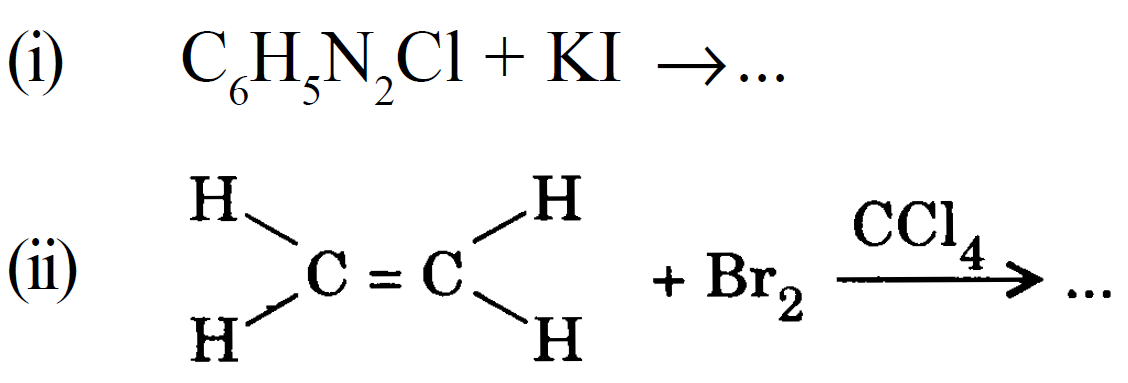
Explain the basicity of alkanamine compounds relative to ammonia in gaseous state based on inductive effect of the alkyl group.
The decomposition of dimethyl ether leads to the formation of CH4, H2 and CO and the reaction rate is given by 
Rate $= k \left[ CH _3 OCH _3\right]^{3 / 2}$ 
The rate of reaction is followed by increase in pressure in a closed vessel, so the rate can also be expressed in terms of the partial pressure of dimethyl ether, i.e.,
Rate $= k \left( p _{ CH _3 OCH _3}\right)^{3 / 2}$
If the pressure is measured in bar and time in minutes, then what are the units of rate and rate constants?
Complete the following reaction equations: