Maharashtra BoardEnglish MediumSTD 12 SciencePhysicsWave Optics4 Marks
Question
Explain what is meant by polarization and derive Malus’ law.
✓
Answer
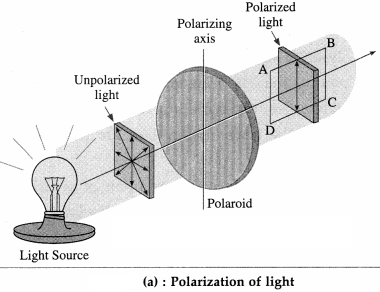
According to the electromagnetic theory of light, a light wave consists of electric and magnetic fields vibrating at right angles to each other and to the direction of propagation of the wave. If the vibrations of $\vec{E}$ in a light wave are in all directions perpendicular to the direction of propagation of light, the wave is said to be unpolarized.
If the vibrations of the electric field $\vec{E}$ in a light wave are confined to a single plane containing the direction of propagation of the wave so that its electric field is restricted along one particular direction at right angles to the direction of propagation of the wave, the wave is said to be plane-polarized or linearly polarized.
This phenomenon of restricting the vibrations of light, i.e., of the electric field vector in a particular direction, which is perpendicular to the direction of the propagation of the wave is called polarization of light.
Consider an unpolarized light wave travelling along the $x$-direction. Let $c , v$ and $\lambda$ be the speed, frequency and wavelength, respectively, of the wave. The magnitude of its electric field $(\vec{E})$ is,
$E=E_0 \sin (k x-\omega t)$, where $E_0=E_{\max }=$ amplitude of the wave,$\omega=2 \pi v=$ angular frequency of the wave and $k=\frac{2 \pi}{\lambda}=$ magnitude of the wave vector or propagation vector.
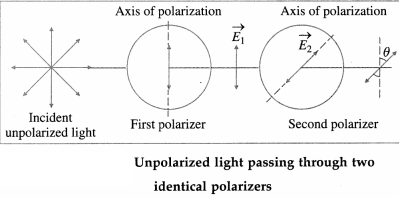
The intensity of the wave is proportional to $\left|E_0\right|^2$. The direction of the electric field can be anywhere in the $y$-z plane. This wave is passed through two identical polarizers as shown in below figure.
When a wave with its electric field inclined at an angle $\varphi$ to the axis of the first polarizer is passed through the polarizer, the component $E_0 \cos \varphi$ will pass through it. The other component $E_0 \sin \varphi$ which is perpendicular to it will be blocked.
Now, after passing through this polarizer, the intensity of this wave will be proportional to the square of its amplitude, i.e., proportional to $\left|E_0 \cos \varphi\right|^2$.
The intensity of the plane-polarized wave emerging from the first polarizer can be obtained by averaging $\left|E_0 \cos \varphi\right|^2$ over all values of $\varphi$ between 0 and $180^{\circ}$. The intensity of the wave will be
proportional to $\frac{1}{2}\left|E_0\right|^2$ as the average value of $\cos ^2 \varphi$ over this range is $\frac{1}{2}$. Thus the intensity of an unpolarized wave reduces by half after passing through a polarizer.
When the plane-polarized wave emerges from the first polarizer, let us assume that its electric field $\left(\overrightarrow{E_1}\right)$ is along the $y$-direction. Thus, this electric field is, $\overrightarrow{E_1}=\hat{ j } E _{10} \sin (k x-\omega t )$
where, $E _{10}$ is the amplitude of this polarized wave. The intensity of the polarized wave, $I _1 \propto\left| E _{10}\right|^2 \ldots(2)$
Now this wave passes through the second polarizer whose polarization axis (transmission axis) makes an angle θ with the y-direction. This allows only the component $E_{10} \cos \theta $ to pass through it. Thus, the amplitude of the wave which passes through the second polarizer is $E_{20} = E_{10} \cos \theta $ and its intensity,
$ I _2 \propto\left|E_{20}\right|^2$
$\therefore I _2 \propto\left|E_{10}\right|^2 \cos ^2 \theta$
$\therefore I _2= I _1 \cos _2 \theta \ldots \text { (3) }$
Thus, when plane-polarized light of intensity $I_1$ is incident on the second identical polarizer, the intensity of light transmitted by the second polarizer varies as $\cos^2\theta , i.e., I_2 = I_1 \cos^2\theta $, where$ \theta $ is the angle between the transmission axes of the two polarizers. This is known as Malus’ law
[Note : Etienne Louis Malus (1775-1812), French military engineer and physicist, discovered in 1809 that light can be polarized by reflection. He was the first to use the word polarization, but his arguments were based on Newton’s corpuscular theory.]
Need a full question paper?
Generate a complete, print-ready paper with questions like this in minutes — across 16+ boards, with answer keys.